
The Future of Artificial Intelligence: Navigating the Next Era of Innovation
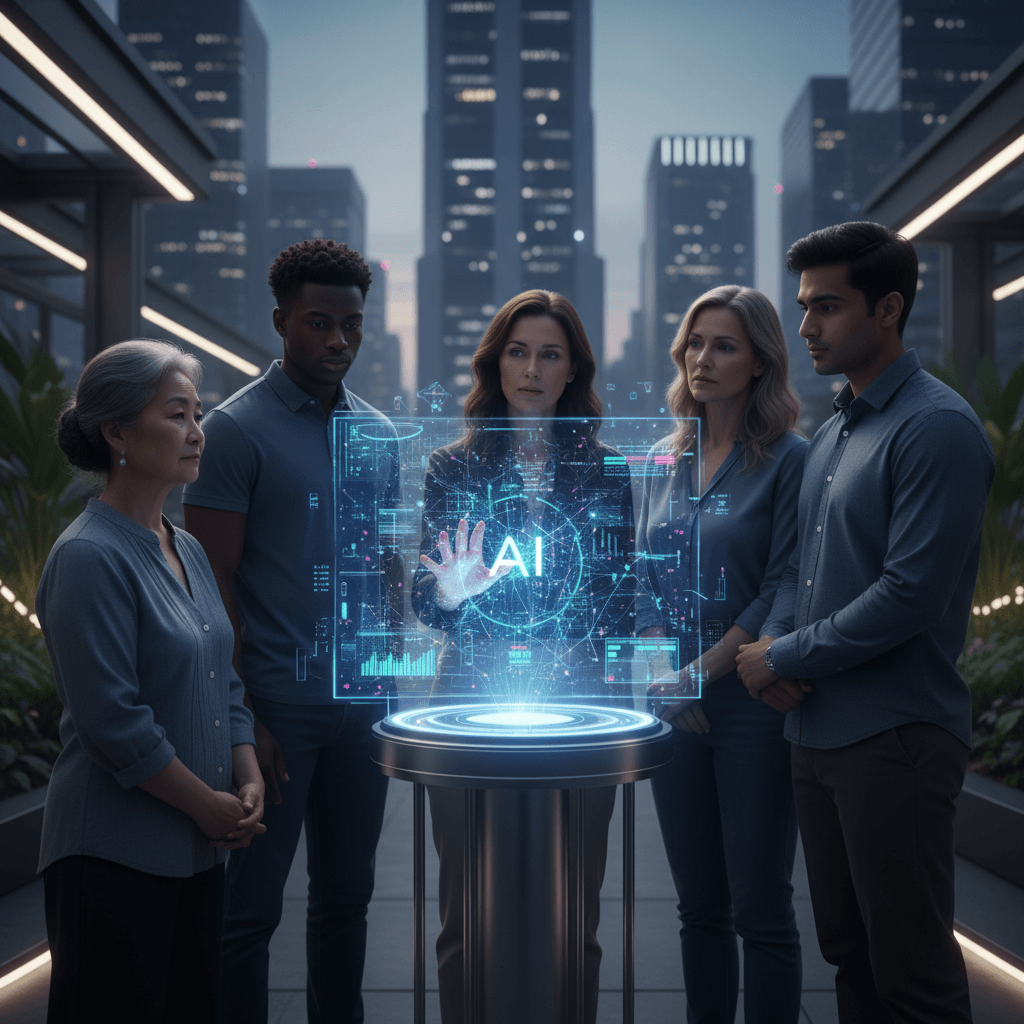
Exploring the convergence of humanity and artificial intelligence.
Introduction: Beyond the Buzzwords – Understanding AI’s Trajectory
AI is a concept generating significant debate, promising radical advancements and posing existential threats. This article explores the evolving landscape of AI, moving beyond sensationalism to pragmatic realities and possibilities. It aims to demystify AI’s impact and potential, examining breakthroughs, ethical quandaries, and societal shifts. Understanding AI’s scope, from historical roots to future applications, is crucial for thriving in an intelligent world.
A Glimpse Back: The Journey of Artificial Intelligence So Far
The formal field of AI was established in 1956 at the Dartmouth Workshop, with early pioneers envisioning human-like machine intelligence (“symbolic AI” or GOFAI). This era saw breakthroughs in logic and expert systems but lacked flexibility. An “AI winter” occurred in the 1980s. The resurgence began with increased computational power, vast datasets, and improved algorithms, particularly in machine learning. Deep learning, a form of machine learning using multi-layered neural networks, enabled AI to excel in image recognition, natural language processing, and game-playing (e.g., DeepMind’s AlphaGo). Today, AI is embedded in daily life, from recommendations to medical diagnostics.
The Present Landscape: AI We See (and Don’t See) Today
AI is pervasive and often operates behind the scenes. Daily interactions include voice assistants (Siri, Alexa), predictive text, spam filters, and fraud detection. E-commerce uses AI for recommendations, and social media curates feeds. Industries benefiting from AI include manufacturing (robots, predictive maintenance), finance (algorithmic trading, risk assessment), and transportation (autonomous vehicles, logistics). Creative fields are also seeing AI assistance in writing, design, and music. This integration highlights AI’s evolution into a practical tool, paving the way for future advancements.
Core Pillars of Tomorrow’s AI: Key Areas of Innovation
The next decade will see paradigm shifts driven by interconnected AI innovations:
Generative AI
: Models like GPT, DALL-E, and Midjourney create novel content (text, images, audio, video) from prompts. Future applications include hyper-personalized content, accelerated design, synthetic data generation, and enhanced human creativity. Ethical concerns like deepfakes and misinformation need navigation.AI in Healthcare
: Promises more accessible, efficient, and personalized medical services. Future applications include advanced diagnostics (early disease detection), personalized medicine (tailored treatments), accelerated drug discovery, AI-powered robotic surgery, and predictive health analytics for public health. Robust data security and ethical guidelines are essential.Autonomous Systems and Robotics
: Revolutionizing industries and daily life. Advancements include fully autonomous vehicles, advanced robots for complex tasks in unpredictable environments, smart infrastructure for optimized urban planning, and automated logistics/supply chains. Robust safety protocols and societal impact considerations (employment) are crucial.Hyper-Personalization
: AI will evolve into digital companions understanding preferences, needs, and emotional states for bespoke experiences. This includes adaptive user interfaces, proactive assistance, personalized learning environments, and customized well-being support. Balancing convenience with privacy and user control is key.Education Transformed
: AI offers personalized and adaptive learning. Future applications include intelligent tutoring systems understanding cognitive styles, personalized curriculum development, automated assessment with immediate feedback, AI-powered translation for global knowledge access, and immersive VR/AR learning experiences. AI will augment, not replace, human teachers.Cybersecurity’s New Frontier
: AI is crucial for defense but also a tool for adversaries. Future developments include proactive threat detection, automated incident response, behavioral analytics for anomaly detection, and AI-powered phishing detection. Malicious actors will use AI for advanced malware, deepfake phishing, and autonomous hacking, creating an AI-driven arms race.Climate Change and Sustainability
: AI is a powerful ally. Contributions include optimized energy grids, precision agriculture (reducing resource consumption), environmental monitoring (deforestation, wildlife tracking, pollution detection), material science for sustainability, and enhanced climate modeling. The energy consumption of AI itself is a concern, but intelligent deployment offers significant potential.
Navigating the Ethical Maze: Challenges and Responsibilities
Accelerating AI development brings ethical and societal challenges:
Bias and Fairness
: AI trained on biased data can perpetuate discrimination. Ensuring fairness requires scrutinizing data, developing fairness metrics, and building interpretable AI models.Privacy and Data Security
: AI’s reliance on vast data raises privacy concerns. Robust data governance, anonymization techniques, and clear user consent are needed. Data breaches involving AI are a significant risk.The Workforce Revolution
: AI-driven automation may displace jobs but also create new ones. Managing this transition requires reskilling/upskilling programs and adapting education for an AI-powered world, focusing on uniquely human skills.Control and Accountability
: As AI becomes more autonomous, questions of responsibility arise. Developing explainable AI (XAI), clear legal frameworks for liability, and human oversight mechanisms are crucial for maintaining trust and ethical governance.
The AI Hype Cycle vs. Reality: Separating Fact from Fiction
Discourse around AI is often polarized. It’s important to distinguish the AI hype cycle from tangible progress. Breakthroughs like large language models are built on decades of research. True Artificial General Intelligence (AGI) remains a distant goal; current advancements are primarily in narrow AI. Realistic expectations are needed for informed discussion and practical AI development.
Quiz Time: Test Your AI Knowledge!
1. True or False: AI is a new concept, only emerging in the 21st century.
2. True or False: Generative AI can create original content like text, images, and music from simple prompts.
3. True or False: AI is expected to completely eliminate the need for human creativity in most fields in the near future.
Preparing for an AI-Powered World: Strategies for Individuals and Society
Adapting to an AI-powered world requires a proactive approach:
Individuals
: Focus on lifelong learning, emphasizing uniquely human skills (creativity, critical thinking, emotional intelligence). Learn to use AI tools effectively and adopt a “human-in-the-loop” mindset.Organizations
: Foster a culture of AI experimentation, invest in workforce upskilling, and develop ethical deployment guidelines. Strategize AI for enhanced customer experiences and operational efficiency.Governments/Policymakers
: Shape AI through regulation, R&D investment, and education. Balance innovation with ethics, ensure data privacy, address job displacement, and promote equitable access. International cooperation is vital.
Conclusion: Charting a Course Towards an Intelligent Tomorrow
The future of AI presents profound opportunities and challenges. From healthcare and creativity to sustainability and societal optimization, AI’s impact will be transformative. This era of AI development requires responsible innovation, ethical deployment, investment in education, and thoughtful dialogue. By making conscious choices, AI can serve as a powerful tool for human progress, solving pressing problems and building a more intelligent, equitable, and sustainable world. The future of AI is a shared human endeavor.
The Antikythera Mechanism: Humanity’s Forgotten Technological Legacy