
The Antikythera Mechanism: Humanity’s Forgotten Technological Legacy
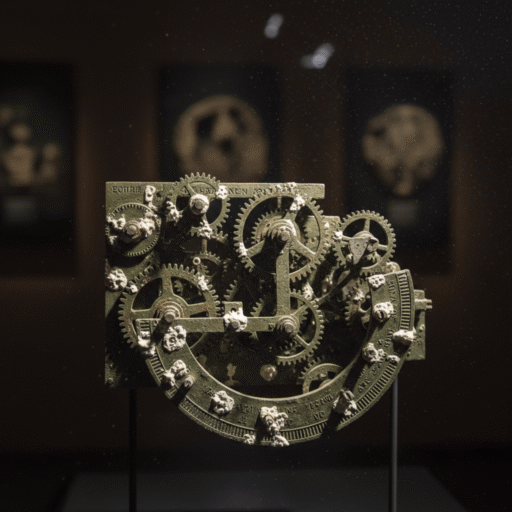
Curioscope’s Lens
The Antikythera Mechanism is a glitch in the matrix of history. It shouldn’t exist—at least, not in the timeline we were taught. Finding a computer in a Roman shipwreck is like finding a jet engine in a medieval tomb. At Curioscope, this artifact represents the terrifying fragility of knowledge. It proves that civilization doesn’t always move forward; sometimes, we forget, and the “dark ages” aren’t just a lack of light, but a loss of memory.
Introduction: Unraveling the Enigma
The Antikythera Mechanism is described as a device so advanced and intricate that its existence challenges our understanding of ancient capabilities. Crafted over two millennia ago, it predates similar technology by over a thousand years and is hailed as the world’s first analog computer. Its discovery in the Aegean Sea has fundamentally altered perceptions of ancient Greek ingenuity and prompts reflection on lost advanced knowledge.
The Serendipitous Discovery in the Depths
- Discovery Context: In the spring of 1901, Greek sponge divers, led by Captain Dimitrios Kontos, discovered a shipwreck off the coast of Antikythera.
- Initial Find: Elias Stadiatis, a diver, descended to approximately 42 meters (138 feet) and found a field of marble and bronze statues.
- Salvage Operation: The Greek government launched a salvage operation over two years, recovering artifacts including bronze sculptures (like the Ephebe of Antikythera), marble statues, glassware, jewelry, and pottery.
- Mechanism Identification: In 1901, archaeologist Valerios Stais noticed a corroded bronze mass with embedded gearwheels, initially an intriguing curiosity due to its complexity and the difficulty of analysis with early 20th-century technology.
Peering Inside the “World’s First Analog Computer”
Early investigations by British science historian Derek J. de Solla Price identified the mechanism as a sophisticated astronomical calculator in 1959. More recently, the Antikythera Mechanism Research Project used high-resolution imaging to create detailed 3D reconstructions, revealing at least 30 intricately meshing bronze gears housed in a shoebox-sized wooden case.
Functionality Highlights:
- User Manual: Bronze plates on the front and back contained Greek text explaining its functions.
- Front Dial: Displayed the Greek zodiac and a 336-day Egyptian calendar, adjustable for leap years, with pointers for the Sun and Moon positions.
- Back Dials: Included a Saros dial (predicting solar and lunar eclipses), a Metonic dial (tracking the 19-year Metonic cycle), a Callippic dial (a four-cycle refinement of the Metonic cycle), and a dial for the Olympiad cycle (timing of Panhellenic Games).
- Technological Sophistication: Incorporated a differential gear assembly, a technology not reinvented in Europe until the 16th century, to accurately model the anomalous motion of the Moon.
The Lost Art of Hellenistic Clockwork and Mathematical Astronomy
The mechanism’s advanced gearing challenges conventional timelines of technological development, posing a puzzle about the disappearance of such knowledge. The Hellenistic period (c. 323 BC – 31 BC) was a golden age of scientific and engineering innovation, with intellectual centers like Alexandria and Rhodes. Figures like Archimedes and Hipparchus were prominent.
The mechanism embodied sophisticated theories, including the irregular motion of the moon, requiring advanced gear systems. Its precision indicates a thriving tradition of skilled artisans. The decline of the Hellenistic world, political instability, the rise of Rome, and the destruction of intellectual centers likely contributed to the loss of this specialized knowledge.
Theories of Authorship and the Masterminds Behind the Gears
While no single author is definitively identified, several prominent figures are considered:
- Archimedes of Syracuse (c. 287 – c. 212 BC): A polymath known for mechanical devices and gear trains.
- Hipparchus of Nicaea (c. 190 – c. 120 BC): Considered the greatest astronomer of antiquity; his theories on lunar motion likely underpinned the mechanism.
- Posidonius of Apamea (c. 135 – c. 51 BC): A Stoic philosopher and polymath from Rhodes; Cicero described a planetary model built by him that mirrored the mechanism’s capabilities.
It is most likely a product of collaborative effort, combining astronomical knowledge with engineering prowess, possibly from a workshop or academy on Rhodes.
The Shipwreck’s Story and its Journey Through Time
The Antikythera shipwreck, a large Roman cargo vessel, sank between 70 and 60 BC, likely bound for Rome, carrying goods from the eastern Mediterranean. Its cargo included bronze and marble statues, pottery, glassware, jewelry, coins, and foodstuffs, suggesting transport of spoils or luxury items for wealthy Romans.
The mechanism was preserved by being buried in marine sediment within its wooden box, creating an anaerobic environment that protected the delicate bronze gears from decay for two millennia. The shipwreck connects the mechanism to trade routes, political ambitions, and intellectual currents of the late Hellenistic and early Roman worlds.
Modern Research and the Ongoing Quest for Understanding
The Antikythera Mechanism Research Project (AMRP), initiated in 2005, utilized specialized X-ray microtomography and polynomial texture mapping. These advanced techniques revealed intricate details, confirmed Price’s hypotheses, identified previously unread inscriptions (user manual), and provided stronger evidence for planetary calculations.
Numerous working models and digital simulations have been built, and renewed archaeological expeditions continue to search for more fragments and to better understand the ship’s cargo, route, and sinking.
The Enduring Legacy and What it Tells Us About Humanity’s Past and Future
The mechanism pushes back the timeline of sophisticated clockwork and geared mechanisms by over a thousand years, challenging linear views of technological progress. Its survival by chance highlights the precariousness of knowledge transmission and the potential for lost technological marvels.
It prompts contemplation on genius, the transmission of ideas, and the interconnectedness of theoretical knowledge and practical application. The Antikythera Mechanism is a profound testament to ancient capabilities, illuminating a forgotten era of technological brilliance and sophisticated scientific thought, reminding us that history is dynamic and understanding is constantly evolving.
Editor’s Reflection
As we gaze at these corroded gears, we aren’t just looking at a calculator; we are looking at a tragedy. It took Europe 1,500 years to rediscover what the Greeks had already mastered. How many other masterpieces are lying in the silt, waiting to tell us that we are not the first to reach for the stars? The Mechanism is a silent guardian of a truth we often ignore: Progress is not inevitable. It must be protected, or it can simply vanish beneath the waves.
Quiz: Test Your Knowledge!
1. The Antikythera Mechanism was discovered fully intact and perfectly preserved.
2. The mechanism incorporated differential gearing, a technology not seen again for over a thousand years.
3. The Antikythera Mechanism was primarily designed to predict weather patterns.