
Seokguram:
The Stone Smile of Silla
An artificial cave built with 360 granite blocks. A passive HVAC system 1,000 years ahead of its time. And the tragic mistake that suffocated it.
Curioscope’s Lens
Standing atop Mt. Toham in Gyeongju, South Korea, Seokguram Grotto is not merely a Buddhist shrine; it is a mathematical anomaly. Built in 751 AD during the Unified Silla dynasty, it represents the zenith of East Asian art and engineering. But unlike the rock-cut caves of India or China, Seokguram was constructed, block by heavy granite block, into an artificial dome that defies gravity. Even more astounding was its ancient climate control system—a mechanism so sophisticated that modern science failed to replicate it, leading to a catastrophic “restoration” in the 20th century. This article unearths the lost science of the Silla engineers and the philosophical journey etched into every stone.
I. The Architect’s Karmic Burden
The story of Seokguram begins with a man named Kim Daeseong. According to the Samguk Yusa (Memorabilia of the Three Kingdoms), Kim was a Prime Minister of the Silla Kingdom who believed deeply in reincarnation. He initiated two massive projects: Bulguksa Temple, located at the foot of the mountain, was built to honor his parents in his current life. Seokguram Grotto, perched high on the peak, was dedicated to the parents of his past life.
This duality is crucial. Bulguksa represents the earthly realm—complex, sprawling, and wood-based. Seokguram represents the spiritual realm—solitary, geometric, and eternal stone. Unlike the soft sandstone used in Indian cave temples (like Ajanta), Korea is formed of granite. Granite is incredibly hard, brittle, and difficult to carve. The Silla artisans could not dig into the mountain. Instead, they had to quarry thousands of granite blocks, transport them up a steep mountain, and assemble an artificial cave that mimicked nature. It was an engineering challenge equivalent to building a pyramid on a cliff edge.
II. Sacred Geometry: The Rotunda of Heaven
The grotto is designed as a physical manifestation of Buddhist cosmology. The layout consists of three parts:
- 01.The Antechamber (Square) Representing the Earth. Here, eight Guardian Deities and two Diamond Kings stand watch, protecting the dharma.
- 02.The Corridor (Passage) The transitional space guarded by the Four Heavenly Kings. Walking through this narrow tunnel symbolizes the journey from the mundane to the sacred.
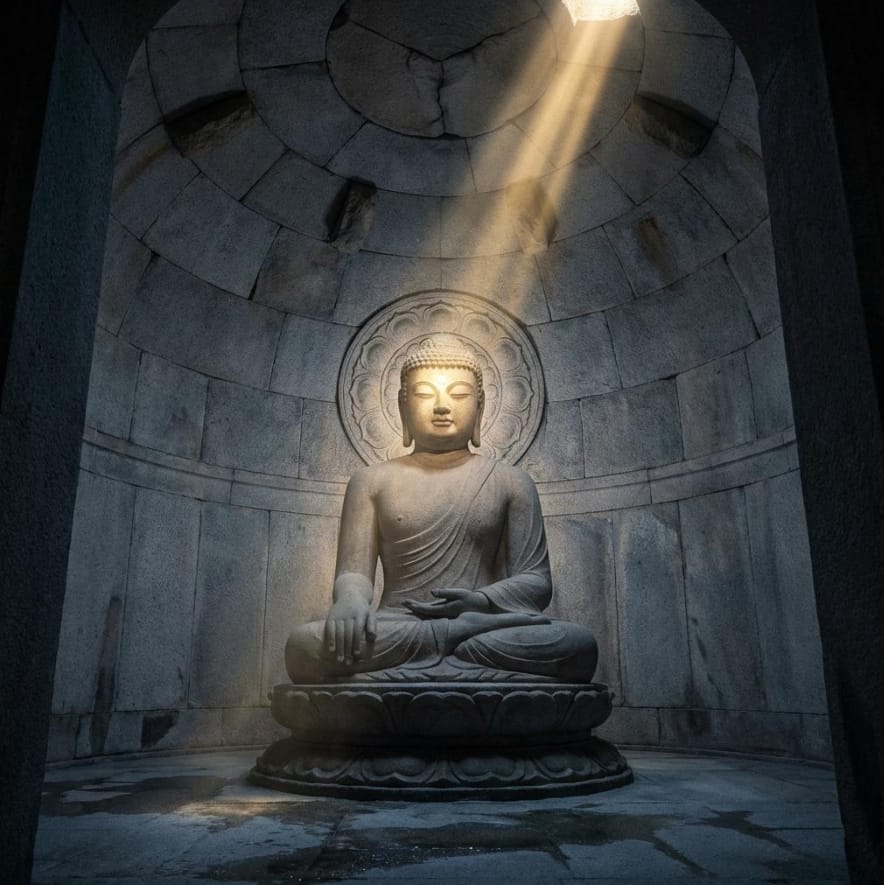
- 03.The Main Rotunda (Circle) Representing Heaven. A perfect dome constructed of 360 stone slabs, symbolizing the days of a lunar year and the universe itself.
The dome is a structural miracle. Silla engineers used a technique involving stone rivets. Protruding stones (like nails) were inserted between the dome’s layers to balance the center of gravity and lock the structure in place. The final capstone, weighing 20 tons, sits atop this delicate web of tension and compression.
The central Buddha (Sakyamuni) is carved from a single block of white granite, standing 3.5 meters high. The proportions follow a strict 1:1.1 ratio (body to pedestal), creating a sense of absolute stability. The statue faces East-Southeast, precisely aligned to catch the first rays of the winter solstice sun on the urna (forehead jewel), illuminating the entire grotto with reflected light.
III. The Lost Science: A Passive HVAC System
How did a cave made of granite survive 1,200 years of Korea’s humid summers without mold or moss? This is the true genius of Seokguram. The architects understood thermodynamics perfectly.
The Dew Point Mechanism
The floor of the grotto was built over a cold subterranean spring. The architects left gaps in the floorstones. This chilled the floor granite to a temperature lower than the ambient air. When humid air entered the grotto, moisture would condense on the cold floor stones rather than on the precious statue or wall carvings. The floor acted as a natural dehumidifier.
Furthermore, the dome was covered with a layer of stones and earth that allowed the structure to “breathe.” Ten niches carved into the upper walls of the rotunda facilitated air circulation, creating a convection current that vented warm air out and drew fresh air in. It was a self-regulating, zero-energy climate control system.
IV. The Tragedy of Concrete: A Modern Failure
The tragedy of Seokguram is that modern science destroyed what ancient wisdom had preserved. In the early 20th century, during the Japanese colonial period, well-intentioned engineers attempted to “restore” the grotto, which had fallen into disrepair.
Ignorant of the breathing mechanism, they encased the entire outer dome in concrete to stabilize it. This was a fatal error. The concrete sealed the structure, blocking the airflow and trapping moisture inside. The natural dehumidifying system was suffocated.
Almost immediately, the grotto began to leak and grow mold. In the 1960s, further attempts to fix this involved adding a second concrete dome and installing industrial air conditioners. Today, the grotto is hermetically sealed behind a glass wall, dependent on noisy machines to do what the stones once did silently and naturally. The statue is safe, but it is in a coma, cut off from the wind and the sun.
V. The Pantheon of Stone
Despite the glass barrier, the artistry remains breathtaking. Surrounding the central Buddha are reliefs of the Ten Disciples, each with a unique facial expression and posture—one looks pensive, another ascetic, another joyful. They are incredibly realistic, capturing individual personalities in granite.
Behind the Buddha, directly on the rear wall, is the eleven-headed Avalokitesvara (Guanyin). This relief is considered the masterpiece of Silla carving. Because of the curved wall, the figure appears to step forward towards the viewer.
Perhaps the most subtle feature is the halo. The lotus-flower halo is not attached to the Buddha’s head; it is carved on the back wall of the dome. However, the architect calculated the viewing angle from the antechamber so precisely that to a pilgrim kneeling in prayer, the halo appears to hover perfectly behind the Buddha’s head—a divine optical illusion.
Architectural Exam: True or False
Test your understanding of Silla’s lost science.
Editor’s Reflection
Visiting Seokguram is a bittersweet experience. You hike up the winding path of Mount Toham, smelling the pine and the damp earth, expecting to meet the sublime face-to-face. But when you arrive, you meet a glass wall. You stand in a queue of tourists, peering into a climate-controlled room that feels more like a sterile laboratory than a sacred cave.
Yet, looking past the reflection of the glass, the Buddha’s face remains unperturbed. The smile is faint, enigmatic, and profoundly confident. It is a smile that seems to say, “I have seen empires rise and fall, I have seen concrete poured and cracked, and I am still here.”
Seokguram is a humbling reminder of our own technological arrogance. We assume that because we have smartphones and satellites, we are smarter than the ancients. But the Silla engineers harmonized with nature; they used the cold spring water and the wind to breathe life into stone. We, with all our advanced materials, suffocated it with concrete. We tried to conquer nature, while they danced with it.
Curioscope invites you to consider: Preservation is not just about keeping a structure standing; it is about keeping its spirit alive. Perhaps one day, we will have the wisdom to remove the concrete and the glass, and let the Buddha breathe the mountain air once again.
The Stone That Spoke: Deciphering the Silence of Three Millennia