
The Chrononaut’s Conundrum: Unpacking the Science, Philosophy, and Fiction of the Time Traveler
An exploration into the theoretical underpinnings, paradoxes, philosophical implications, and cultural legacy of temporal displacement.
Curioscope’s Lens
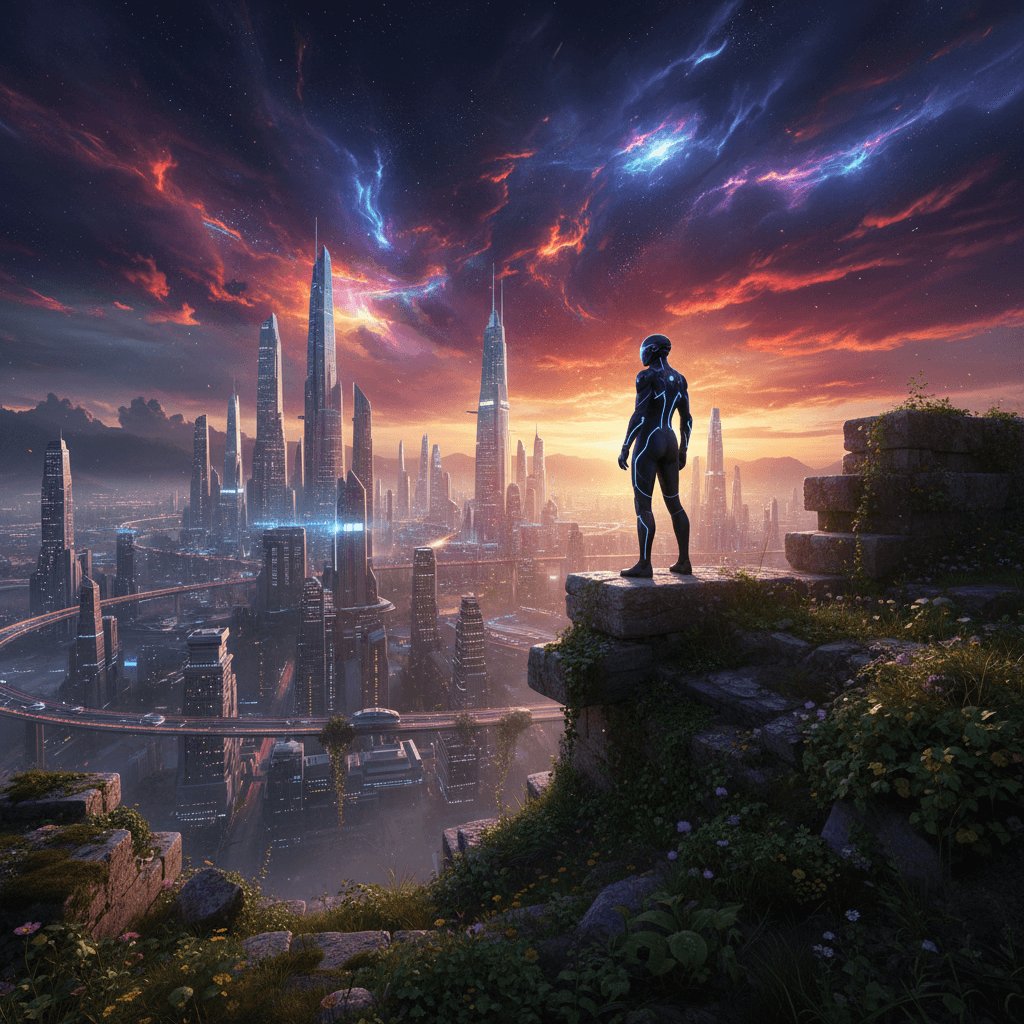
Time travel isn’t just a sci-fi trope; it’s the ultimate expression of human regret. We don’t obsess over flux capacitors and wormholes because of the physics; we obsess because we all have a moment we wish we could rewrite. At Curioscope, we view the time traveler not as a scientist, but as a tragic hero fighting the one law that governs us all: entropy. The paradox isn’t that you might kill your grandfather; the paradox is that even if you could go back, you’d still be the person who needed to escape the present.
The concept of a “Time Traveler” has captivated humanity, offering the prospect of transcending linear time to explore history or the future. This allure, however, introduces paradoxes, philosophical quandaries, and scientific hurdles. The fascination stems from human regrets, curiosity, and the desire for control, with a time traveler embodying ultimate power. This exploration delves into the theoretical underpinnings, paradoxes, philosophical implications, and cultural legacy of time travel.
The Enduring Allure of the Temporal Journey
The fantasy of time travel is driven by desires to:
- Rectify historical errors or prevent catastrophes.
- Satisfy curiosity by witnessing past events or future marvels.
- Achieve connection and closure by revisiting moments or understanding past motivations.
The time traveler is perceived as an omniscient observer, potential savior, or guardian of the timeline, making the concept a cornerstone of human imagination.
Scientific Speculations: Is Time Travel More Than Just a Dream?
While cinematic portrayals are fictional, scientific inquiry into time travel is serious, rooted in Albert Einstein’s theories of relativity.
Einstein’s Legacy: Spacetime and Time Dilation
- Special Theory of Relativity (1905): Introduced spacetime as an interwoven continuum. Time is relative, not absolute, and its passage differs for observers in different frames of reference, especially near the speed of light.
- Time Dilation: A proven phenomenon where traveling at high speeds causes time to pass slower for the traveler relative to a stationary observer. Astronauts on the ISS experience this, demonstrating a form of one-way future travel.
- General Theory of Relativity (1915): Showed that massive objects distort spacetime, and this gravitational influence also slows down time. Clocks tick slower in stronger gravitational fields. This also enables one-way future travel but not return to the original present.
The Quest for Backward Time Travel: Wormholes and Closed Timelike Curves
[Image of wormhole Einstein-Rosen bridge diagram]Backward time travel is the more speculative and challenging aspect.
- Wormholes (Einstein-Rosen Bridges): Hypothetical shortcuts through spacetime.
- Theory: Connect vastly separated regions of space and potentially time.
- Challenges: Extremely unstable, require “exotic matter” with negative energy density to remain open, and demand immense energy beyond current capabilities.
- Closed Timelike Curves (CTCs): Paths in spacetime that return to their starting point.
- Theory: Suggested by solutions involving rotating black holes (Kerr black holes) or cosmic strings, allowing a particle to return to its own past.
- Challenges: Depend on extreme conditions and unproven physics. Their existence directly leads to paradoxes, which many physicists view as evidence against their realization.
- Other theoretical models (e.g., Frank Tipler’s rotating cylinder, Kurt Gödel’s rotating universe) also suggested CTCs but required practically impossible conditions.
- Scientific Consensus: Future time travel (via dilation) is verified; backward time travel is highly improbable or impossible due to causality violation and extreme physical requirements.
The Mind-Bending Paradoxes of Temporal Displacement
These logical contradictions arise when considering altering the past:
- The Grandfather Paradox: A time traveler prevents their grandparents from meeting, thus preventing their own birth, which would then make the time travel impossible. This creates a causal loop contradicting the principle of cause and effect.
- The Bootstrap Paradox (Causal Loop or Ontological Paradox): Information or objects exist without a true origin point, creating a self-existing loop (e.g., giving Beethoven his own symphony, which he then composes). It defies the understanding that every effect has an original cause.
- Polchinski’s Paradox: A billiard ball sent through a wormhole into its past emerges and knocks its earlier self, preventing it from entering the wormhole. This creates a direct logical contradiction.
Proposed Solutions to the Paradoxes (Theoretical):
- The Novikov Self-Consistency Principle: Any actions taken by a time traveler would already be part of history; the past cannot be changed. This implies a deterministic universe where free will concerning past alteration is an illusion.
- The Many-Worlds Interpretation (MWI) of Quantum Mechanics: Every quantum event causes the universe to split into parallel universes. Altering the past would create a new parallel universe, leaving the original timeline unaffected.
- The Fixed/Deterministic Universe: Time is a fixed dimension; all events exist. A time traveler merely experiences different points in this fixed reality without altering it.
- The Mutable/Changing Universe: The past can be altered, leading to unforeseen ripple effects. This is common in science fiction but scientifically problematic due to paradoxes.
Test Your Temporal Knowledge!
See how well you grasp the concepts of time travel. Answer True or False for each question below.
Question 1: Time dilation near light speed allows future travel.
Question 2: The Grandfather Paradox involves preventing one’s own birth.
Question 3: The Many-Worlds Interpretation creates a single, unified new timeline by changing the past.
Types of Time Travel: From Natural Progression to Paradoxical Journeys
- Forward Time Travel:
- Natural Aging: Moving forward at a constant rate.
- Relative to Others (Time Dilation): Verified phenomenon where high speeds or strong gravity cause less time to pass for an observer.
- Cryosleep/Suspended Animation: Biologically pausing life to skip time, maintaining biological integrity.
- Backward Time Travel:
- Challenging frontier requiring manipulation of spacetime.
- Theoretical hurdles (wormholes, CTCs) and paradoxes make it highly unlikely or impossible.
The Time Traveler in Popular Culture: A Mirror to Our Hopes and Fears
The “Time Traveler” is a prominent figure in literature, film, and television, exploring human aspirations, anxieties, and ethics.
Literature:
- The Time Machine (H.G. Wells, 1895): Pioneered time travel tropes, exploring class division and evolution.
- A Connecticut Yankee in King Arthur’s Court (Mark Twain, 1889): Humorous critique of sending modern knowledge to the past.
- Slaughterhouse-Five (Kurt Vonnegut, 1969): Explores non-linear time and fate.
Film:
- Back to the Future Trilogy (1985-1990): Iconic franchise exploring paradoxes with a mutable timeline.
- Terminator Series (1984-Present): Focuses on altering past events to prevent future AI uprising, leaning towards a fixed or difficult-to-change past.
- 12 Monkeys (1995): Complex narrative hinting at a deterministic timeline where attempts to change the past are futile or contribute to it.
- Interstellar (2014): Uses extreme time dilation near a black hole to convey temporal disconnections.
- Primer (2004): Realistic, intricate depiction of accidental time travel and its consequences.
Television:
- Doctor Who (1963-Present): Features a time-traveling alien exploring temporal scenarios and interventionist ethics.
- Outlander (2014-Present): A 20th-century nurse transported to 18th-century Scotland.
- Travelers (2016-2019): Operatives from the future send consciousnesses back to prevent civilization’s collapse.
These narratives shape public perception, inspire scientific inquiry, and explore ethical boundaries.
Philosophical Quandaries: Free Will, Identity, and Morality
Time travel raises profound philosophical questions:
- Determinism vs. Free Will: If the past is fixed, does free will exist? If the past can be changed, what does it mean for reality and our choices?
- Personal Identity: Which version of oneself is “you” if the past is altered? What constitutes continuous identity across temporal shifts?
- Moral and Ethical Dilemmas:
- The “Hitler Problem”: The ethical dilemma of killing a historical figure to prevent atrocities, with unpredictable consequences.
- Exploiting Future Knowledge: Ethical implications of using future information for personal gain or disrupting natural progress with future technologies.
- Responsibility of a Time Traveler: The obligation to intervene or observe, and the psychological burden of knowing future tragedies.
These dilemmas highlight that time travel would be a profound ethical challenge, requiring new codes of conduct.
The Practicalities (or Impracticalities) of Building a Time Machine
Significant practical challenges exist even if physics allowed it:
- Immense Energy Requirements: Creating and stabilizing wormholes or CTCs would require stellar or galactic energy levels.
- Precision and Control: Accurately targeting a specific point in time and space is difficult due to cosmic motion (Earth’s orbit, solar system’s movement, galactic drift).
- Survival in Different Eras: Biological (pathogens, atmosphere) and social (language, culture, suspicion) challenges would be immense.
Modern Theories and the Frontiers of Physics
Scientific exploration of time continues:
- Quantum Gravity: Theories like String Theory or Loop Quantum Gravity aim to reconcile General Relativity and Quantum Mechanics, potentially revealing new insights into spacetime.
- M-Theory/String Theory: Proposes extra dimensions that might offer novel ways to traverse spacetime.
- Alcubierre Warp Drive: Theoretical method for faster-than-light travel by warping spacetime, which could have implications for temporal mechanics.
- The Fermi Paradox and Time Travel: The absence of observable time travelers could suggest its impossibility or strict non-intervention policies.
The Time Traveler’s Dilemma: What Would You Do?
The thought experiment of being a time traveler prompts personal questions about where to go, what to change, and the responsibility involved. The temptation to alter the past is strong, but understanding the cascading effects requires wisdom.
Conclusion: The Enduring Journey Through Time and Thought
The “Time Traveler” symbolizes humanity’s imagination and quest for understanding, blurring science and philosophy. While backward time travel remains elusive, the theories and thought experiments it inspires are valuable for grappling with causality, determinism, identity, and the nature of time. From Einstein’s theories to popular narratives, the time traveler’s journey continues to push the boundaries of comprehension. Whether a fantasy or a future reality, the concept remains an enduring symbol of human curiosity, ambition, and the desire to transcend linear progression, forever reaching for the past and future. The grand exploration of time continues.
Editor’s Reflection
Perhaps the fact that time travel remains impossible is the universe’s greatest mercy. If we could change the past, we would never learn to live with it. The finality of time forces us to cherish the present. So, while we dream of flux capacitors and TARDISes, let’s remember: the only moment we can actually control is *now*. And maybe, just maybe, that’s enough.