
The Baghdad Battery:
An Electric Enigma
Did the Parthians harness the electron 2,000 years before modern science? Or have we projected our own technological bias onto a simple clay pot?
Curioscope’s Lens
In the dusty archives of the National Museum of Iraq in the 1930s, a German painter-turned-archaeologist named Wilhelm König stumbled upon an object that shouldn’t exist. It wasn’t a golden idol or a cuneiform tablet, but a modest, yellow clay pot about the size of a human fist. Inside, however, lay a configuration of copper and iron so precise, so deliberate, that it looked less like a vessel and more like a machine. König made a radical suggestion that shook the foundations of archaeology: this was a galvanic cell. A battery. Two millennia before Alessandro Volta was born. This article dissects the controversy, the chemistry, and the tragic disappearance of one of history’s most debated artifacts.
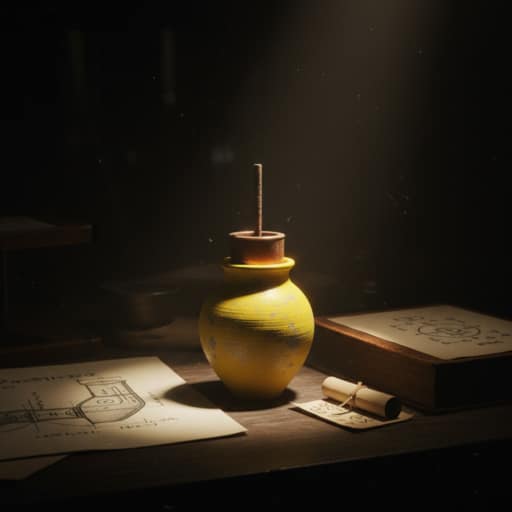
Part I: The Anatomy of the Artifact
To understand why the “battery” theory persists, one must look closely at the object’s engineering. The Baghdad Battery isn’t just a pot; it is a system of nested components.
Found near the ancient metropolis of Ctesiphon (modern-day Khujut Rabu), the artifact dates back to either the Parthian (250 BC–224 AD) or Sasanian (224–651 AD) periods. The vessel itself is an unremarkable ovoid clay jar, roughly 14 centimeters (5.5 inches) tall. But the magic lies inside.
- The Copper Cylinder: A sheet of high-purity copper, rolled into a tube approximately 9cm long. The bottom was sealed with a crimped copper disc and sealed with asphalt (bitumen), making it water-tight.
- The Iron Rod: Suspended inside the copper cylinder—but crucially, not touching it—was a corroded iron rod.
- The Asphalt Stopper: The top of the jar was sealed with a heavy plug of bitumen, which held the iron rod in place, ensuring it remained suspended in the center of the copper tube without making direct contact.
This configuration—two dissimilar metals separated by a gap and encased in a container—is the exact definition of a galvanic cell. All that was missing was an acidic liquid (an electrolyte) to fill the jar. When König examined the interior, he found traces of corrosion that suggested the presence of an acidic agent long ago, perhaps wine, lemon juice, or grape vinegar.
Part II: The Chemistry of the Ancients
If you pour an electrolyte into the Baghdad Battery, does it work? The short answer is: Yes.
Since the 1940s, numerous engineers and historians, including the team from the TV show MythBusters, have built replicas. When filled with grape juice, vinegar, or even benzoquinone (a chemical found in beetles), the device consistently produces an electric current.
The MythBusters Test
In a famous experiment, the MythBusters team connected ten replica jars together. They managed to generate over 4 volts of electricity. While this isn’t enough to jump-start a chariot, it is certainly enough to feel a tingle or power a very small process.
The leading theory for its use is Electroplating. Wilhelm König speculated that ancient jewelers might have used these cells to plate gold onto silver objects. Indeed, many artifacts from the region exhibit incredibly thin, uniform layers of gilding that are difficult to explain with traditional fire-gilding methods. A series of these batteries could theoretically transfer gold ions from a solution onto a metal surface.
Another theory is more mystical. If hidden inside a statue or an altar, a connected battery could deliver a mild shock to a worshipper touching it. In a world without electricity, such a “magical” tingle would be undeniable proof of divine power. This “Theology of Shock” suggests the battery was a tool not of industry, but of awe.
Part III: The Skeptic’s Case (The Scroll Jar)
Despite the allure of ancient high-tech, mainstream archaeology remains deeply skeptical. Why? Because context is everything, and the Baghdad Battery has very little.
1. No Wires: To make a circuit work, you need wires to connect the terminals. No conductive wires (like iron or copper wire) have ever been found in association with these jars. Without a way to tap the power, the “battery” is useless.
2. The Asphalt Seal: The copper cylinder was completely sealed shut with asphalt. This makes refilling the electrolyte (which would deplete quickly) extremely difficult and impractical for a functional battery.
3. The Alternative: The mundane explanation is that these were storage vessels for sacred scrolls. Papyrus and parchment rot over time, leaving behind organic acidic residue. The metal cylinders would protect the fragile texts from the elements. Similar scroll jars have been found at nearby excavation sites like Seleucia, containing the remnants of documents, not electrolytes.
Part IV: A Tragedy of War
Perhaps the saddest part of this story is that we may never know the truth. In April 2003, during the invasion of Iraq, the National Museum in Baghdad was looted. Thousands of priceless artifacts were stolen or destroyed in the chaos.
Among the lost items was the original Baghdad Battery. The object that sparked a thousand theories is now gone—melted down for scrap, hidden in a private collection, or shattered on the floor. We are left only with König’s drawings, a few black-and-white photos, and replicas. The physical evidence required to perform modern chemical analysis (like mass spectrometry on the interior residue) has vanished into the fog of war.
Fact or Fiction? The Battery Quiz
Test your knowledge of Mesopotamia’s greatest riddle.
Editor’s Reflection
The Baghdad Battery is more than an archaeological puzzle; it is a Rorschach test for how we view the past. When we look at that small, yellow clay pot, do we see the primitive fumblings of a pre-scientific society? Or do we see a lost golden age of knowledge, erased by the sands of time?
There is a certain arrogance in the modern mind that assumes we invented complexity. We hold our smartphones and assume that “tech” belongs to us. But the human brain was just as large, just as creative, and just as desperate to manipulate its environment 2,000 years ago as it is today. Whether the Parthians used this jar to plate gold, zap believers, or simply keep a holy scroll dry, they engineered a solution using the chemistry available to them. That is engineering, pure and simple.
The tragedy of the museum looting adds a layer of heartbreak to the mystery. It reminds us that history is fragile. It is not a permanent record carved in stone; it is a collection of surviving scraps that can be wiped away in a weekend of violence. The battery is gone, and with it, perhaps the final clue to its purpose.
Curioscope leaves you with this thought: We may never know if the Parthians had the “lightbulb moment” of electricity. But the Baghdad Battery proves they had the spark of curiosity. And sometimes, the question is more electrifying than the answer.
Göbekli Tepe: Unearthing Eden and the Dawn of Pre-Agricultural Civilization