
The Enigma
Underfoot
For 40 years, a phantom artist has been embedding a message of resurrection into the asphalt of American cities. Who is he, and what does he want?
🔍 Curioscope’s Lens
The urban landscape is a canvas for peculiar messages, but none are as persistent, cryptic, or technically ingenious as the Toynbee Tiles. Embedded in the asphalt of major cities from New York to Santiago since the 1980s, these plaques bear a consistent, haunting command: “RESURRECT DEAD ON PLANET JUPITER.” They represent a pre-internet viral phenomenon, a testament to a singular, lifelong obsession, and a riddle that has captivated urban archaeologists for decades. This article peels back the layers of linoleum and tar to reveal the human story beneath the street.
Part I: The Message in the Street
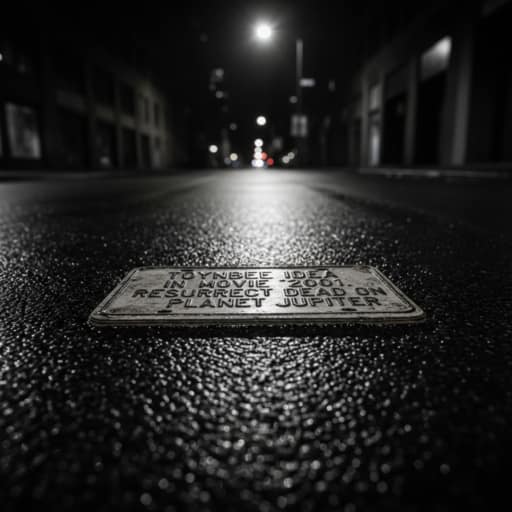
Imagine walking through the busy intersection of 5th Avenue in New York or Broad Street in Philadelphia. You look down to check for traffic, and there, fused perfectly into the black asphalt, is a block of linoleum with a message that reads like a fever dream:
TOYNBEE IDEA
IN MOViE `2001
RESURRECT DEAD
ON PLANET JUPITER
This isn’t graffiti sprayed on a wall; it is a physical intervention in the city’s infrastructure. The tiles are roughly the size of a license plate, made from layers of linoleum and asphalt glue. The method of their installation is a stroke of genius. The artist wraps the tile in tar paper and places it on the road, perhaps from a moving car. As cars drive over it, the pressure bonds the tile to the road. The sun melts the tar paper away, revealing the message. It is a slow-developing photograph made of traffic and heat.
Part II: Decoding the Madness
The text seems like nonsense, but it is actually a highly compressed synthesis of three distinct cultural references. To understand the tiler, we must unpack his library.
- 01The Toynbee Idea Refers to historian Arnold Toynbee. In his writings, Toynbee discussed the idea that human civilization progresses by overcoming challenges. More specifically, he mused about a future where science could physically resurrect the dead, fulfilling the promises of religion through technology.
- 02Movie ‘2001 Stanley Kubrick’s masterpiece 2001: A Space Odyssey. The film ends with the astronaut Bowman being transformed into a “Star Child” near Jupiter. The tiler interpreted this literally: Jupiter is the engine of resurrection.
- 03The Destination Why Jupiter? In the tiler’s worldview, the gas giant’s immense energy or specific atmosphere is the necessary cauldron for bringing biological matter back to life.
Part III: The Phantom in the Car
For decades, the identity of the tiler was the internet’s favorite mystery. Then, in 2011, the documentary Resurrect Dead seemingly cracked the code. The trail led to a reclusive resident of Philadelphia named Severino “Sevy” Verna.
The evidence was compelling. Verna drove a car with a hole cut out of the passenger floorboard—a customized mechanism allowing him to drop tiles onto the highway while driving, unseen. He was a shortwave radio enthusiast who had previously broadcast messages about colonizing Jupiter under the alias “James Morasco.” Neighbors described him as brilliant but deeply paranoid, a man who felt he possessed a secret that could save humanity, if only they would listen.
But the story gets darker. As the years went on, the tiles changed. The hopeful messages of resurrection were replaced by paranoid rants about the FBI, the media, and “Hellion Jews.” The “House of Hades” tiles appeared, aggressive and fragmented. It was a visual diary of a mind slowly deteriorating under the weight of its own obsession and isolation.
Part IV: Why We Look Down
Why do these tiles fascinate us? They are, after all, technically vandalism. Yet, they are preserved, photographed, and mapped by thousands of fans.
The answer lies in the medium. In a world of digital ephemera, where tweets vanish in seconds, the Toynbee Tiles are aggressively physical. They require labor, risk, and travel to create. They are made to be walked upon, driven over, and weathered. They are a shout for immortality carved into the very skin of the city.
Even as many original tiles are paved over, copycats have sprung up worldwide. The message has outlived the messenger. The “Toynbee Idea” may be scientifically nonsensical, but as a piece of folklore, it has already achieved the resurrection it sought.
Decode the Pavement: True or False
How well do you know the mystery beneath your feet?
Editor’s Reflection
I often find myself looking down when I walk through a city, scanning the crosswalks not for safety, but for secrets. The Toynbee Tiles have changed the way I see the urban floor. To most, a road is just a surface to get from A to B. But for Sevy Verna, it was a printing press. It was the only way he knew to scream his truth to a world that had stopped listening.
There is a profound sadness in the concept of “Resurrect Dead on Planet Jupiter.” It is the ultimate denial of grief. It is a refusal to accept that goodbye is forever. We can call it madness, sure. But isn’t it also the most human wish imaginable? We all want to see our lost ones again. We all want a second chance. Verna just happened to build a theology out of linoleum to make it happen.
What strikes me most is the solitude of the act. Imagine driving alone at 3 AM, cutting a hole in the floor of your car, dropping a message into the void of the highway, hoping that maybe, just maybe, someone will read it and understand. It is a message in a bottle cast into a sea of concrete.
Curioscope invites you to remember this: The line between a visionary and a madman is often just a matter of who is listening. The Toynbee Tiler may not have resurrected anyone on Jupiter, but in a strange way, he resurrected himself. As long as we keep looking down and reading his tiles, he is not truly gone.
The Baghdad Battery: Unearthing Mesopotamia’s Most Electrifying Ancient Mystery