
Göbekli Tepe:
Unearthing Eden
Before the wheel, before writing, before cities… there was a temple. How did Stone Age hunter-gatherers build the impossible?
Curioscope’s Lens
For centuries, the story of human civilization was simple: we discovered farming, settled down, formed villages, and then—once we had full bellies and spare time—we built temples and invented religion. It was a logical progression from survival to spirituality. But in 1994, a German archaeologist named Klaus Schmidt climbed a hill in southeastern Turkey and found something that shattered that timeline. He found Göbekli Tepe. A massive, sophisticated temple complex built by people who had not yet invented the wheel, pottery, or agriculture. It suggests a radical new truth: Civilization didn’t create religion. Religion created civilization.
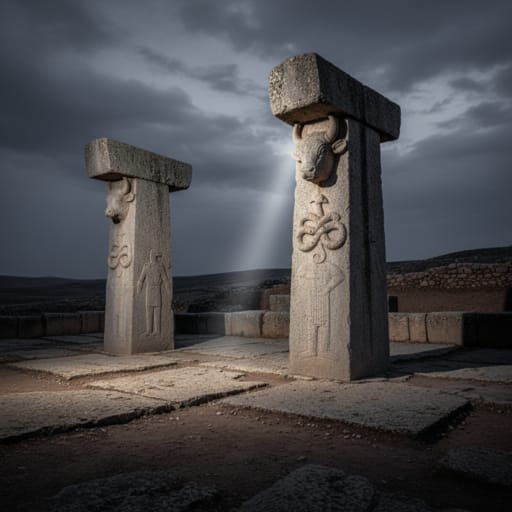
Part I: The Impossible Architecture
Göbekli Tepe (“Potbelly Hill”) sits atop a limestone ridge in the Urfa province of Turkey. Dating back to approximately 9,500 BCE, it is a staggering 11,000 to 12,000 years old. To put that in perspective: it was already an ancient ruin when the Great Pyramids of Giza were built. It predates Stonehenge by over 6,000 years.
The site consists of multiple circular enclosures, or “temples,” comprised of massive T-shaped limestone pillars. Some of these pillars stand up to 5.5 meters (18 feet) tall and weigh between 10 to 20 tons. Yet, the people who built them were Pre-Pottery Neolithic hunter-gatherers. They had no metal tools, no beasts of burden, and no written language.
How did small, nomadic bands of people carve, transport, and erect such monoliths? Archaeologists estimate it would have required a workforce of at least 500 people. This implies a level of social organization and cooperation previously thought impossible for hunter-gatherers. They weren’t just surviving; they were planning, engineering, and creating art on a monumental scale.
The Symbolism of the T-Pillars
The T-shaped pillars are not just structural supports; they are stylized human figures. Carved arms reach down the sides, with hands meeting at the “waist” (a belt). They are faceless giants, perhaps representing ancestors, shamans, or the first gods. Their surfaces are teeming with reliefs of dangerous animals: lions, scorpions, snakes, vultures, and boars. Unlike later Neolithic art which focused on fertility and livestock, this is a menagerie of predators—a memory of a wilder, more dangerous world.
Part II: The Birth of Agriculture?
The most revolutionary theory emerging from Göbekli Tepe is the “Feasting Hypothesis.” Building such a massive complex required feeding hundreds of workers for months or years. Hunting and gathering alone couldn’t sustain such a dense population in one place.
Genetic analysis of modern wheat strains points to the Karaca Dağ mountain range, just 20 miles from Göbekli Tepe, as the place where wild einkorn wheat was first domesticated. It is highly probable that the need to brew beer and bake bread for the great religious festivals at the temple forced these hunter-gatherers to start farming.
This flips the script of human history. We didn’t build temples because we invented farming; we invented farming to build temples. The urge to worship, to gather, and to touch the divine was the engine that drove the Neolithic Revolution.
Part III: The Cult of the Dead
But what happened inside these enclosures? Recent evidence suggests a dark answer: Skull Cults. Fragments of human skulls found at the site show signs of being carved, drilled, and perhaps hung on cords. This aligns with practices found in other Neolithic sites in the Levant, where ancestors were venerated (or enemies desecrated) by preserving their skulls.
The abundance of vulture imagery on the pillars also supports the theory of “Sky Burials” (excarnation), where bodies were left out to be picked clean by birds, freeing the soul to ascend to the heavens. Göbekli Tepe may have been a gateway between the world of the living and the world of the dead.
Part IV: The Great Burial
Perhaps the biggest mystery of all is how Göbekli Tepe ended. Around 8,000 BCE, after being in use for over a thousand years, the site wasn’t destroyed or abandoned to the elements. It was deliberately buried.
The builders hauled tons of soil, rubble, and refuse to completely cover the enclosures, creating the artificial hill (“Tepe”) we see today. Why? Was it an act of desecration? Or was it a final act of reverence, preserving the sacred space by returning it to the earth, much like a burial? By burying it, they inadvertently preserved it perfectly for 10,000 years, leaving a time capsule for us to decode.
Unearth the Truth: True or False
Test your knowledge of the world’s oldest temple.
Editor’s Reflection
Göbekli Tepe is more than a pile of old rocks; it is a mirror that reflects our own misconceptions about our ancestors. We often think of “primitive” humans as solely focused on survival—finding the next meal, escaping the cold. We assume that art, philosophy, and religion are luxuries that come only after the stomach is full.
But this site proves us wrong. It tells us that the hunger for meaning was just as primal as the hunger for food. These people dragged 10-ton pillars up a hill not because it made practical sense, but because they needed to. They needed to materialize their gods, to anchor their cosmology in stone, to create a space that was separate from the chaos of the wild.
It reminds me that we are, and always have been, creatures of the spirit. The first cathedral wasn’t built in medieval Europe; it was built on a Turkish hilltop 12,000 years ago by people who had nothing but flint tools and a shared vision. They didn’t build it because they were civilized; they built it to become civilized. And in doing so, they started the long, strange journey that led to us.
Curioscope invites you to wonder: If religion birthed civilization, what will birth the next stage of human evolution? What are the “temples” we are building today that will define the next 10,000 years?
The Man from Taured: A Gateway to Another Dimension or Just an Elaborate Hoax?