
Exploring the Universe, One Discovery at a Time
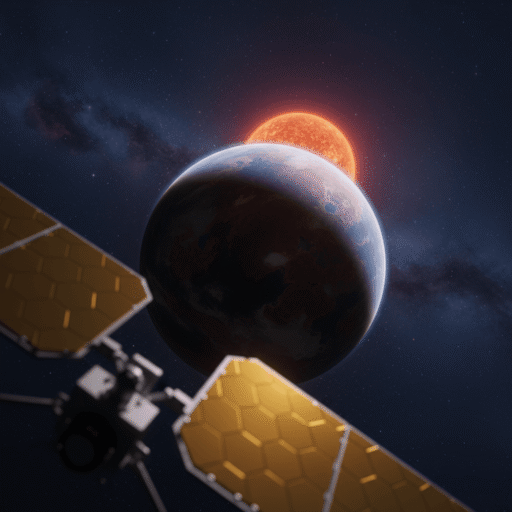
JWST’s Latest Glimpse: Unveiling the Atmospheric Secrets of LHS 1140 b and the Hunt for Biosignatures
Curioscope’s Lens
The search for biosignatures isn’t just about chemistry; it’s about cosmic loneliness. When we point the James Webb Telescope at LHS 1140 b, we aren’t just analyzing an atmosphere; we are asking the oldest question in human history: ‘Is anyone else out there?’ At Curioscope, we believe the answer—whether yes or no—will be the most profound shock to our collective ego since Copernicus moved the Earth from the center of the universe.
Introduction
The blog post discusses the ongoing quest to answer whether humanity is alone, focusing on exoplanet research and the capabilities of the James Webb Space Telescope (JWST). It highlights recent excitement, particularly on platforms like Reddit, surrounding hypothetical new findings about LHS 1140 b, a super-Earth orbiting a dim red dwarf star, and its potential atmospheric signatures that could indicate life.
The Ever-Expanding Cosmos: Our Quest for Other Earths
- The concept of exoplanets shifted from speculation to reality in the mid-1990s.
- As of early 2026, over 5,500 exoplanets have been confirmed, demonstrating their ubiquity.
- Exoplanets vary widely in size, composition, and orbit, including gas giants, super-Earths, mini-Neptunes, and rogue planets.
- Rocky planets in the “habitable zone” (where liquid water can exist on the surface) are prime targets for life detection.
- Early detection methods (transit, radial velocity) provided limited atmospheric data.
Enter the James Webb Space Telescope: A New Era of Discovery
Launched in December 2021, JWST is the most powerful space observatory ever built, observing primarily in infrared light.
Infrared observation penetrates dust and gas clouds, allowing observation of fainter objects and cooler universe regions.
JWST’s infrared capability is crucial for exoplanet studies because planets emit heat (infrared) and atmospheric gases absorb/emit infrared at specific wavelengths.
Transit Spectroscopy
JWST analyzes starlight filtered through an exoplanet’s atmosphere during a transit. Absorbed wavelengths reveal the atmosphere’s chemical composition.
JWST’s 6.5-meter mirror and instruments (NIRSpec, MIRI) enable detailed atmospheric analysis of Earth-sized and super-Earth exoplanets, previously beyond reach.
LHS 1140 b: A Prime Candidate in the Habitable Zone
Discovered in 2017, LHS 1140 b is a rocky super-Earth located 49 light-years away in the constellation Cetus. It orbits a dim red dwarf star, LHS 1140.
Key Attributes:
- Rocky Composition: Mass ~6.9 times Earth’s, radius ~1.7 times Earth’s.
- Habitable Zone Orbit: Orbits closer to its star than Earth to the Sun (24.7-day year), but receives about half the insolation of Earth due to the star’s dimness, potentially allowing liquid water.
- Quiet Host Star: LHS 1140 is considered a relatively “quiet” red dwarf, potentially allowing the planet to retain its atmosphere.
- Transit Detection: Transits its star, enabling atmospheric characterization by JWST.
The recent buzz on Reddit is attributed to hypothetical JWST data suggesting atmospheric composition analysis.
The Art of Atmospheric Characterization with JWST
JWST measures dips in starlight at different infrared wavelengths during transits. Each gas has a unique spectral “fingerprint” (wavelengths of absorption).
JWST’s instruments create a transmission spectrum, revealing atmospheric components.
Key gases of interest for rocky exoplanets:
- Water Vapor (H2O): Indicates potential for liquid water.
- Carbon Dioxide (CO2): Influences planetary climate and surface temperature.
- Methane (CH4): Can be geological or biological; a potential biosignature.
- Oxygen (O2) / Ozone (O3): Oxygen is reactive and often replenished by life (e.g., photosynthesis). Ozone is an indirect sign of oxygen.
- Nitrogen (N2): Important for atmospheric density, though difficult to detect spectroscopically.
The Reddit discussions likely focused on intriguing combinations or concentrations of these gases.
What Are Biosignatures? The Whispers of Life
A biosignature is a substance, structure, or pattern reliably indicating biological activity.
Atmospheric Biosignatures:
Specific gas combinations unlikely to exist without life. Strongest Indicator: Simultaneous detection of multiple gases in chemical disequilibrium (e.g., oxygen and methane coexisting on Earth due to biological production).
Potential Biosignatures:
- Oxygen (O2) and Ozone (O3).
- Methane (CH4) and Nitrous Oxide (N2O) in tandem or unusual concentrations.
- Methyl Chloride (CH3Cl) or Dimethyl Sulfide (DMS) (produced almost exclusively by life on Earth).
Caveat: No single gas is absolute proof; abiotic processes can mimic biosignatures. Robust evidence requires multiple indicators and understanding of the planet’s environment.
The Challenges and Caveats: A Difficult Journey
- False Positives: Gases can be produced both biologically and geologically.
- Limited Data Resolution: Faint signals require extensive observation; resolution may limit distinguishing subtle features.
- Atmospheric Escape: Stellar winds and flares can strip atmospheres, especially around red dwarfs.
- Cloud Interference: Clouds can obscure spectral signals from gases.
- Unknown Chemistries: Search is biased towards Earth-like life; other chemistries may exist.
Hypothetical JWST observations would undergo intense scrutiny and require follow-up.
The Future of Exoplanet Exploration and Astrobiology
JWST data refines models of planetary formation, evolution, and atmospheric dynamics, guiding future missions.
Future observatories like Habitable Worlds Observatory (HWO) and LUVOIR are proposed with larger mirrors and coronagraphs for direct imaging and more detailed spectroscopy.
Exoplanet study and biosignature search are linked to astrobiology, the study of life’s origins, evolution, and distribution in the universe.
Conclusion: A Universe Awakened
- JWST’s capabilities mark a significant step towards scientifically searching for alien life.
- LHS 1140 b represents the hopes of scientists and enthusiasts in this search.
- JWST’s unveiling of LHS 1140 b’s atmospheric secrets could reshape our understanding of life.
- The pursuit itself is a testament to human curiosity and the drive to explore.
- The universe’s diversity and potential for life are increasingly evident.
Editor’s Reflection
Even if LHS 1140 b turns out to be barren rock, the very fact that we can taste its air from 49 light-years away is a miracle of human ingenuity. We are the universe waking up to itself. Whether we find neighbors or just empty rooms, the search itself defines who we are: the species that refused to stay in the dark.
Test Your Knowledge!
1. True or False: The James Webb Space Telescope primarily observes in visible light, similar to the Hubble Space Telescope.
2. True or False: LHS 1140 b is a gas giant exoplanet located well outside its star’s habitable zone.
3. True or False: The simultaneous detection of oxygen and methane in an exoplanet’s atmosphere could be a strong indicator of biological activity due to their chemical disequilibrium.
Cracking the Code: The Zodiac Killer’s 340 Cipher Deciphered After 51 Years