
The Enigma of the Voynich Manuscript: A Medieval Mystery Unveiled
Curioscope’s Lens
In an age where AI translates languages in milliseconds, the Voynich Manuscript remains a stubborn, beautiful anomaly. It is the Everest of cryptography. At Curioscope, we believe its value lies not in the solution, but in the obsession. It proves that despite our technological arrogance, history can still keep a secret. Perhaps it is a gibberish hoax, or perhaps it is the lost wisdom of a forgotten world. Either way, it reflects our desperate human need to find meaning in the chaotic unknown.
A Puzzling Past
The Voynich Manuscript, a medieval codex filled with mysterious writing and enigmatic illustrations, has baffled cryptographers, linguists, and historians for centuries. Discovered in 1912 by Polish book dealer Wilfrid Voynich, this peculiar book, dating back to the early 15th century, remains one of the world’s most enduring and fascinating unsolved mysteries.
Its pages are adorned with botanical drawings that depict no known plant species, astronomical charts that don’t align with conventional understanding, and what appear to be pharmaceutical recipes or alchemical symbols, all accompanied by a unique, flowing script that defies decipherment.
Illustrations: A Visual Code?
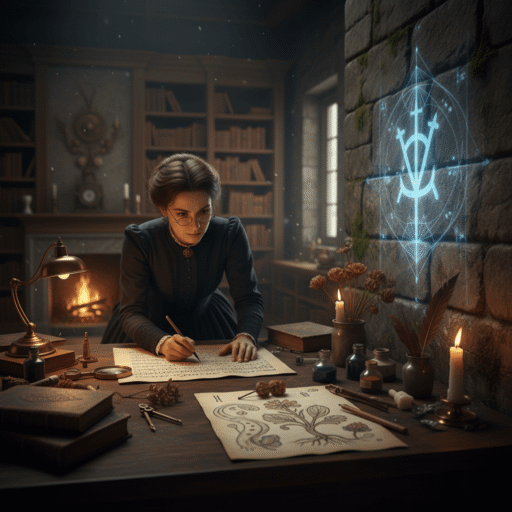
Beyond the text, the manuscript’s illustrations are a world unto themselves. The “Voynich plants” often feature roots, leaves, and flowers from multiple species, or characteristics that defy botanical classification. The “cosmological” section contains diagrams of stars and celestial bodies that are similarly unconventional.
Some scholars believe these drawings are not merely decorative but integral to the meaning of the text, perhaps serving as a visual lexicon or aiding in a mnemonic system. Could the bizarre flora and fauna be a deliberate obfuscation, or do they represent a medieval understanding of botany and astronomy that we no longer recognize?
The Legacy of the Unreadable
The Voynich Manuscript continues to captivate because it challenges our understanding of knowledge, communication, and history. Its enduring mystery has inspired novels, documentaries, and countless research projects. It stands as a testament to the human desire to decipher the unknown, a silent challenge from the past beckoning us to unlock its secrets.
Whether it is an elaborate hoax, a medieval encyclopedia of forgotten lore, or an alien message, the Voynich Manuscript remains a compelling artifact. Its unread pages whisper possibilities, inviting each new generation to take up the gauntlet and perhaps, finally, unveil the truth.
Editor’s Reflection
If the manuscript is ever decoded and turns out to be a medieval herbal remedy book or a health manual for women, will we be disappointed? Probably. The mystery is often more intoxicating than the truth. The Voynich Manuscript serves as a mirror; we project our own desire for magic and hidden knowledge onto its pages. Its silence is its greatest story.
Voynich Manuscript: Truth or False?
1. The Voynich Manuscript was discovered in the 18th century.
False. The Voynich Manuscript was discovered by Wilfrid Voynich in 1912.
2. The script of the Voynich Manuscript resembles a known ancient language.
False. The script is unique and bears no resemblance to any known language, making its decipherment exceptionally difficult.
3. Carbon dating suggests the manuscript was created in the 13th century.
False. Carbon dating has placed the creation of the manuscript in the early 15th century (between 1404 and 1438), disproving earlier theories of 13th-century authorship.
4. The “Voynich plants” depicted in the manuscript are all identifiable species.
False. Many of the botanical drawings in the Voynich Manuscript depict plants that do not correspond to any known species, often combining features of multiple plants.
Cracking the Code: The Zodiac Killer’s 340 Cipher Deciphered After 51 Years