
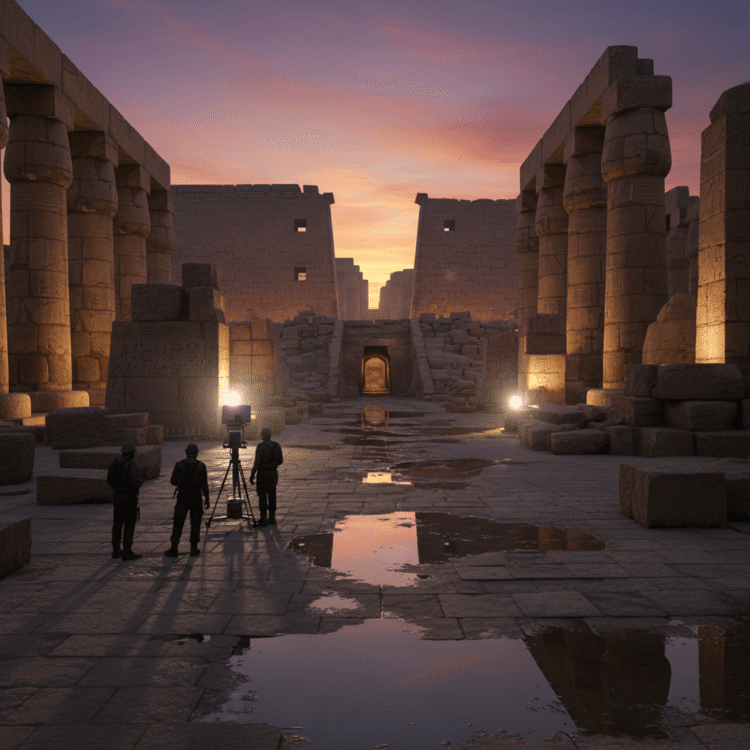
Unearthing the Siren’s Secret: The Modern Archaeological Quest for Cleopatra’s Lost Tomb
Curioscope’s Lens
Cleopatra is more than a historical figure; she is a ghost that haunts the Western imagination. We know how she died, we know who she loved, but her final resting place remains a stubborn void in the map of history. Why does this particular search captivate us so intensely? Perhaps it’s because finding her tomb feels like reclaiming a narrative stolen by Roman conquerors. At Curioscope, we are fascinated not just by the potential gold, but by the detective story unfolding beneath the sands of Taposiris Magna—a 2,000-year-old cold case heating up before our eyes.
Cleopatra VII, the last active pharaoh of ancient Egypt, remains an enigmatic figure synonymous with power, beauty, intrigue, and tragedy. Her reign marked the end of ancient Egypt’s glory and the rise of Roman dominance, with significant alliances with Julius Caesar and Mark Antony.
Her dramatic death by asp is well-documented, but the whereabouts of her tomb, believed to be with Mark Antony, is the greatest unsolved archaeological mystery. The discovery promises not only ancient treasures but also unprecedented insights into her life, death, burial practices, the final days of the Ptolemaic dynasty, and the Roman annexation of Egypt. Modern archaeology, employing advanced technology, is actively searching for the tomb.
Cleopatra’s Legacy and Final Days
Born in 69 BCE, Cleopatra VII Philopator was a Ptolemaic ruler of Greek descent. She was fluent in Egyptian, symbolizing her commitment to her kingdom. Her reign focused on maintaining Egypt’s independence against the expanding Roman Republic. Her relationships with Caesar and Antony were strategic political alliances.
After Caesar’s assassination, she supported Antony against Octavian. Their defeat at the Battle of Actium (31 BCE) and subsequent suicides in 30 BCE led to Egypt becoming a Roman province. Plutarch describes Cleopatra’s capture by Octavian, her refusal to be paraded as a trophy, and her suicide by asp. Octavian granted her wish to be buried with Antony “in the most sumptuous and regal manner,” a key detail for modern theories.
Reasons for the Tomb’s Elusiveness
- Political Climate: Octavian, the conqueror, sought to erase Antony and Cleopatra’s memory, potentially leading to the tomb being modest or obscured to prevent it from becoming a symbol of resistance. The new Roman administration had no interest in preserving a memorial to them.
- Alexandria’s Transformation: Over two millennia, Alexandria has undergone significant changes due to urban development, seismic activity, and natural erosion.
- A substantial part of the ancient city, including the royal quarter, has succumbed to the sea due to subsidence and earthquakes.
- This submerged landscape requires complex and costly underwater archaeological techniques.
- Ancient Burial Practices: Ptolemaic rulers, being Hellenistic monarchs, might have favored less monumental burial styles within city necropolises compared to earlier pharaohs.
- Scarcity of Records: Specific records regarding Cleopatra’s tomb are scarce or lost, forcing reliance on fragmented secondary sources.
Traditional Theories and Historical Accounts
Joint Tomb: Plutarch’s account suggests a joint burial with Antony, likely within or near Alexandria’s royal precincts.
Alexandria’s Royal Quarter: This area, now largely submerged beneath the modern city’s Eastern Harbor, housed Cleopatra’s palace and other significant structures.
- Archaeological expeditions, notably by Franck Goddio’s IEASM, have explored these submerged ruins, uncovering architectural remains and artifacts.
- The possibility of the tomb being within this submerged complex remains strong, buried under sediment and water.
Western Necropolis: Some theories suggest the tomb might be in areas like Kom el-Shuqafa, which has Roman-era catacombs possibly built on older Ptolemaic grounds. However, no specific evidence links Cleopatra to these sites.
Lack of Specific Markers: Ancient texts lack detailed architectural descriptions or geographic markers, making searches reliant on interpretation and educated guesswork.
The Taposiris Magna Theory
Championed by Dr. Kathleen Martinez: A Dominican archaeologist who has dedicated over two decades to the search.
Hypothesis: Cleopatra, identifying with the goddess Isis, would have chosen a burial site linked to this deity. Taposiris Magna, with its large temple dedicated to Osiris (Isis’s consort), fits this criterion.
Replication of Myth: Martinez believes Cleopatra aimed to replicate the myth of Isis bringing Osiris back to life, making a temple of Osiris the most sacred choice for their joint entombment.
Excavations:
- The team has found numerous artifacts bearing Cleopatra’s image and name (coins, statues).
- A vast network of tunnels and shafts has been discovered beneath the temple.
- In 2022, a 1,305-meter-long tunnel, carved into rock at a depth of 13 meters, was announced. Its design is compared to the Eupalinos Tunnel on Samos.
- Parts of the temple complex may have sunk due to ancient earthquakes.
- Several mummies, including high-ranking individuals, and intricate burial shafts have been found, but none definitively identified as Cleopatra or Antony.
Significance: The extensive findings at Taposiris Magna suggest the site held immense religious and royal importance during the Ptolemaic era.
Other Avenues and Unexplored Possibilities
- Discreet Burial/Destruction: The possibility that her remains were not interred in a grand tomb, were disturbed, or destroyed.
- Unrecognized Discovery: The chance that the tomb was found and its significance unrecognized or its contents plundered without documentation.
- Underwater Archaeology in Alexandria: Continued systematic mapping of the submerged royal quarter by organizations like IEASM, using advanced sonar and ROVs, keeps hope alive for discoveries beneath the seabed.
- Multidisciplinary Approach: The confluence of land and sea searches, employing unique methodologies, is essential.
Technological Innovations in the Search
- Ground-Penetrating Radar (GPR): Detects subsurface anomalies and buried structures non-invasively, crucial for initial surveys and mapping tunnel systems.
- LIDAR (Light Detection and Ranging): Creates detailed 3D terrain maps, useful for surveying vast landscapes and revealing subtle topographical changes.
- Sonar and Magnetometers: Used for underwater exploration to map the seafloor and detect ferrous objects or buried structures.
- Remote-Operated Vehicles (ROVs) and Autonomous Underwater Vehicles (AUVs): Navigate and survey dangerous underwater environments, equipped with cameras and sonar.
- 3D Mapping and Photogrammetry: Create precise 3D models of sites and artifacts for analysis, preservation, and virtual reconstruction.
- Geophysical Surveys: Techniques like electrical resistivity tomography (ERT) and seismic refraction provide insights into subsurface geology and detect buried remains.
Profound Impact of a Future Discovery
- Global Sensation: Comparable to the discovery of Tutankhamun’s tomb, generating immense worldwide interest.
- Scientific and Historical Insights:
- Ptolemaic Burial Practices: Direct evidence of how the last Ptolemaic rulers were interred, potentially revealing a blend of Greek and Egyptian traditions.
- Artifacts and Inscriptions: Preservation of personal possessions, funerary goods, papyri, and inscriptions offering glimpses into Cleopatra’s life, beliefs, and the political realities of her time.
- Revision of Historical Narratives: Challenging or corroborating existing accounts, offering a more balanced portrayal of Cleopatra, potentially countering Roman propaganda.
- Forensic Anthropology: If remains are found, analysis could confirm identity, provide details on health, diet, and cause of death.
- Cultural and Economic Impact: A significant boost to Egypt’s cultural tourism and national pride.
- Connection to History: A moment of profound connection to a pivotal figure, opening new avenues for research and understanding.
Ethical Considerations
- Preservation of Sites and Artifacts: Emphasis on non-invasive techniques and meticulous documentation to prevent irreversible destruction.
- Ownership and Display: Discoveries belong to the Egyptian state, with decisions on storage, study, and display balancing global scholarship with national sovereignty.
- Impact on Modern Communities: Considering infrastructure, local development, and visitor management, integrating local communities into the process.
- Responsible Heritage Management: Ensuring the legacy of Cleopatra is respected, preserved, and shared for the benefit of all humanity.
Conclusion
The search for Cleopatra’s tomb embodies humanity’s fascination with its past and the drive to uncover truths behind legends. Archaeologists, using advanced technology and dedication, are meticulously searching submerged Alexandria and the Taposiris Magna tunnel systems.
Each find brings them closer to solving this mystery, a testament to Cleopatra VII’s enduring mystique. The discovery would be a victory for archaeology and a profound moment for those captivated by her story.
Editor’s Reflection
While I root for Dr. Martinez and the marvels of modern scanning technology, a quiet part of me wonders about the finality of discovery. Cleopatra was a master of image and manipulation in life; perhaps her disappearance was her final, calculated act of defiance against Rome. If we do find her, the mystery ends. History becomes data. But until that day, she remains the Siren of the Nile—calling to us from the deep, always just out of reach. Is the search itself now more valuable than the finding?
Cleopatra’s Quest: True or False Quiz
1. Cleopatra was the last pharaoh of ancient Egypt.
2. Cleopatra’s tomb is definitively known to be located in the heart of modern Alexandria’s Western Necropolis.
3. Dr. Kathleen Martinez is a leading archaeologist who believes Cleopatra’s tomb is likely within the Taposiris Magna temple complex.
The Antikythera Mechanism: Humanity’s Forgotten Technological Legacy