
Echoes from the Abyss: Unraveling the Deep Ocean’s Most Profound Secrets
Curioscope’s Lens
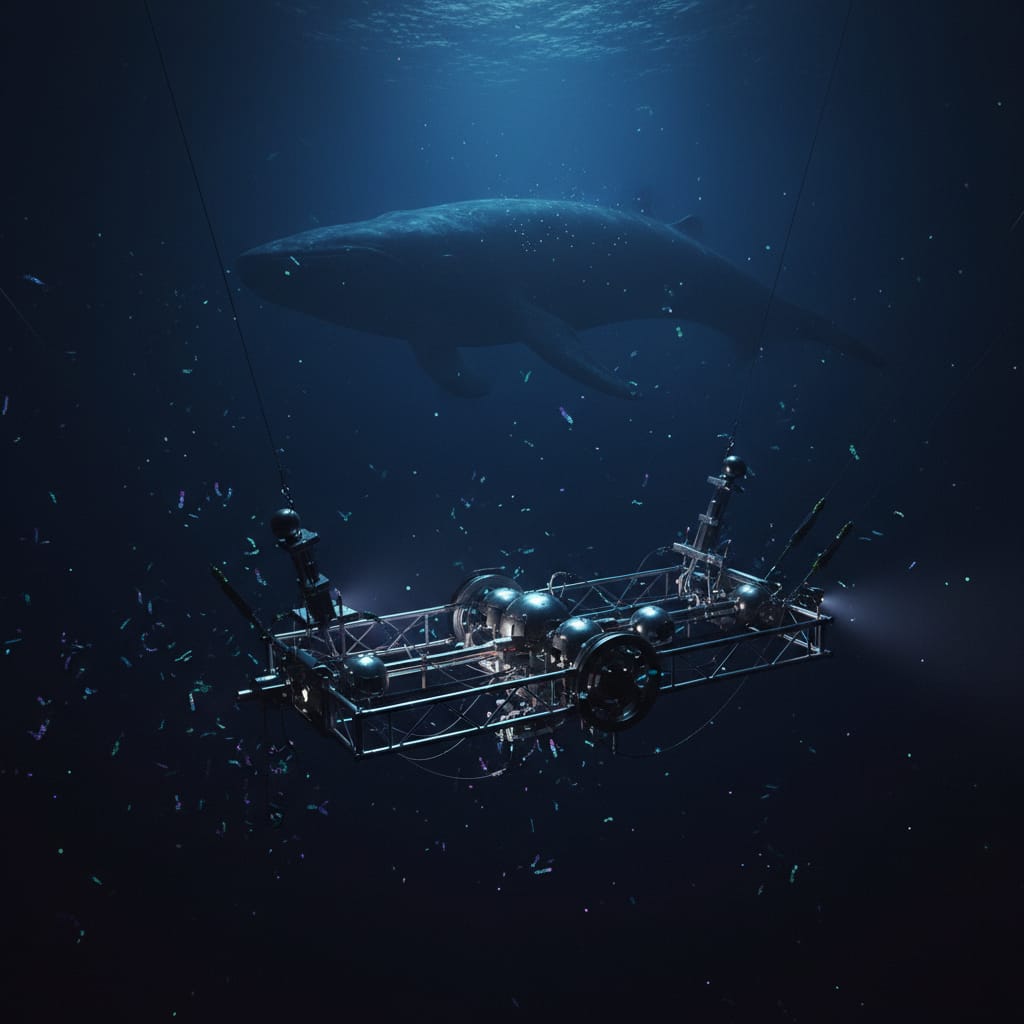
The ocean is the last place on Earth where monsters can still hide. When “The Bloop” was first recorded, it didn’t just register on sensors; it registered in our primal imagination. For a brief moment, science couldn’t rule out the impossible: a creature so large it defied biology. At Curioscope, we love this sound not because it might be a monster, but because it reminds us how little we actually know about our own planet. In the deep dark, mystery is the only thing we can see clearly.
The deep ocean, representing over 95% of Earth’s living space, remains humanity’s last true frontier, characterized by crushing pressure, perpetual darkness, and frigid temperatures. This vast, unexplored realm is home to life that adapts in unimaginable ways and harbors countless mysteries, including the enigmatic ultra-low frequency sound known as “The Bloop.”
The Enigmatic Bloop: A Symphony of the Unknown
- Discovery: In 1997, the U.S. National Oceanic and Atmospheric Administration (NOAA) recorded a series of powerful, ultra-low frequency sounds using its equatorial Pacific autonomous hydrophone array.
- Characteristics: The sound, dubbed “The Bloop,” was an “ultrasonic boom” – a rapid upsweep lasting about a minute, originating from a remote point south of Chile.
- Amplitude and Range: It was detected by hydrophones across over 5,000 kilometers, indicating a sound source of immense power, far exceeding that of any known animal.
- Exclusion of Known Sources: Initial analysis ruled out man-made sounds (submarines, bombs) and geological events (volcanoes, earthquakes) due to differing acoustic signatures.
- Biological Resemblance: The sound’s frequency pattern bore a striking resemblance to the vocalizations of large biological organisms, such as whales.
- Implication of Size: The Bloop’s sheer scale and volume suggested a creature far larger than even the blue whale, the largest known animal.
- Public Fascination: This sparked speculation about colossal, undiscovered marine beasts and became a symbol of the deep ocean’s vast unknowns.
Deep-Sea Acoustics: Listening to the Ocean’s Heartbeat
- Sound in Water: Sound travels approximately 4.5 times faster and further in water than in air, making it the primary sense for many deep-sea creatures.
- Hydrophones: Underwater microphones (hydrophones) are crucial tools for oceanographers to listen to the ocean’s acoustic landscape, detecting sounds from icebergs, earthquakes, ships, and marine life.
- Ocean Soundscape: The deep ocean is rich with sounds from whales, dolphins, fish, and shrimp.
- Marine Mammal Communication: Marine mammals, particularly blue whales, use low-frequency calls that can travel hundreds or thousands of kilometers for communication.
- Differentiating Sounds: Scientists face the challenge of distinguishing natural sounds from anomalous signals.
- Bloop’s Uniqueness: The Bloop’s extremely low frequency, high amplitude, and specific spectral signature made it stand out from typical marine mammal vocalizations or geological events, fueling the “super-organism” hypothesis.
Known Deep-Sea Giants: A Glimpse of What Is
- Colossal Squid (Mesonychoteuthis hamiltoni): Largest invertebrate by mass, reaching 10-14 meters (33-46 feet), with basketball-sized eyes.
- Giant Squid (Architeuthis dux): Longest invertebrate, up to 13 meters (43 feet) for females.
- Sperm Whale (Physeter macrocephalus): Largest toothed predator, diving to 2,250 meters (7,380 feet) to hunt squid. Reaches up to 20 meters (67 feet) and possesses the largest brain of any animal.
- Other Large Inhabitants: Includes certain shark species, giant isopods, and various deep-sea fish adapted to extreme environments.
- Comparison to Bloop: Even these known giants are dwarfed by the theoretical size of a creature capable of producing the Bloop’s sound.
Hypotheses for the Bloop’s Origin: From Icequakes to Biological Behemoths
Geological Origins:
- Icequakes: Cracking and fracturing of large icebergs or calving glaciers in the Southern Ocean can produce powerful, low-frequency sounds.
- Resonance: These sounds can resonate across vast distances in deep ocean sound channels.
- Limitations: While some similarities existed, the Bloop’s specific characteristics (rapid upsweep, unique spectral signature) made definitive attribution difficult.
- Other Geological Activity: Underwater avalanches or subtle tectonic shifts were also considered.
Biological (Unknown Creature):
- Captivating Hypothesis: The sound’s “biological” characteristics (varying frequency, short duration) fueled speculation of an unknown megafauna.
- Size Implication: The power of the sound suggested a creature several times the size of a blue whale, requiring a very large sound source for efficient energy generation.
- Deep-Sea Gigantism: This phenomenon, where deep-sea creatures grow larger than their shallow-water relatives, was cited as a potential factor.
- Modern Myth: The Bloop became a modern myth, symbolizing the ocean’s capacity for concealment and wonder.
Resolution (2002): NOAA published a study definitively linking the Bloop and similar sounds to the fracturing and melting of large icebergs. The complex acoustic signatures produced by massive icebergs under stress, especially when grounding or breaking, were found to be consistent with the Bloop’s characteristics.
Enduring Possibility: While the Bloop was identified as geological, the possibility of other, true biological leviathans in the unexplored deep sea persists.
Quick Quiz: Test Your Deep Ocean Knowledge!
What was the primary characteristic that made “The Bloop” sound so unique?
The Limits of Human Knowledge: A Vast, Uncharted Realm
- Unexplored Ocean: Over 80% of the ocean remains unmapped and unexplored, with better maps of Mars’ surface than Earth’s seafloor.
- Challenges to Exploration:
- Crushing Pressure: Pressure increases by approximately one atmosphere every 10 meters (33 feet). At the Mariana Trench’s bottom (nearly 11,000 meters), pressure is over 1,000 times that at sea level.
- Perpetual Darkness: Below the euphotic zone, absolute darkness prevails, requiring reliance on bioluminescence, chemosynthesis, or enhanced senses.
- Extreme Cold: Most of the deep sea is frigid, with temperatures just above freezing.
- Vastness and Accessibility: The sheer volume and distances make systematic exploration expensive, time-consuming, and technologically demanding.
- Symbolism of the Bloop: The Bloop emerged from this uncharted territory, symbolizing the profound mysteries that remain hidden.
Modern Deep-Sea Exploration: Peering into the Abyss
- Technological Advancements: Significant progress has been made through robotics, imaging, and data processing.
- ROVs and AUVs: Remotely Operated Vehicles (ROVs) and Autonomous Underwater Vehicles (AUVs) are essential for descending to extreme depths, collecting data, and mapping the seafloor.
- Manned Submersibles: Continue to provide direct, though limited, observation opportunities.
- Key Discoveries:
- New Species: Thousands of new species are identified annually, including bizarre fish and glowing jellyfish.
- Hydrothermal Vents: Ecosystems thriving on chemosynthesis, not photosynthesis, in extreme environments.
- Deep-Sea Coral Reefs: Extensive, ancient reefs in cold, dark waters supporting diverse species.
- Seafloor Mapping: High-resolution sonar is revealing unknown mountain ranges, canyons, and trenches.
- Reinforcement of Potential: Discoveries of large species like the amphipod Alicella gigantea (up to 30 cm) and “supergiant” crustaceans reinforce the potential for undiscovered massive life forms.
The Future of Deep-Sea Discovery: A Continuous Quest
- Advanced Autonomous Systems: Future exploration will utilize more sophisticated autonomous systems for longer durations and larger area coverage.
- AI and Machine Learning: Crucial for processing vast data, identifying patterns, and directing exploration.
- Integrated Sensing Technologies: Combining acoustics, imaging, chemical analysis, and genetic sequencing for a holistic view.
- Deep-Sea Observatories: Permanent installations with sensor arrays and hydrophones for continuous monitoring and detection of new phenomena.
- Importance of Deep-Sea Understanding: Critical for climate regulation, biodiversity, and resource management.
- Threats to Ecosystems: Climate change, pollution, and deep-sea mining pose risks to fragile deep-sea environments.
- Responsible Exploration: An imperative to pursue knowledge without harming these pristine environments.
The Enduring Allure of the Unknown
- Human Curiosity: The fascination with phenomena like the Bloop stems from an innate human curiosity about the unknown.
- Last Bastions of Mystery: The deep ocean remains one of the last truly mysterious places in an increasingly mapped world.
- Imagination and Wonder: It serves as a canvas for imagination, where unbelievable possibilities might exist, tapping into primal fears and wonders.
- Persistence of Mystery: Even with scientific explanations, the allure of the unknown persists, with new mysteries emerging from resolved ones.
- Pushing Boundaries: The deep sea challenges technological capabilities and ignites the spirit of exploration.
- Metaphorical Space: The ocean’s depths represent humanity’s endless quest for knowledge and understanding, a testament to ongoing discovery.
- Redefining Understanding: The possibility remains that future echoes from the abyss could redefine our understanding of life itself.
Editor’s Reflection
Even if “The Bloop” was just ice breaking, the thrill it gave us was real. It tapped into a fundamental truth: we are small, and the ocean is vast. We have mapped the moon more thoroughly than our own seabed. Perhaps we need these mysteries. They humble us. They remind us that for all our satellites and sensors, there are still places on this blue marble where we are not the masters, but merely guests in the dark.
The Enigma of Flight 305: Unmasking the Skyjacker Who Vanished with $200,000