
Deconstructing the Tartarian Empire Conspiracy Theory
Curioscope’s Lens
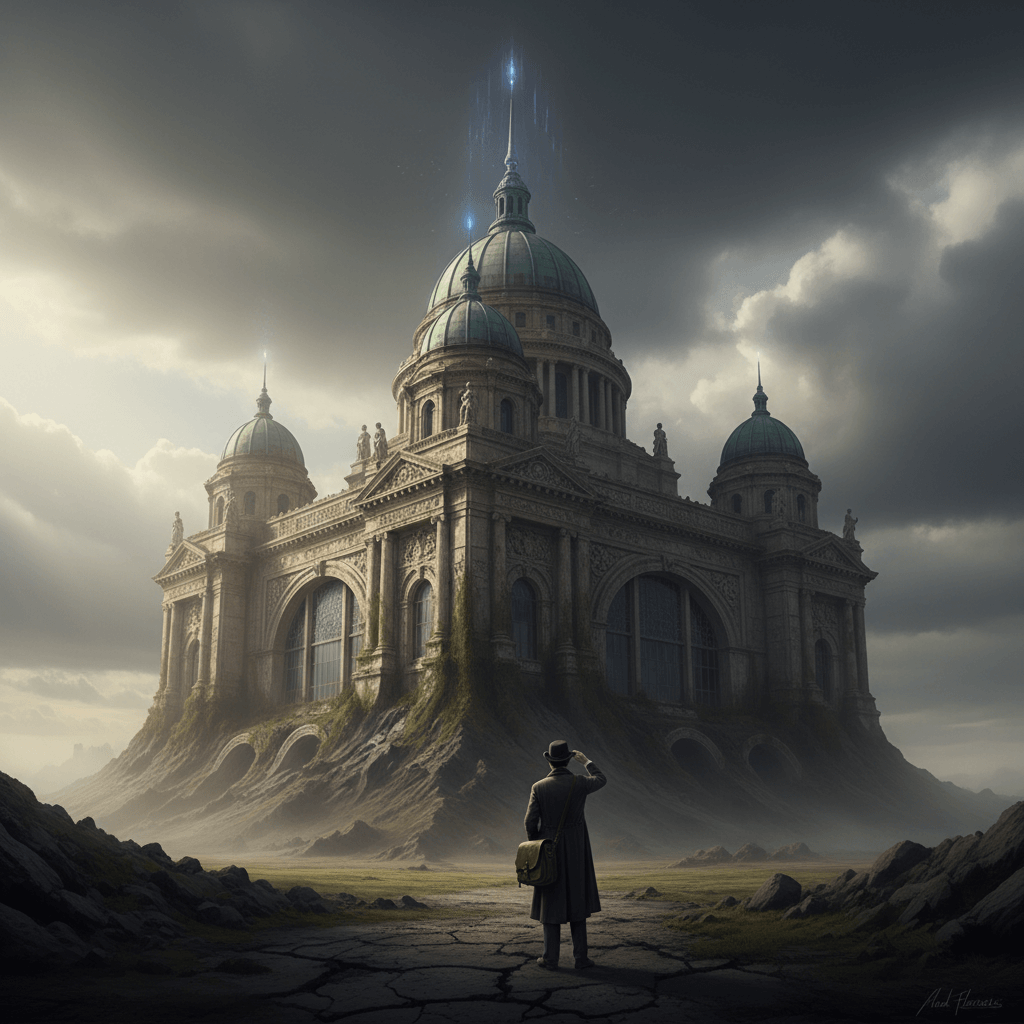
The Tartaria theory is fascinating not because it’s true, but because it reveals a deep, collective “aesthetic grief.” We look at the impossible beauty of cathedrals and capitols and feel a sense of loss compared to today’s utilitarian glass boxes. It is psychologically easier to believe that a utopia was stolen from us by a shadowy cabal than to accept the mundane reality: that we simply traded ornamentation for efficiency and cost-effectiveness. Tartaria isn’t history; it’s a fairy tale for a disenchanted world.
The Tartaria theory is fascinating not because it’s true, but because it reveals a deep, collective “aesthetic grief.” We look at the impossible beauty of cathedrals and capitols and feel a sense of loss compared to today’s utilitarian glass boxes. It is psychologically easier to believe that a utopia was stolen from us by a shadowy cabal than to accept the mundane reality: that we simply traded ornamentation for efficiency and cost-effectiveness. Tartaria isn’t history; it’s a fairy tale for a disenchanted world.
This blog post explores the “Tartarian Empire conspiracy theory,” an online phenomenon that posits the existence of a vast, technologically advanced global civilization called Tartaria, which was allegedly erased from official historical records. The theory taps into a fascination with hidden pasts and suppressed truths, offering a vision of a sophisticated civilization with advanced architecture and technology that far surpasses conventional historical understanding. The post aims to differentiate between the historical term “Tartary” and the conspiratorial narrative, examine the theory’s origins and core tenets, dissect its “evidence,” and critically assess these claims against established historical and archaeological knowledge. It also explores the psychological and sociological factors contributing to the theory’s appeal in the digital age.
The Genesis of the Tartarian Empire Theory
- Core Premise: The theory suggests a magnificent, global civilization named Tartaria once existed, possessing advanced technology (like “free energy” or atmospheric electricity) and a unique architectural style. This empire allegedly fell or was destroyed, and its existence was systematically expunged from historical records by an elite group or through a “reset event.”
- Modern Origins: The conspiracy theory is relatively recent, emerging prominently in the early 21st century, largely driven by online communities, YouTube, social media, and independent blogs. It combines genuine historical curiosities, misinterpretations of architecture, selective map readings, and distrust of official narratives.
- Historical “Tartary”: Historically, “Tartary” was a broad European geographical designation used from the Middle Ages to the 19th century for a vast, ill-defined region of Central and Northern Asia. It was inhabited by various Turkic and Mongol peoples and was not a single, unified empire but a catch-all term for lands east of the Caspian Sea and north of China. Proponents of the conspiracy theory reinterpret this term as evidence of a singular, monolithic empire.
Key Tenets and Alleged “Evidence” of the Tartarian Conspiracy
1. The “Mud Flood” Phenomenon
- Claim: Many historical buildings worldwide appear partially buried, with their lower stories submerged. This is attributed to a global cataclysmic “mud flood” or “great reset” that buried Tartarian cities, forcing survivors to build new ground levels on top.
- “Evidence” Cited: Buildings with windows starting just above ground level or disproportionately large basement windows. Cities like St. Petersburg and many North American cities are frequently highlighted.
2. Advanced Architecture and “Free Energy”
- Claim: The alleged Tartarian empire possessed architectural and technological capabilities far exceeding those attributed to their supposed eras. Buildings from the 18th, 19th, and early 20th centuries (state capitols, world’s fair halls, cathedrals) are presented as examples of Tartarian craftsmanship.
- Interpretation: Ornate spires, domes, and statues are seen as functional components of an advanced “free energy” system, acting as antennas for atmospheric electricity or “Vril energy.”
- Destruction: The destruction of such buildings during wars (WWI, WWII) or urban renewal is interpreted as a deliberate act to erase Tartarian remnants.
3. Star Forts as Tartarian Outposts
- Claim: The distinctive geometric designs of star forts (fortifications with multiple bastions) are seen as undeniable proof of a worldwide, unified Tartarian civilization.
- Argument: Their global distribution and complexity suggest a single advanced civilization, not individual nation-states adapting a common defensive style.
4. The “Great Reset” and Suppressed History
- Claim: A powerful, shadowy cabal orchestrated a global event (mud flood, wars, famines) leading to Tartaria’s collapse.
- Revisionism: Following the collapse, the cabal allegedly initiated a massive historical revision project, rewriting textbooks, fabricating timelines, and destroying evidence of the true past to keep humanity ignorant.
- Maps: Old maps showing “Tartary” are presented as fragmented evidence of the cover-up.
Quick Check: Tartarian Theory
Is “Tartary” (as described in historical maps) a term for a single, unified global empire with advanced technology, or a broad geographical designation for a region of Central and Northern Asia?
Differentiating Historical Tartary from Conspiratorial Tartaria
Historical Tartary
- A general European term for a vast, loosely defined region of Asia (13th-19th centuries).
- Encompassed areas inhabited by various nomadic and semi-nomadic Turkic and Mongol peoples.
- Included sub-regions like “Independent Tartary,” “Chinese Tartary,” and “Muscovite Tartary.”
- Reflected European geographic knowledge and colonial interests, not a single unified empire.
- Areas within historical Tartary were home to powerful, distinct empires and khanates (e.g., Golden Horde, Timurid Empire) but not a singular “Tartarian Empire.”
- The term disappeared from maps due to refined cartography, increased exploration, and the rise of precise geopolitical boundaries.
Conspiratorial Tartaria
- A construct that repurposes the historical term.
- Imbues “Tartary” with global reach, advanced technology, a unified government, and a catastrophic, deliberately suppressed demise.
- Lacks archaeological, historical, or primary textual evidence to support its existence.
- No Tartarian coinage, literature, unified government archives, or universally recognized language/script commensurate with such a civilization.
- Relies on reinterpreting existing evidence through a conspiratorial lens rather than deriving conclusions from verifiable primary sources.
Deconstructing the “Evidence” from a Skeptical Perspective
1. The “Mud Flood” Re-examined
- Sedimentation and Urban Development: Cities naturally accumulate layers of debris, soil, and new construction, causing street levels to rise over centuries.
- Basements and Cellars: Many historical buildings were intentionally built with basements or cellars for various purposes, with windows designed for light and ventilation.
- Changing Architectural Styles and Functions: Buildings might be constructed on sloped sites or adapted to changing urban landscapes.
- Grading and Landscaping: New road construction or public space development can alter ground levels around existing structures.
- Localized Flooding: Regional floods can deposit sediment, but these are not global events and leave distinct geological signatures.
2. Grand Architecture and the Industrial Revolution
- Architectural Styles: Buildings often exemplify styles like Neoclassicism, Beaux-Arts, and Gothic Revival, popular during periods of national pride and economic growth.
- Technological Innovations: The Industrial Revolution introduced new materials (steel, concrete) and construction techniques (steam power, mass production) enabling larger, more complex, and ornate buildings.
- Skilled Labor and Immigration: Rapid urban expansion attracted vast numbers of skilled craftsmen and laborers.
- World’s Fairs: These events showcased contemporary architectural and technological achievements, not remnants of a forgotten empire.
- “Free Energy” Claims: The idea of “free energy” powering these buildings lacks scientific basis; technology of the time relied on conventional energy sources. Spires and domes were architectural elements.
3. Star Forts: Military Engineering
- Origin: Developed in Italy in the 15th century as a response to gunpowder artillery.
- Design: Angled bastions eliminated blind spots and allowed for enfilading fire, providing optimal defense.
- Global Spread: The design spread globally through European military engineering and colonial expansion, becoming a standard fortification type.
- Explanation: Their global presence signifies the widespread adoption of a successful military innovation, not the footprint of a single empire.
The Psychology of Conspiracy and the Digital Age
- Distrust of Institutions: A general distrust of governments, media, and academia makes individuals receptive to alternative explanations.
- Sense of Empowerment: Discovering a “hidden truth” can provide a sense of intellectual superiority and being “in the know.”
- Community and Belonging: Online communities offer shared purpose and reinforce beliefs, creating echo chambers.
- Cognitive Biases: Confirmation bias and anecdotal reasoning play significant roles, facilitated by the internet’s selective dissemination of information.
- Allure of Grand Narratives: Humans are drawn to comprehensive, dramatic stories that offer explanations for complex phenomena.
- Aesthetic Appeal: The imagery associated with Tartaria (grand architecture, ancient maps) is visually appealing and lends itself to online content.
Conclusion
The Tartarian Empire conspiracy theory, while romantically appealing, lacks substantiation through rigorous historical, archaeological, and scientific scrutiny. The historical term “Tartary” refers to a geographical region, not a global empire. The “anomalies” cited by proponents can be explained by established historical, engineering, and scientific principles. Critical engagement with such theories, differentiating documented history from speculative narratives, is crucial for navigating the contemporary information landscape.
Editor’s Reflection
While it’s fun to imagine hidden empires, the real danger of the Tartaria theory is that it robs our actual ancestors of their achievements. By claiming that 19th-century builders couldn’t possibly have constructed such grandeur, we underestimate human ingenuity and grit. The “mud flood” didn’t bury history; our own forgetfulness did. The true wonder isn’t some lost technology, but what ordinary people can build with simple tools and extraordinary vision.