
Ancient Mysteries Journal
Exploring the Unseen, Unraveling the Unknown
Ethiopia’s Holy Secret: Unraveling the Legend of the Ark of the Covenant’s True Home
A journey through history, faith, and one of the world’s most enduring mysteries.
Curioscope’s Lens
Why does the Ark of the Covenant captivate us so deeply? It is more than just a biblical artifact; it represents the tangible intersection of the divine and the human. At Curioscope, we are constantly drawn to the gaps in history—the places where records end and legends begin. Among all the theories of the Ark’s resting place, the Ethiopian claim stands out not just for its audacity, but for the unwavering conviction of those who guard it. Join us as we step beyond the veil of history to explore a secret kept for millennia.
The Ark of the Covenant, a sacred chest containing the Ten Commandments, was the most revered object of ancient Israel, symbolizing God’s presence. Its power was legendary, but it vanished from historical records, leading to speculation. The most compelling claim is that it now resides in Axum, Ethiopia. This post will examine the Ark’s origins, its disappearance from Jerusalem, the narrative of the *Kebra Nagast*, and the traditions of the Ethiopian Orthodox Tewahedo Church.
The Ark’s Genesis: Power, Presence, and Prophecy
- Origin: God instructed Moses on Mount Sinai to construct the Ark from acacia wood, overlaid with pure gold, and adorned with golden cherubim.
- Contents: Traditionally held the stone tablets of the Ten Commandments, Aaron’s staff, and a pot of manna.
- Significance: Embodied the covenant between God and His people, representing divine law, priestly authority, and God’s miraculous provision.
- Role in Israelite History: Led Israelites through the wilderness, parted the Jordan River, caused the walls of Jericho to collapse, and was carried into battle, guaranteeing victory. Its presence signified God’s immediate presence.
- Reverence and Danger: Touching it without authorization resulted in death (e.g., Uzzah).
- Location: Resided in the Tabernacle, then brought to Jerusalem by King David and housed in the Holy of Holies of Solomon’s First Temple.
The Vanishing Act: The Ark’s Disappearance from Jerusalem
- Biblical Silence: The biblical narrative becomes silent about the Ark’s fate after its enshrinement in Solomon’s Temple.
- Last Mention: Last clear reference is within the Temple during King Josiah’s reign (late 7th century BCE).
- Babylonian Sack: When Nebuchadnezzar sacked Jerusalem and destroyed Solomon’s Temple in 586 BCE, the Ark was conspicuously absent from the list of plundered treasures taken to Babylon.
- Theories of Disappearance:
- Plundered and Destroyed/Concealed: Its spiritual significance led to its destruction or concealment, making it unworthy of mention.
- Hidden by Priests: Concealed in subterranean chambers beneath the Temple Mount, possibly by Josiah or Jeremiah, awaiting restoration.
- Destroyed by Babylonians: An act of desacralization to crush Judean spirit.
- Lack of Evidence: No definitive archaeological evidence has been found in Jerusalem or surrounding regions to support these theories. This vacuum allows the Ethiopian narrative to flourish.
The Kebra Nagast: Ethiopia’s Epic Narrative
- Content: The *Kebra Nagast* (“The Glory of Kings”) is the national epic and religious text of the Ethiopian Orthodox Tewahedo Church, compiled around the 14th century CE from earlier traditions.
- Narrative: Details the journey of the Ark from Jerusalem to Ethiopia.
- Queen of Sheba and Solomon: Makeda, the Queen of Sheba, visits King Solomon, leading to the birth of their son, Menelik I.
- Menelik’s Return: Menelik travels to Jerusalem, and Solomon arranges for the firstborn sons of Israel’s nobles and priests to accompany him back to Ethiopia.
- The Ark’s Transfer: Azariah, son of Zadok the High Priest, and companions secretly replace the true Ark with a replica, believing God intended the Ark to move to a purer land. They carry the genuine Ark out of the Temple under cover of night.
- Journey to Axum: The *Kebra Nagast* describes miraculous occurrences during their journey.
- Establishment of Solomonic Dynasty: Upon arrival in Axum, the Ark is received with reverence. Menelik I establishes the Solomonic dynasty, claiming direct lineage from Solomon and Sheba.
- Divine Orchestration: The event is portrayed not as theft but as a divinely orchestrated transfer, signifying God’s shift of favor to Ethiopia. This narrative grants the Ethiopian monarchy sacred legitimacy.
- Belief: For Ethiopians, the *Kebra Nagast* is a foundational historical and spiritual truth.
Axum and the Ethiopian Orthodox Tewahedo Church: Custodians of the Sacred
- Axum’s Role: Spiritual heart of Ethiopia and purported home of the Ark of the Covenant for over a millennium.
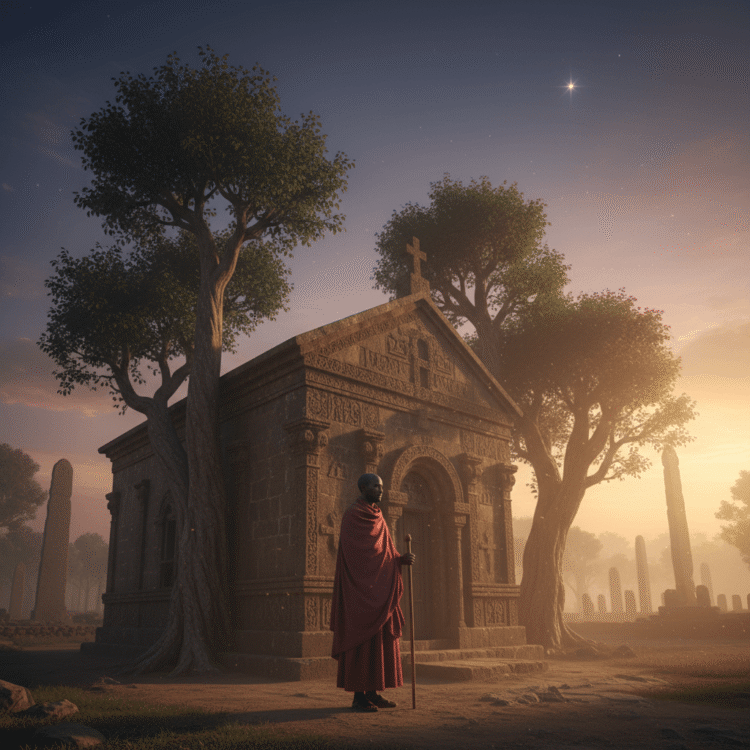
- Church’s Tradition: The Ethiopian Orthodox Tewahedo Church upholds the tradition that the Ark resides in the Chapel of the Tablet, next to the Church of Our Lady Mary of Zion.
- Guardianship: Only one specially chosen monk, the ‘Guardian of the Ark’ (*Abuna Herya*), is permitted to enter the chapel and attend to the Ark. This monk is chosen for life and cannot leave the chapel grounds.
- Tabots: Every Ethiopian Orthodox church contains a *tabot* (consecrated slab), considered a replica of the Ark. These are carried in processions, symbolizing the divine Ark’s presence.
- Commitment to Protection: The Church has fiercely protected the Ark through centuries of conflict and persecution.
- Basis of Belief: Unbroken oral tradition, the *Kebra Nagast*, and profound faith, rather than external validation or archaeological proof.
- Living Presence: For Ethiopians, the Ark is a living presence, a divine guarantee of God’s covenant with Ethiopia.
Historical and Archaeological Scrutiny of the Ethiopian Claim
- Lack of Independent Evidence: The primary challenge is the absence of independent, corroborating evidence for the *Kebra Nagast*’s narrative.
- Archaeological Findings: No physical evidence from Axum or Ethiopia definitively links to the biblical Ark. The Chapel of the Tablet is relatively modern.
- Dating of Kebra Nagast: Compiled in the 14th century CE, over two millennia after the purported events, raising questions about historical accuracy.
- Biblical and Jewish Sources: Silence in Jewish and early Christian sources regarding the Ark’s whereabouts after the First Temple’s destruction is a significant point of contention.
- Replica Theory: The detailed account of the Ark’s replacement with a replica lacks parallel in other texts.
- Absence of Proof vs. Disproof: The lack of external evidence does not necessarily equate to disproof, especially for deeply held religious traditions.
- Sanctity and Secrecy: The Ethiopian Church maintains the Ark’s sanctity demands secrecy and protection from skeptical eyes.
- Faith-Based Evidence: The faithful consider their unbroken oral tradition and the *Kebra Nagast* sufficient proof.
- Tension: The debate highlights the tension between empirical methodologies and faith-based traditions.
- Living Testimonies: Reverence, pilgrimages, *tabot* processions, and identity rooted in the Ark’s presence are seen as living testimonies.
Alternative Theories and Lingering Mysteries
- Hidden by Priests: Some Jewish traditions suggest concealment in a secret chamber beneath the Temple Mount by King Josiah or Jeremiah before the Babylonian siege. Excavations have been inconclusive.
- Destroyed by Babylonians: The Ark might have been destroyed or melted down by the Babylonians, its spiritual significance or limited material value rendering it unmentioned in plunder lists.
- Taken to Egypt: Speculation exists that it was transported to Egypt for safekeeping or seized during an Egyptian invasion, but lacks definitive Egyptian records or archaeological finds.
- Essenes and the Copper Scroll: The Copper Scroll, listing hidden treasures, has led to speculation, but lacks direct reference to the Ark.
- Enigma’s Impact: The lack of evidence for these theories reinforces the Ethiopian claim as the most detailed and strongly held tradition. The Ark’s disappearance remains one of history’s greatest unsolved puzzles.
The Enduring Impact: Faith, Culture, and Identity
- Living Presence: For Ethiopian Orthodox Christians, the Ark in Axum is a living presence, bestowing divine favor and signifying God’s covenant with Ethiopia.
- Spiritual Education and Heritage: The *Kebra Nagast* is taught from childhood, forming an integral part of spiritual education and national heritage.
- Foreign Relations and National Pride: Ethiopian emperors, claiming lineage from Menelik I, used the Ark connection to legitimize rule and assert divine right. It was seen as a protector of the realm.
- Global Fascination: The Ark’s mystique draws pilgrims and curious minds to Axum, contributing to Ethiopia’s unique global standing.
- Inspiration: The legend has inspired books, documentaries, and films, cementing its place as an iconic treasure. It taps into a universal fascination with lost artifacts and the divine.
- Cultural and Spiritual Impact: A testament to belief, tradition, and how sacred objects define and sustain identity.
- Timeless Vigil: The secret of the Ark remains in Axum, a symbol of ancient faith resisting modern skepticism.
Conclusion: The Ark’s Enduring Legacy
The Ark of the Covenant, whether a physical artifact or a powerful symbol, remains a profound mystery. The Ethiopian Orthodox Tewahedo Church offers a compelling narrative of its presence in Axum, guarded by a solitary monk, symbolizing God’s enduring covenant with Ethiopia. For believers, it is a source of spiritual power and national pride. For skeptics, it is a case study in religious conviction and tradition. The Ark’s legend highlights the potent role of sacred objects in shaping societies, fostering beliefs, and providing connection to the divine. The secret of the Ark continues its timeless vigil at the crossroads of faith and legend.
Editor’s Reflection
As we conclude this journey, a question lingers: Does the physical presence of the Ark truly matter more than the faith it inspires? Science demands empirical proof, yet the monks of Axum offer something perhaps more resilient—an unbroken chain of guardianship that has survived empires. Personally, I find the mystery itself to be the treasure. If the Ark were revealed to the world tomorrow, stripped of its legend by scientific instruments, would it lose its sanctity? Perhaps some secrets are meant to remain hidden, protecting not just the object, but the wonder it instills in us all. What do you believe lies behind the doors of the Chapel of the Tablet?
Test Your Knowledge: The Ark of the Covenant Quiz!
1. The Ark of the Covenant is widely believed to contain the original tablets of the Ten Commandments.
2. The Kebra Nagast is an ancient Greek text that describes the Ark’s journey to Ethiopia.
3. In Axum, Ethiopia, only one specially chosen monk is permitted to see the Ark of the Covenant.