
Born Without Parents: Are We Brewing “Soulless” Humans in a Petri Dish?
No Egg, No Sperm, Just Science. Welcome to the Era of Synthetic Life.
Curioscope’s Lens
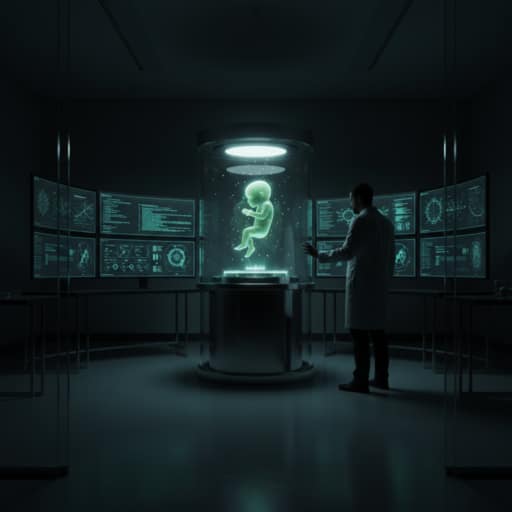
The creation of synthetic human embryos from stem cells, bypassing egg and sperm, prompts a re-examination of human existence and identity. These lab-grown entities, termed blastoids or synthetic embryo models, mimic early human development, raising profound moral and philosophical questions about the essence of humanity, the origin of life, and the potential for future generic cloning. The research aims to understand infertility, genetic disorders, and miscarriages, while reducing reliance on natural human embryos. In animal models, these structures have developed precursors for the placenta, yolk sac, embryo, beating heart, and brain foundations.
Scientific Advancements and Motivations
Achievement:
Successful generation of synthetic human embryos from pluripotent stem cells.
Mechanism:
Stem cells self-organize to form structures resembling the blastocyst stage.
Significance:
Provides an unprecedented window into the “black box” period of early human development, previously inaccessible due to ethical and practical limitations.
Motivations:
- Unraveling mysteries of infertility.
- Illuminating origins of genetic disorders and recurrent miscarriages.
- Developing novel diagnostic tools and therapeutic strategies.
- Reducing reliance on natural human embryos for research.
Developmental Potential (Animal Models):
Formation of precursors for placenta, yolk sac, embryo, beating heart, and foundational brain elements.
Ethical and Philosophical Quandaries
Moral Status:
Debate over whether synthetic embryos should receive the same moral and legal protections as naturally conceived embryos, especially as they become more sophisticated.
Depersonalization:
Concerns about the “depersonalization” of early human life and the instrumentalization of potential life for experimental purposes.
The 14-Day Rule:
Historical Context: A guideline limiting human embryo research to prevent development beyond the primitive streak formation (precursor to the nervous system), partly due to the concept of “individuation” (inability to split into identical twins after 14 days).
Challenge: Synthetic embryo models are not created by fertilization, raising questions about their applicability to this rule. Some ethicists argue for reassessment to prevent an ethical vacuum.
The Concept of a “Soul”:
Varied Definitions: Diverse interpretations across Christianity, Judaism, Hinduism (atman), Buddhism (anattā), and philosophy (Plato, Epicurus, Aristotle).
Implication for Synthetic Embryos: Questions arise whether lab-created entities can possess a soul if it’s divinely gifted or tied to natural conception.
Fear of “Soulless” Humans: Deeply unsettling, touching upon fundamental understandings of dignity and moral worth. Concerns about creating beings in a moral limbo if they gain sentience or viability.
Synthetic Embryos vs. Human Cloning
Synthetic Embryos:
Derived from stem cells, mimic early development for research, currently non-viable, cannot lead to live birth, lack crucial elements of natural embryos (zona pellucida), do not originate from oocyte/sperm/zygote, have differing developmental pathways, and can be maintained for approximately nine days.
Human Cloning:
Aims to create a genetically identical copy of an existing human.
Therapeutic Cloning: Creates cloned embryos for stem cell harvesting to treat diseases.
Reproductive Cloning: Seeks to create a living human being genetically identical to another. Condemned and illegal in most countries due to ethical and safety concerns.
“Generic Cloning Factories”:
The idea of viable, “soulless” synthetic humans is currently science fiction, not scientific fact, due to the non-viability and developmental limitations of current synthetic embryos.
Knowledge Check: True or False?
Potential Exploitation and Consent
Risk of Exploitation:
If technologies advance to create viable human-like entities, risks of individuals being created for specific purposes (organ harvesting, experimental use) violate human rights and dignity.
Stem Cell Source:
Ethical questions arise if embryonic stem cells are used.
Consent:
Clear and explicit consent from cell donors regarding the potential uses of their biological material, including the creation of embryo models, is paramount.
Regulatory Landscape and Global Confusion
United Kingdom:
Synthetic embryos, not created by fertilization, technically fall outside the strict definition of “human embryos” under existing law, potentially allowing research beyond 14 days, though voluntary guidelines exist.
Canada:
Explicitly includes synthetic human embryos in regulations, limiting research to 14 days for purposes related to improving assisted reproduction.
United States:
Lacks specific federal regulations; federal funding for such research is prohibited. Most scientists voluntarily adhere to the 14-day moratorium.
International Society for Stem Cell Research (ISSCR):
Suggested potential relaxation of the 14-day rule on a case-by-case basis with strong scientific justification, but no country has formally adopted this.
Overall:
Varying stances highlight global ethical and legal confusion.
Re-evaluation of Human Identity
Genetic Uniqueness vs. Individuality:
While genetic identity is fundamental, individuality is shaped by environment, experiences, and choices.
Psychological Burdens of Cloning:
A cloned person might face burdens of being perceived as a “copy,” potentially infringing on autonomy.
Societal Implications:
Challenges traditional understandings of family structures, reproduction, and lineage.
Impact of Genetic Alterations:
Questions about how fundamental genetic alterations impact mental identity, consciousness, and sense of self.
Call for Collective Moral Deliberation
Stakeholders:
Scientists, ethicists, policymakers, religious leaders, and the public must be involved.
Need for Frameworks:
Urgent need for robust ethical and legal frameworks.
ISSCR Role:
Proactively developing guidelines and advocating for specialized scientific and ethics review processes.
Balancing Act:
Maximizing research benefits (understanding development, addressing infertility, combating genetic diseases) while upholding human dignity and preventing misuse.
Responsibility:
The journey into synthetic human embryos is a testament to human ingenuity but demands thoughtful navigation of a complex ethical landscape. The “black box” of early human development is yielding secrets, but the “black box” of what it means to be human in this new era remains mysterious.
Editor’s Reflection
We have reached a moment that Mary Shelley could only dream of in her darkest nightmares. The ability to craft a beating heart from a petri dish forces us to confront the most terrifying question of our existence: Is the “soul” a divine spark, or merely a biological byproduct?
If we create a being that looks like us, bleeds like us, and perhaps one day thinks like us, but was never “born” in the traditional sense, have we created a monster or a miracle? The silence of these synthetic embryos is deafening. It screams that biology is becoming programmable code.
At Curioscope, we believe the danger lies not in the “soullessness” of these creations, but in the potential soullessness of their creators. As we tear down the wall between the natural and the artificial, we must ensure that in our rush to become gods, we do not lose our own humanity. The test tube is no longer just for science; it is now a mirror. And we might be afraid of what we see looking back.