
The Stone That Spoke: Deciphering the Silence of Three Millennia
🏛 Curator’s Note
For three millennia, Ancient Egypt built wonders that touched the sky. Yet for 1,400 years, its written voice was silent, trapped behind a veil of misunderstanding. This is the story of the key—a fractured stone—and the intellectual duel between two brilliant minds that unlocked a lost civilization and gave a voice back to history itself.
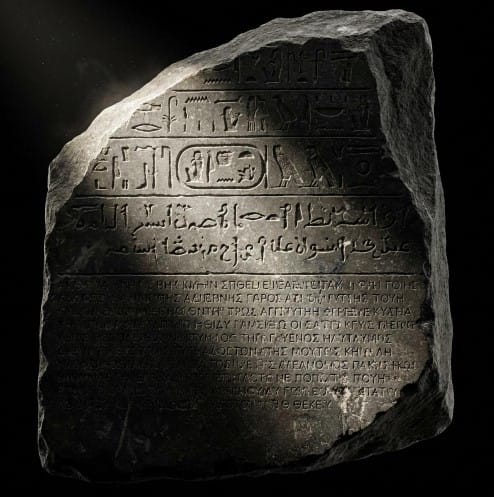
Imagine a library containing the records of a civilization spanning 3,000 years. Now imagine the key to that library was lost for another 1,400. The monumental temples, the cryptic tombs, the silent sphinx—all became mute relics of a culture whose voice had been extinguished. This was the state of Egyptology before a chance discovery in the Nile Delta during the heat of a Napoleonic campaign.
I. The Fort in the Delta: An Accidental Resurrection
In the summer of 1799, amidst Napoleon’s ambitious Egyptian Campaign, a group of French soldiers under Lieutenant Pierre-François Bouchard were reinforcing the defenses of Fort Julien near the port town of el-Rashid, known to Europeans as Rosetta. Embedded in an old wall was a slab of dark, granodiorite stone, unremarkable except for the dense inscriptions covering its surface. It was immediately clear this was no ordinary building block. The stone bore three distinct bands of text: the elegant, pictorial script of hieroglyphs at the top (badly damaged), a cursive script in the middle known as Demotic, and, crucially, a fully legible section of Ancient Greek at the bottom. The officers present, many of whom were educated members of Napoleon’s *Commission des Sciences et des Arts*, understood the implication instantly: if the three scripts contained the same message, this stone was a potential key—a linguistic bridge to the lost world of the pharaohs.
II. The Decree of Memphis: A Bureaucratic Key
The great secret unlocked by the Rosetta Stone was not a profound philosophical text or a mythical epic. It was, rather, a mundane piece of bureaucratic administration. The inscription is a decree passed by a council of priests in Memphis in 196 BC, affirming the royal cult of the 13-year-old King Ptolemy V Epiphanes on the first anniversary of his coronation. It lists his pious deeds, such as giving gifts to the temples and granting tax exemptions to the priesthood, and in return, the priests pledge their loyalty. The most vital part was what scholars now call the “Rosetta Clause,” which mandated that the decree be inscribed “in sacred [hieroglyphs], native [Demotic], and Greek characters” and set up in all major temples. The stone in our possession is just one of many such stelae, a fragment that survived the ages.
III. The Intellectual Duel: The Polymath vs. The Prodigy
After the French surrender to British forces in 1801, the stone became property of the British Crown and found its permanent home in the British Museum. Plaster casts and lithographic copies were distributed across Europe, igniting an intellectual arms race. Two brilliant minds emerged as the main rivals: Dr. Thomas Young in England and Jean-François Champollion in France.
Young, a polymath known for his work on the wave theory of light, approached it as a code-breaker. He correctly deduced that the Demotic script was a cursive form derived from hieroglyphs and identified that the royal names, enclosed in oval rings called cartouches, were written phonetically. He successfully isolated the sounds for “P-T-O-L-M-E-S” (Ptolemy). However, he was hampered by the prevailing belief that hieroglyphs were purely symbolic ideograms; he thought phonetic spelling was only used for foreign rulers’ names.
Champollion, on the other hand, was a linguistic prodigy obsessed with Egypt since childhood. His secret weapon was his profound knowledge of Coptic, the liturgical language of Egyptian Christians, which he correctly theorized was the direct descendant of the ancient Egyptian language. While Young saw a code, Champollion saw a living, breathing language waiting to be reawakened.
IV. The Breakthrough: “Je tiens l’affaire!”
The turning point came in September 1822. Champollion was studying copies of cartouches from the temple at Abu Simbel, which predated Greek and Roman rule. If Young’s theory was correct, these native pharaohs’ names should be purely symbolic. He examined a cartouche containing a sun disk (⊙), a crook-like symbol (𓄟), and two repeating signs (𓋴𓋴). Knowing from his Coptic studies that the word for “sun” was “Ra,” he tentatively assigned that sound to the first symbol. The middle symbol was familiar from the name Ptolemy, representing an ‘m’ sound. He hypothesized ‘Ra-mes-s’—Ramesses, a legendary pharaoh. He quickly turned to another cartouche containing an ibis (a symbol for the god Thoth) and the same ‘mes-s’ characters: Thoth-mes-s—Thutmose. It all clicked into place. The system wasn’t purely symbolic or purely phonetic; it was a complex, beautiful hybrid of both. Overcome with excitement, he burst into his brother’s office, cried out, “Je tiens l’affaire!” (“I’ve got it!”), and promptly collapsed, remaining unconscious for five days.
V. Unlocking the Library of History
Weeks later, Champollion published his findings in the *Lettre à M. Dacier*, outlining the fundamental principles of the hieroglyphic system. He explained that it was composed of phonograms (signs representing sounds), ideograms (signs representing whole concepts), and determinatives (silent signs placed at the end of a word to clarify its meaning, like distinguishing between a river and a person with the same name). Suddenly, the inscriptions on obelisks, papyri, and temple walls were no longer just decoration. They were history. For the first time, scholars could read the Turin King List, accounts of the Battle of Kadesh, and the personal letters of scribes and artisans. Egypt was transformed from a land of myth into a civilization with a recorded, human history.
VI. A Legacy Etched in Stone
Champollion’s relentless work took a toll on his health, and he died in 1832 at the age of just 41, his great Egyptian Grammar published posthumously. He did not simply decipher a script; he resurrected a culture. The Rosetta Stone, a decree meant to secure a boy king’s legacy, ultimately secured the legacy of an entire civilization. It stands today not just as a repository of three ancient texts, but as a timeless monument to human curiosity, intellectual perseverance, and the profound power of language to conquer the silence of millennia.
Knowledge Check
Curator’s Final Reflection: The Irony of the Stone
As we reflect on the Rosetta Stone, we encounter a delightful historical irony. This black slab, arguably the most important archaeological object in the world, is not a poem, a philosophy, or a secret map. It is, in essence, a bureaucratic tax receipt—a political compromise between a teenage king and a powerful priesthood. It is mundane administration carved in stone.
Yet, therein lies the profound lesson. The “key” to unlocking 3,000 years of lost history did not come from a grand monument, but from the trash heap of daily life, recycled into a fortress wall. It reminds us that history is not just written by the victors; it is often preserved by the accidents of survival.
Without this accidental survival, the Sphinx would have remained silent, and the Pyramids would be nothing more than mute piles of geometry.
Jean-François Champollion died young, exhausted by his obsession, but he achieved a form of immortality that pharaohs could only dream of. He proved that with enough intellect and perseverance, even the silence of millennia can be broken. The Rosetta Stone is a testament to the fact that while civilizations may fall and languages may die, the human drive to understand—and to be understood—is truly eternal.