
The Isdal Woman:
Death in Ice Valley
A burnt body. Eight fake passports. Coded notes. 50 years later, we still don’t know her name.
Curioscope’s Lens
We live in a world where anonymity is extinct. Our digital footprints are indelible, our locations tracked, our identities verified by algorithms. But in 1970, a woman walked into the freezing valleys of Norway and achieved the impossible: she erased herself completely. The “Isdal Woman” is not just a cold case; she is a phantom. She moved through Europe like a ghost, changing names as easily as she changed wigs, leaving behind a trail of clues so baffling they seem written by a novelist. Was she a Cold War spy caught in the crossfire? A fugitive running from a dark past? Or simply a woman who wanted to disappear? We open the case file once more to find the truth buried in the ice.
Part I: The Scene of the Crime
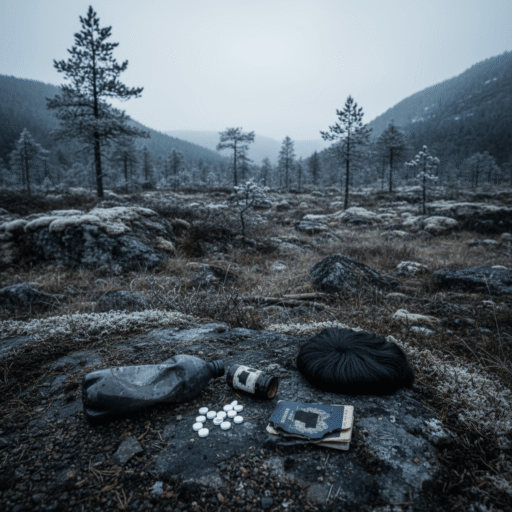
It was the first Sunday of Advent, November 29, 1970. The Isdalen valley (“Ice Valley”) near Bergen, Norway, is a place of stark, rugged beauty—and a dark reputation among locals as a place where people go to end their lives. A university professor and his two young daughters were hiking when they smelled something burning.
Among the scree and rocks, they found the charred remains of a woman. She was lying on her back, her hands clenched in what forensic experts call a “pugilist pose”—a reaction of muscles to intense heat. But the scene was staged in a bizarre, almost ritualistic manner.
- The Body: Front completely burned, back untouched. Soot in her lungs proved she was alive when the fire started.
- The Objects: Around her were arranged 12 sleeping pills (Fenemal), a packed lunch, an empty bottle of St. Hallvard liqueur, and two plastic bottles that smelled of gasoline.
- The Labels: Crucially, every single identifying mark—tags on her clothes, labels on the bottles—had been painstakingly scraped off or cut away.
This was not a panicked suicide. This was a meticulous operation. Someone wanted this woman to be found, but they never wanted her to be known.
Part II: The Suitcases of Secrets
Days later, investigators found two suitcases checked into the Bergen railway station. A fingerprint on a pair of sunglasses matched the body. Police opened the cases hoping for answers; instead, they found chaos.
The suitcases contained a spy’s toolkit: wigs, non-prescription glasses (likely for disguise), German and Norwegian money hidden in the lining, and cosmetics. But again, the obsession with anonymity was absolute. The labels were removed from every garment. Even the prescription sticker on a tube of eczema cream (Betnovate) had been scraped off, erasing the doctor’s name and the patient’s identity.
The most chilling discovery was a black notepad. Inside were columns of codes: dates, locations, and letters. 10 N 30 O 24 M 31 M
Police breakers cracked it quickly. It was a travel log. She had been crisscrossing Europe—Paris, Hamburg, Oslo, Bergen—moving with a frenetic, purposeful energy. She used at least eight different aliases (Finella Lorck, Claudia Tielman, etc.) and carried eight fake passports. Who needs eight passports unless they are running from a state power?
Part III: The Cold War Context
To understand the Isdal Woman, you must understand 1970s Norway. It was the height of the Cold War. Bergen was a strategic NATO port. The woman was seen observing military test flights of the new Penguin missile technology. Witnesses described her as intense, paranoid, and often speaking in German or French, but telling hotel staff she was from Belgium.
Was she a Soviet agent? An Israeli Mossad operative hunting Nazis? Or perhaps a “Checkist”—a counter-intelligence agent? The police investigation was surprisingly brief. Within weeks, they ruled it a suicide by overdose and burning. The case was closed, the files sealed. Rumors persist to this day that the Norwegian Intelligence Service (PST) pressured the police to bury the case to avoid an international diplomatic incident.
Part IV: Modern Science Speaks
In 2016, the case was reopened by journalists and forensic experts. They exhumed her jawbone (which had been preserved) and applied modern isotope analysis. The results were a revelation.
- 01Age & Origin She was older than she looked—around 40, born roughly in 1930. The isotopes in her teeth indicated she moved around frequently as a child, likely in the border region between Germany and France (Nuremberg area) during World War II.
- 02The ‘Golden’ Smile Her dental work was unique and expensive, using gold bridges distinctive to Central Europe. This was not the mouth of a peasant; she came from wealth or was well-funded.
This paints a tragic picture: A child of the war, perhaps displaced, learned to survive by hiding, by moving, by becoming anyone she needed to be. Did she ever stop running?
The Investigator’s Exam: True or False
Can you distinguish the evidence from the rumors?
Editor’s Reflection
The Isdal Woman haunts me not because she died, but because she erased herself before she did. In our modern age, we are obsessed with being seen, with leaving a legacy, with screaming “I was here!” into the digital void. She did the opposite. She spent her final hours scraping the labels off her life, ensuring that when the end came, she would be nothing but ash and bone.
There is a profound loneliness in that act. Was it an act of professional discipline—a spy protecting her network to the bitter end? Or was it an act of existential despair—a rejection of identity itself? To die alone in a frozen valley is a tragedy; to die as a cipher is a statement.
The police called it suicide. But suicide is usually a cry for help, a final message. Her death was a locked door. By destroying her identity, she denied us the ability to mourn her. We mourn the “Isdal Woman,” the mystery, the puzzle. But we cannot mourn the person, the child who grew up in war-torn Germany, the woman who loved chocolate (as evidenced by the wrappers in her suitcase) and garlic. She remains, 50 years later, the ultimate stranger.
Curioscope invites you to consider: In a world where privacy is dead, is total anonymity the ultimate freedom, or the ultimate prison? The Isdal Woman took her secrets to the grave, and in doing so, she became immortal.