
The Enigmatic Trails
A Blog Post
The Devil’s Footprints of Devon: An Enduring Mystery
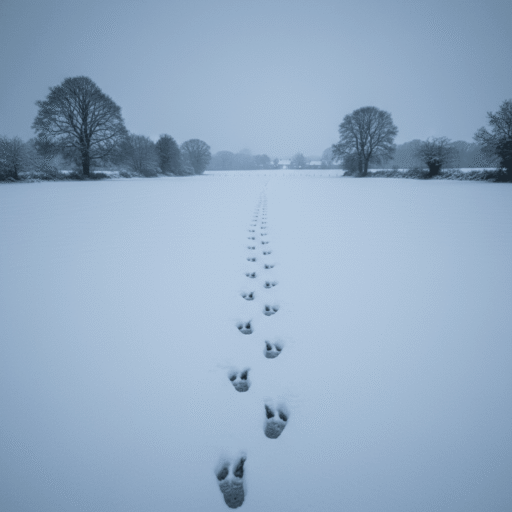
The Devil’s Footprints of Devon is an enduring mystery that began on the morning of February 8, 1855, when a series of unusual tracks appeared across East and South Devon, England, following a night of snowfall. These prints, described as cloven and hoof-like, stretched for an estimated 40 to 100 miles in an almost unbroken single file line. The tracks measured approximately four inches long and three inches wide, with a distinct cleft, and were spaced roughly eight inches apart.
The phenomenon was particularly perplexing due to the seemingly impossible terrain the prints traversed. They were observed scaling vertical walls, crossing rivers without corresponding prints on the banks, appearing on the snow-covered roofs of houses, and entering enclosed courtyards and gardens surrounded by high fences. In some instances, the tracks appeared to pass directly through solid walls. This seemingly supernatural ability to overcome obstacles fueled widespread panic and religious fervor among the local populace, leading many to believe the prints were of demonic origin.
Contemporary accounts, including those published in “The Illustrated London News,” consistently described the prints as resembling the hoof of a donkey or a small pig, but with unnatural regularity and depth. The precision and uniformity of the marks, coupled with their vast geographical spread and the seemingly impossible paths they took, baffled investigators.
Several theories were proposed to explain the prints:
- Animal Kingdom Theories:
- Professor Richard Owen, a naturalist, suggested the prints were made by a badger. This was met with skepticism due to the differences in badger tracks, gait, and their inability to traverse the observed obstacles.
- Other speculative animal theories included escaped kangaroos (whose prints are distinct and not cloven), otters (whose prints are webbed), and small rodents or birds (whose size and track patterns are inconsistent). None of these could account for all aspects of the phenomenon.
- The ‘Balloon Hoax’ Theory: A correspondent suggested that an experimental hot-air balloon might have dragged an anchor or chain, creating the marks. This was largely dismissed as improbable, as an anchor would not consistently produce perfectly formed, identical, cloven hoof-like prints in a single file over such distances and obstacles.
- Weather and Geological Phenomena: Some theories proposed that unusual interactions of frost, ice, and melting snow, or rare meteorological glaciation, could have created the illusion of tracks. However, the consistency, depth, and seemingly “intelligent” path of the tracks made these explanations difficult to substantiate.
The Devil’s Footprints of Devon remains an enduring mystery and a classic case study in cryptozoology and folklore. Its allure lies in its multifaceted nature, combining elements of natural history, psychology, and the human fascination with the unknown. The event highlights the limitations of scientific understanding when faced with anomalous occurrences and the role of superstition and collective belief in interpreting unusual phenomena.
Modern re-evaluations continue to explore possibilities, including:
- Misidentified Animal Tracks: Unusual weather conditions distorting ordinary animal prints. However, this struggles to explain the scale, consistency, and obstacle traversal.
- Experimental Devices: Speculation about a secret, early experimental vehicle, though lacking historical evidence and a clear explanation for cloven hoof marks.
- Wind and Snow Dynamics: The possibility of wind sculpting snow into precise patterns, though unlikely to create such a long, consistent, and “intelligent” trail.
The mystery’s legacy is significant, inspiring numerous retellings and solidifying its status as an unsolved historical mystery. The event serves as a reminder that despite scientific advancements, some phenomena continue to defy easy explanation, leaving behind a chilling testament to the unknown.
Test Your Knowledge: True or False Quiz
The Devil’s Footprints phenomenon began in the year 1855.
True FalseThe mysterious footprints were primarily observed in Scotland.
True FalseProfessor Richard Owen famously attributed the prints to a kangaroo.
True False
Declassified CIA Exploration of Consciousness: The Gateway Process