
The Dead Internet Theory: Is Your Digital World Real or Run by Bots? Unmasking the AI Takeover of Online Spaces.
Curioscope’s Lens
The internet’s familiar glow now casts an unsettling shadow, suggesting a shift from human voices to an “algorithmic hum” of synthetic data. The Dead Internet Theory (DIT), once fringe, has gained traction, questioning the authenticity of online content and interactions. It probes whether we are participants in an automated theatre, with a subtle but significant change observed since roughly 2016, indicating a fading organic vibrancy.
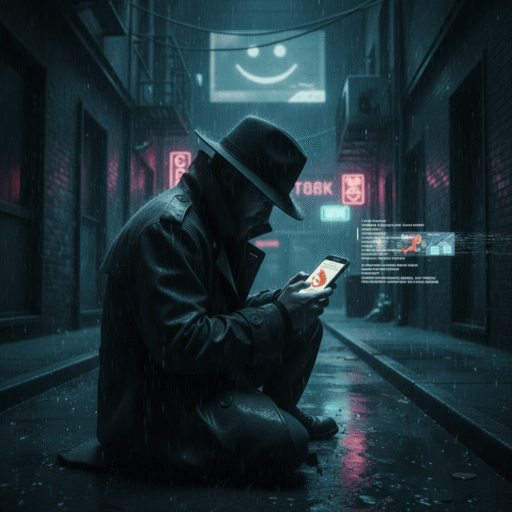
The Whispers of a Machine-Driven Web: Deconstructing the Dead Internet Theory
The Dead Internet Theory (DIT) posits that since approximately 2016, the internet is no longer primarily a realm of genuine human interaction but is largely populated by bot activity and automatically generated content. Proponents believe this landscape is manipulated by algorithmic curation, potentially by government agencies or corporations, to control populations, shape public perception, and minimize authentic human activity. The theory’s genesis is difficult to pinpoint, emerging from online subcultures, but it was significantly amplified by a 2021 Agora Road forum post by “IlluminatiPirate.” DIT rests on two components: the displacement of organic human activity by bots and algorithmically curated results, and the conspiratorial claim of intentional manipulation by powerful entities to control public perception.
The Haunting Echoes: Arguments and Perceived Evidence Fueling the Theory
While conspiratorial, DIT’s underlying observations about the internet’s changing nature are quantifiable and acknowledged.
Increased Bot Traffic
Imperva’s 2023 report indicated nearly half (49.6%) of internet traffic was automated, a 2% increase from 2022 and the highest since 2013. Human traffic decreased to 50.4%. Reports for April 2025 claimed bot traffic surpassed human visits at 51%. “Bad bots” constituted 32% of traffic in 2023, up from 30.2% in 2022. Simple bots surged to 39.6% in 2023 from 33.4% in 2022, driven by generative AI and LLMs for web scraping and script creation. Tech figures like Sam Altman and Alexis Ohanian have acknowledged the growing non-human content presence.
Proliferation of AI-Generated Content
Advanced AI tools (ChatGPT, Gemini, DALL-E, Midjourney, Runway ML) have made creating synthetic content easier. Experts predict up to 90% of online content could be synthetically generated by 2026, with some projecting 99%-99.9% by 2025-2030. This includes AI images, text, comments, music, and videos. In 2024, Google reported its search results were inundated with websites “created for search engines instead of people.” A May 2025 review found over a thousand news sites run by bots, some fabricating news, including misleading claims about the Ukraine war.
Algorithmic Curation
Aggressive sorting on platforms like X and Facebook creates echo chambers, making the internet feel “sterile.” This curation, designed for engagement, trains users to behave in repetitive ways, blurring lines with bots.
Repetitive and Generic Content/Interactions
- “I hate texting” Tweets: Since 2020, variations of this phrase have gone viral, suspected to be amplified by bots.
- Generic Comments: Formulaic responses like “I love it!” or “Great work!” lack genuine engagement.
- Viral AI-Generated Images: Bizarre AI images like “Shrimp Jesus” (Facebook, early 2024) become pervasive without clear human intent beyond engagement.
“Inversion” Point
A concern that bot traffic could become so prevalent that systems perceive bots as authentic users and humans as anomalies, breaking the social contract of online platforms.
These arguments, supported by observable shifts, make DIT’s claims increasingly plausible.
Separating Signal from Noise: Criticisms and Evolving Expert Views
Initially dismissed as a “paranoid fantasy,” expert views have shifted due to rapid AI advancements.
Criticism of Conspiratorial Elements
The idea of a completely “dead” internet manipulated by a centralized effort lacked concrete evidence. Caroline Busta called it a “paranoid fantasy” in 2021, though agreeing the internet felt “emptier.” Before LLMs, many found the theory unsubstantiated, highlighting human creativity and platform efforts against bots. Joseph Jones stated in 2025 that DIT was “wrong overall” but represented a future trajectory.
Exaggeration of AI Capabilities (Early Stages)
Experts argued that generative AI wasn’t yet consistently creating high-quality content that drove trends independently. Human influencers were still seen as leaders, with bots amplifying.
Prioritization of Engagement Metrics
Social media’s focus on engagement and advertising revenue can lead to a “dehumanized internet experience,” shifting from connection to content consumption.
Shift in Expert Perspectives
The advent of sophisticated generative AI has moved the conversation from dismissal to grappling with a plausible, concerning future. Sam Altman noted in September 2025, “it seems like there are really a lot of LLM-run Twitter accounts now.” Alexis Ohanian stated, “it’s not if most of what we see online will be AI-generated. It’s that it already is.”
“Exponential Asymmetry”
AI allows bots to operate continuously, overwhelming human constraints. Timothy Shoup predicted in 2022 that 99%-99.9% of online content might be AI-generated by 2025-2030. Google’s observations about SEO-driven AI websites further support this.
Difficulty Differentiating Content
The blurring lines pose risks to the digital public sphere and democratic communication, potentially creating a “synthetic public sphere” amplifying misinformation and swaying public sentiment.
While extreme conspiratorial claims are met with skepticism, the core idea of an internet increasingly populated by bots and AI, diminishing authentic human interaction, is now seen as a highly plausible and concerning trajectory. Experts call for responsible AI implementation, transparency, and regulation.
Society and Psyche Under Siege: The Profound Impacts of a “Dead” Internet
The implications of DIT extend beyond technical discussions to societal and psychological realms.
Societal Impact
- Erosion of Trust: Diminished reliability of the internet as a source of truth due to AI-generated content.
- Manipulation of Public Opinion: Bots and AI can boost favorable content, influence search results, and propagate narratives, creating a “synthetic public sphere” and potentially leading to “algorithmic authoritarianism.”
- Dehumanization of Online Spaces: Risk of online communities becoming sterile, corporate-controlled environments focused on metrics rather than genuine interaction.
Psychological Impact
- Isolation and Disconnection: Users may feel like they are “shouting into an empty room” if interactions are primarily with bots.
- Distrust in Online Interactions: Pervasive skepticism about the authenticity of online content and engagements.
- Impaired Critical Thinking and Susceptibility to Manipulation: Echo chambers created by algorithmic curation can stunt critical thinking and increase vulnerability to machine-driven narratives.
- Worsening Mental Health: Increased use of bots for companionship may exacerbate loneliness. Lack of emotional intelligence in AI interactions could lead to emotional irregularity and loss of empathy.
- Blurred Lines of Reality: Indistinguishable AI-generated content challenges the distinction between human-created and machine-made reality, leading to cognitive dissonance.
DIT serves as a thought experiment highlighting a real and concerning trajectory for our digital future, impacting societal norms, psychological well-being, and our perception of truth and reality.
The Digital Chasm Widens: Recent Developments and the Future Outlook
DIT has gained prominence in 2024-2025 due to rapid AI advancements.
Explosive Growth of AI-Generated Content
Predictions of 90% AI-generated content by 2025 and 99.9% by 2030 are materializing due to breakthroughs in machine learning.
Dominance of Bot Traffic
Bot traffic surpassed human traffic for the first time in 2024 (51% of web activity), linked to AI and LLMs simplifying bot creation.
Impact on Authenticity and Trust
Difficulty distinguishing human from AI content fuels concerns about misinformation and behavioral conditioning. Sam Altman and Alexis Ohanian have voiced significant concerns.
Real-World Examples
- Viral AI-generated images like “Shrimp Jesus” (early 2024) symbolize an artificial online environment.
- Google acknowledged in 2024 that search results were flooded with AI-generated, SEO-focused websites.
- A May 2025 review found over a thousand bot-run news sites, some fabricating news like “egregiously misleading claims about the Ukraine war.”
- “Zero-click searches” increased significantly, with approximately 60% of US/EU Google searches in 2024 yielding answers without website visits, impacting human content creators.
Focus on Synthetic Public Sphere
The debate centers on the implications of an automated digital public sphere where machines simulate communication, potentially driving political activity and misinformation.
Future Outlook
Emphasis on maintaining authenticity, transparent AI usage, verifying human identity, responsible AI development, and stringent regulatory standards to ensure a human-oriented internet. The challenge is to navigate this “digital chasm” and preserve genuine human connection and critical thought.
True or False: The Dead Internet Theory Challenge
1. The Dead Internet Theory posits the internet has been predominantly populated by bots since approximately 2016, not the early 2000s.
2. Bot traffic surpassed human traffic for the first time in 2024.
3. Sam Altman and Alexis Ohanian have expressed concerns about increasing AI-generated content, not dismissed DIT.
4. The “Shrimp Jesus” image is cited as an example of AI-generated content, not unique human humor.
5. Experts widely agree the internet is changing but not entirely devoid of genuine human interaction, despite AI’s rise.
Editor’s Reflection
The Dead Internet Theory prompts a philosophical question about authenticity in a synthetic world. If the internet’s shared experience is increasingly curated by algorithms and populated by engineered interactions, questions arise about human agency, critical thought, and genuine empathy. While extreme DIT claims may remain conspiratorial, its core concerns about discerning authenticity in a world of synthetic content demand attention. Technology’s power carries a burden of responsibility. The future of the internet hinges on our ability to discern, question, and choose authenticity. The digital world is changing, and our response will define our future reality, emphasizing the need to nurture human qualities like curiosity, skepticism, and genuine connection that machines cannot replicate.
Exploring the Unknown: Supernatural Phenomena, Mysteries Beyond the Bounds of Science