
The Black Knight Satellite
Is an ancient alien sentinel orbiting Earth, or have we been staring at our own trash for 60 years?
👁️ CURIOSCOPE’S LENS
The “Black Knight” is the crown jewel of space conspiracies. It is said to be a 13,000-year-old extraterrestrial satellite, monitoring Earth from a polar orbit long before humans could launch a rocket. The legend weaves together Nikola Tesla, secret spy satellites, and NASA cover-ups into a compelling sci-fi narrative. But when we strip away the myth and apply the cold lens of orbital mechanics and history, a different story emerges—one about human error, cold war paranoia, and our desperate desire to not be alone in the dark.
Part I: The Echoes in the Dark (1899 – 1928)
The myth begins long before the space age. In 1899, the legendary inventor Nikola Tesla set up a high-voltage radio lab in Colorado Springs. One night, he intercepted rhythmic, repetitive radio signals that he couldn’t explain. Tesla, a man ahead of his time, famously speculated: “I have a growing feeling that I was the first to hear the greeting of one planet to another.”
Conspiracy theorists latch onto this as the first contact with the Black Knight. However, modern science offers a less romantic explanation. We now know that Pulsars (rapidly rotating neutron stars) emit exactly the kind of rhythmic radio pulses Tesla described. Tesla wasn’t hearing a satellite; he was likely hearing the heartbeat of a dying star, decades before astronomers knew they existed.
The mystery of LDEs
In the 1920s, Norwegian engineer Jørgen Hals discovered “Long Delayed Echoes” (LDEs)—radio signals that returned seconds after transmission. While still not fully understood, physicists attribute this to radio waves getting trapped in the Earth’s magnetosphere or ionospheric plasma ducts, not an alien repeater station.
Part II: Cold War Paranoia (1950s – 1960s)
The legend solidified during the Space Race. In 1954, newspapers quoted UFO researcher Donald Keyhoe claiming the US Air Force had detected two satellites orbiting Earth. This was shocking because Sputnik 1 wouldn’t be launched until 1957. Who put them there?
Then, in 1960, Time magazine reported that the US Navy’s Dark Fence radar system had detected a dark object in a Polar Orbit. At the time, neither the US nor the USSR had the technology to launch heavy satellites into polar orbit. The implication was terrifying: if it wasn’t ours, and it wasn’t theirs, whose was it?
The Reality: The “Dark Object” was later identified as a casing from the Discoverer VIII satellite launch. It was a piece of classified American spy tech that had gone rogue, not an alien visitor.
Part III: The Smoking Gun (STS-88, 1998)
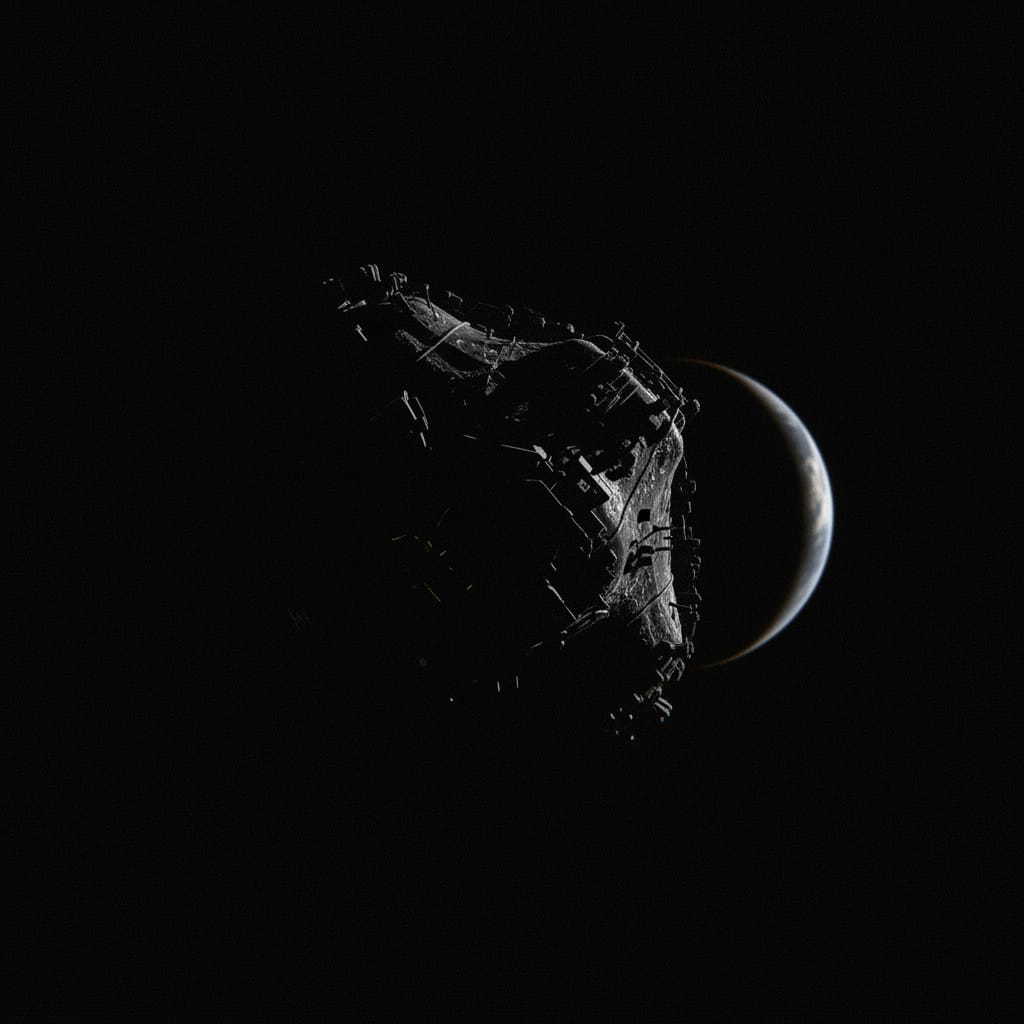
The most famous evidence—the photos you see on the internet—comes from December 1998, during the Space Shuttle Endeavour’s mission (STS-88) to assemble the International Space Station. Astronauts captured high-resolution images of a weird, black, angular object floating above Earth.
It looks undeniably artificial. It looks ominous. It looks like a “Black Knight.”
The Tragic Truth of Item 025570
During a spacewalk to attach the Unity module, astronaut Jerry Ross made a small mistake. A thermal cover (essentially a thick, silver space-blanket) came loose from its tether. As it floated away, it tumbled and twisted.
The “black” color in the photos is because the blanket was in shadow or reflecting deep space. The “angular” shape is simply the rigid fabric crumpled up. NASA tracked this object (Catalog ID: 025570) for weeks until it burned up in the atmosphere. The Black Knight is literally a piece of lost laundry.
Part IV: Why We Believe
If the evidence is so easily debunked—Tesla heard pulsars, the 1960 object was a casing, and the 1998 object was a blanket—why does the legend persist?
It persists because of Pareidolia (our brain’s tendency to find meaningful shapes in random data) and Existential Loneliness. The idea of a 13,000-year-old watcher is comforting. It implies we are important. It implies we are part of a galactic community. A silent alien sentinel is a far more compelling story than “we accidentally dropped some trash in orbit.”
DECODING THE SIGNAL
Test your knowledge: Fact vs. Fiction
Editor’s Reflection
The Black Knight Satellite is more than just a conspiracy theory; it is a mirror reflecting our species’ profound cosmic anxiety. We stand on a small rock, staring into an infinite, silent void, desperate for a sign that we are not alone. The Black Knight fills that silence. It offers a narrative where we are being watched, studied, and perhaps even protected by an ancient, advanced intelligence.
There is a stinging irony in the truth of the Black Knight. The object we revered as an alien artifact turned out to be a thermal blanket—a piece of our own discarded technology. We looked for gods in the sky and found our own trash. This is a powerful metaphor for the Anthropocene era. We have cluttered our orbit with so much debris that we are now creating our own mythology out of the junk we left behind.
But we should not dismiss the Black Knight legend entirely. It serves a purpose. It reminds us of our innate curiosity and our capacity for wonder. The fact that millions of people want to believe in a 13,000-year-old satellite proves that humanity is ready for something bigger than itself.
Curioscope invites you to shift your perspective. Don’t look at the Black Knight as a lie, but as a modern folktale. It is a story we tell ourselves to ward off the loneliness of the universe. The real challenge is not decoding alien signals, but cleaning up our own orbit so that when the real visitors finally come, they don’t have to wade through our garbage to say hello.
The 72-Second Echo: Decoding the Wow! Signal, SETI’s Most Profound Unexplained Mystery