
Benito Mussolini: The Architect of Italian Fascism and His Enduring Legacy
Curioscope’s Lens
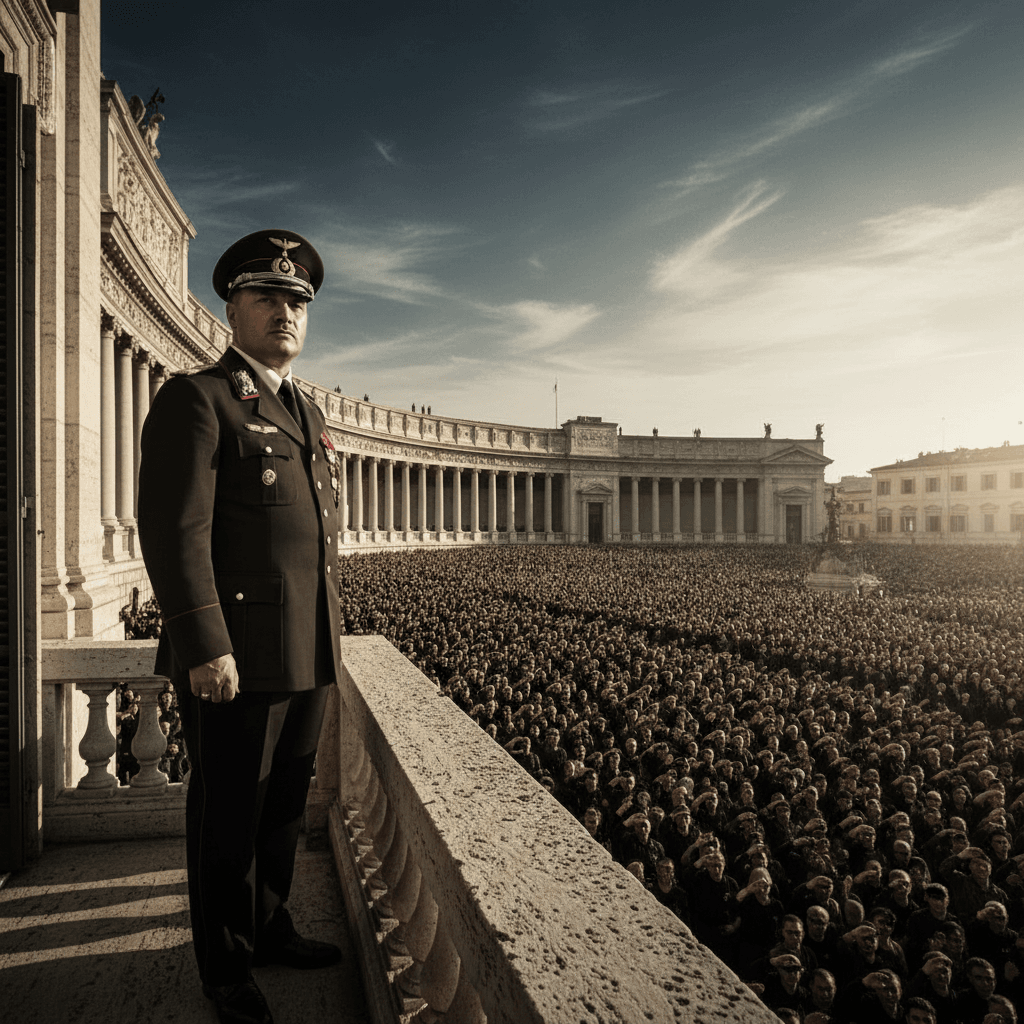
Before Hitler, there was Mussolini. He was the first modern dictator to realize that politics is theater. He didn’t just seize power; he performed it—with uniforms, balconies, and carefully rehearsed jaw-jutting poses. At Curioscope, we explore how a schoolteacher-turned-journalist invented a political brand that seduced a nation and inspired tyrants for a century. His story is a chilling masterclass in how easily democracy can be dismantled by charisma and a well-timed lie.
Benito Amilcare Andrea Mussolini, the architect of Italian Fascism, significantly impacted the 20th century. His rise, totalitarian state consolidation, and downfall offer insights into authoritarianism, nationalism, and the consequences of ambition.
The Formative Years: From Socialist Agitator to Nationalist Firebrand
- Born July 29, 1883, in Predappio, Italy.
- Father: Alessandro Mussolini (blacksmith, socialist). Mother: Rosa Maltoni (Catholic schoolteacher).
- Known for intelligence, rebellious, and violent temperament; expelled from schools.
- Qualified as an elementary school teacher in 1901 but was drawn to socialist activism and journalism.
- Fled to Switzerland in 1902, avoiding military service, and immersed himself in socialist circles, reading Marx, Nietzsche, Sorel, and Pareto.
- Honed oratorical skills and developed a charismatic speaking style.
- Returned to Italy, served military duty, and rose through socialist ranks, becoming editor of Avanti! (Socialist Party newspaper) in 1912.
- Broke with socialist neutrality during WWI, advocating for intervention.
- Expelled from the Socialist Party in 1914; founded Il Popolo d’Italia (The People of Italy) to promote nationalistic and interventionist views.
- This marked a definitive break from the left and the embrace of a new ideology that became Fascism.
- Brief military service during WWI solidified nationalist sentiments and belief in violence.
The Rise of Fascism: From Squadristi to the March on Rome
- Post-WWI Italy faced disillusionment, economic hardship, unemployment, and social unrest.
- March 1919: Founded Fasci Italiani di Combattimento (Italian Combat Squads) in Milan, comprising war veterans, nationalists, and disillusioned socialists.
- Known as “Blackshirts,” they violently opposed socialism and communism, promoting fervent nationalism and strong government.
- Blackshirts attacked socialist/communist organizations, trade unions, and cooperatives, often with official complicity due to fear of Bolshevism.
- Mussolini capitalized on middle/upper-class fear of communist revolution, positioning Fascism as a bulwark against anarchy.
- 1921: Fasci transformed into the National Fascist Party (PNF), attracting industrialists, landowners, professionals, and some workers.
- October 1922: “March on Rome” – a political maneuver backed by the threat of force.
- King Victor Emmanuel III capitulated, fearing civil war, and appointed Mussolini Prime Minister on October 29, 1922.
- This marked the end of liberal democracy and the beginning of the Fascist era.
Consolidating Power: The Dictatorship Unfolds
- Mussolini initially governed within a coalition but aimed for total control.
- 1923: Acerbo Law – electoral reform guaranteeing two-thirds of parliamentary seats to the party winning at least 25% of votes, ensuring Fascist dominance.
- 1924 Election: Conducted under intimidation, resulting in Fascist majority.
- Murder of Giacomo Matteotti (socialist deputy who denounced Fascist fraud) became a turning point.
- January 1925: Mussolini publicly assumed responsibility for Fascist actions in a parliamentary speech, signaling intent for outright dictatorship.
- Subsequent “Fascist Laws” dismantled liberal institutions: abolished press freedom, banned opposition parties, suppressed trade unions, established a special tribunal for political offenses.
- Created the OVRA (Organization for Vigilance and Repression of Anti-Fascism) secret police.
- Parliament became powerless, replaced by the Fascist Grand Council.
- Cult of personality: Mussolini became “Il Duce” (The Leader), promoted through slogans like “Mussolini is always right!” and “Believe, Obey, Fight!”.
- Propaganda saturated public life; mass organizations like Opera Nazionale Balilla (youth movement) indoctrinated the populace.
- Economic policy: “Corporatism” – state control over industry, agriculture, and labor. Led to inefficiency and stifled innovation. Pursued autarky (economic self-sufficiency).
- 1929: Lateran Pacts signed with the Vatican, resolving the “Roman Question” and securing Church support.
Imperial Ambitions and the Path to War
- Mussolini pursued a vision of restoring Italy’s Roman glory and establishing a modern empire.
- October 1935: Invasion of Ethiopia (Abyssinia) using modern weaponry, including chemical warfare.
- League of Nations imposed ineffective sanctions; the weak international response emboldened Mussolini.
- May 1936: Proclaimed the “Italian Empire” after conquering Ethiopia.
- Increasing alignment with Nazi Germany due to shared ideological affinities and common revisionist agenda.
- Spanish Civil War (1936-1939): Italy and Germany supported Franco’s Nationalists, with Italy sending troops and armaments.
- October 1936: Rome-Berlin Axis formed, a precursor to the military pact.
- May 1939: Pact of Steel signed, committing Italy to Germany’s military ambitions.
- April 1939: Italy invaded Albania, making it an Italian protectorate.
- September 1939: Germany invaded Poland, starting WWII. Italy declared non-belligerence due to unpreparedness.
- June 10, 1940: Mussolini declared war on France and Great Britain, convinced of a swift Axis victory after Germany’s success in Western Europe.
World War II and the Unraveling of Il Duce
- Italy’s entry into WWII led to military setbacks and logistical failures due to ill-equipped forces and limited industrial capacity.
- Initial offensives (Greece, North Africa) met with resistance and defeats.
- British forces pushed Italians out of Egypt into Libya.
- Greek campaign required German intervention.
- Ethiopia was reconquered by Allied forces by 1941.
- Failures damaged Mussolini’s prestige and exposed regime weaknesses.
- Public morale declined due to rationing, casualties, and Allied bombing.
- Italy became increasingly dependent on Germany.
- July 1943: Allied invasion of Sicily demonstrated homeland vulnerability.
- July 24, 1943: Fascist Grand Council voted to remove Mussolini from power, led by Dino Grandi and Galeazzo Ciano.
- July 25, 1943: King Victor Emmanuel III dismissed Mussolini and had him arrested.
- Marshal Pietro Badoglio appointed new head of government, initiating armistice negotiations with Allies.
- September 8, 1943: Italy’s surrender to the Allies formally announced.
Test Your Knowledge: The Mussolini Era Quiz!
The Salò Republic and the Final Demise
- September 12, 1943: Mussolini rescued from Gran Sasso by German paratroopers and commandos led by Otto Skorzeny.
- Reinstated by Hitler as head of the Italian Social Republic (Repubblica Sociale Italiana, RSI), or Salò Republic, in German-occupied northern Italy.
- The RSI was a puppet state, dependent on Nazi Germany.
- Mussolini was a figurehead, his authority diminished.
- The Salò Republic engaged in civil strife against Italian partisans and advancing Allied armies.
- Mussolini’s final months were marked by attempts to revive Fascist fervor, disillusionment, and fatalism.
- The regime saw extreme violence and purges, including that of Galeazzo Ciano.
- April 1945: With the war lost, Mussolini and his mistress, Clara Petacci, attempted to flee to Switzerland.
- April 27, 1945: Intercepted by communist partisans near Lake Como.
- April 28, 1945: Mussolini, Petacci, and other Fascist leaders were executed by partisans.
- Bodies hung upside down in Piazzale Loreto, Milan, in a public display of anger.
The Enduring Legacy of Il Duce
- Mussolini’s legacy is debated, characterized by contradictions: charismatic orator, employed violence, led nation to ruin.
- Primary legacy: Invention and implementation of Fascism as a distinct totalitarian ideology (cult of personality, expansionism, suppression of dissent, corporatism).
- Fascist ideology influenced other regimes, notably Nazi Germany.
- For Italy: Ended liberal democracy, curtailed freedoms, fostered obedience and state control.
- Regime achievements (order, infrastructure projects) came at the cost of human rights, political pluralism, and national sovereignty.
- WWII, civil war, and economic devastation were direct consequences of his policies.
- Mussolini remains a controversial figure in Italy, sparking debates on historical memory and neo-fascist sentiments.
- Serves as a cautionary tale about demagoguery, strongman leadership, and the dangers of ideologies prioritizing state power over liberty and peace.
- Highlights the fragility of democracy and the struggle against tyranny.
Editor’s Reflection
Mussolini’s end was as dramatic as his beginning, but far less dignified. The image of him hanging in Piazzale Loreto is not just a picture of death; it is the ultimate refutation of his life’s work. The man who demanded to be worshipped as a god died as a fugitive, executed by his own people. It serves as a stark reminder: power built on fear is a loan, not an asset, and eventually, the debt comes due.
The Enigma of Power: Unraveling the Conspiracy Theories Surrounding Past Dictators