
Adolf Hitler: A Comprehensive Historical Analysis of His Life, Rise, and Devastating Legacy
Curioscope’s Lens
The most frightening thing about Hitler is not that he was a monster, but that he was human. He loved dogs, painted watercolors, and was a vegetarian. He wasn’t an alien invader; he was a product of our own civilization, born from the same cultural soil that gave us Beethoven and Goethe. At Curioscope, we study him not to fetishize evil, but to understand how a modern, educated society can voluntarily march into the abyss.
Adolf Hitler is synonymous with destruction, mass genocide, and World War II. His life story, from obscure beginnings to dictator of Nazi Germany, serves as a cautionary tale about the forces that unleash evil, the fragility of democracy, and the importance of vigilance against extremism. This analysis covers his formative years, rise to power, Nazi ideology, World War II, and his enduring legacy.
From Obscurity to Ideologue: Hitler’s Early Life and Formative Years
- Birth: Adolf Hitler was born on April 20, 1889, in Braunau am Inn, Austria-Hungary.
- Family: His father, Alois Hitler, was a customs official; his mother, Klara Pölzl, was Alois’s third wife and distant cousin. His early life was marked by a strained relationship with his father and a close attachment to his mother.
- Education and Art Dreams: Unremarkable academic record; dropped out at 16, aspiring to be an artist.
- Vienna Years (1907-1913): After his mother’s death in 1907, he moved to Vienna. Rejected twice by the Academy of Fine Arts, he lived a bohemian life, selling paintings. In Vienna, he absorbed and amplified existing anti-Semitic, anti-Marxist, and pan-German nationalist sentiments, influenced by figures like Karl Lueger and Georg von Schönerer. He developed a conspiratorial worldview blaming Jews, Marxists, and Slavs for societal decline.
- Move to Munich (1913): Moved to Munich to avoid Austrian military service.
- World War I (1914-1918): Enthusiastically volunteered for the Bavarian Army. Served as a dispatch runner on the Western Front, experiencing trench warfare. Wounded twice, gassed, and decorated with the Iron Cross First Class. The war fostered camaraderie and a sense of purpose. He viewed Germany’s defeat and the armistice as a “stab-in-the-back” by traitors (Jews, Marxists, Weimar politicians).
The Crucible of Post-War Germany and the Birth of Nazism
- Post-WWI Germany: Political and economic chaos, hyperinflation, economic depression, political extremism, and resentment over the Treaty of Versailles (1919) which imposed harsh reparations, territorial losses, and military restrictions. The Weimar Republic struggled for legitimacy.
- German Workers’ Party (DAP): Discharged from the army in 1919, Hitler became an intelligence agent for the Reichswehr, tasked with infiltrating political groups. He joined the DAP, a small nationalist and anti-Semitic group.
- National Socialist German Workers’ Party (NSDAP): In 1920, he helped transform the DAP into the NSDAP (Nazi Party) and unveiled its 25-Point Program (nationalist, anti-Semitic, anti-capitalist, anti-communist demands).
- Hitler’s Appeal: Charisma, ability to tap into public grievances, simplistic yet powerful messages resonated with a population feeling betrayed and ruined. He blamed “November Criminals,” the Treaty of Versailles, and a “Jewish-Bolshevik conspiracy,” promising national revival and prosperity.
- Beer Hall Putsch (November 1923): Emboldened by hyperinflation and Mussolini’s March on Rome, Hitler attempted a coup in Munich. It failed, leading to his arrest and imprisonment.
- Mein Kampf: During his nine-month imprisonment in Landsberg Prison, he dictated Mein Kampf, his autobiographical manifesto outlining his ideology, racial theories, and plans for Germany. It detailed virulent anti-Semitism, belief in an “Aryan master race,” and the concept of Lebensraum (living space) in the East.
The Cunning Ascent to Absolute Power
- Rebuilding the Party (Post-1924): After release, Hitler rebuilt the party, committing to gaining power through legal means. He professionalized the party structure, established regional organizations (Gaue), and created affiliated groups like the Hitler Youth and the SA (stormtroopers).
- Great Depression (1929 onwards): The economic collapse provided Hitler with an unprecedented opportunity. He skillfully exploited despair, blaming Jews, communists, and the democratic system, promising a strong leader for order and jobs.
- Nazi Propaganda: Masterfully orchestrated by Joseph Goebbels, utilizing mass rallies, film, radio, and posters. Hitler’s oratory created a messianic image.
- Electoral Surges: In the early 1930s, the Nazi Party became the largest party in the Reichstag, though never achieving an “absolute majority.”
- Appointment as Chancellor: On January 30, 1933, President Paul von Hindenburg appointed Adolf Hitler as Chancellor of Germany, marking the end of the Weimar Republic. Conservative elites believed they could control Hitler.
Test Your Knowledge: True or False Quiz
Consolidating Power: The Birth of the Third Reich
- Reichstag Fire (February 1933): Blamed on communists, this event allowed Hitler to invoke emergency powers via the “Decree for the Protection of People and State,” suspending civil liberties and enabling mass arrests.
- Enabling Act (March 1933): Hitler pushed through this act, granting him dictatorial powers to enact laws without the Reichstag or President’s approval, legally dismantling the Weimar Republic.
- One-Party State: Germany became a one-party state; other political parties were banned, trade unions abolished (replaced by the German Labor Front), and state governments centralized. By July 1933, the Nazi Party was the only legal party.
- Night of the Long Knives (June 1934): Hitler purged the SA leadership (under Ernst Röhm) and other perceived opponents, including conservatives, using the SS (Schutzstaffel) for the killings. This cemented his control over the military and established the SS as his instrument of terror.
- Führer and Reich Chancellor: Upon President Hindenburg’s death in August 1934, Hitler merged the offices of Chancellor and President, proclaiming himself Führer and Reich Chancellor. The military swore personal loyalty to him. The Third Reich was established.
The Ideological Underpinnings of Nazism: Race, Expansion, and Totalitarianism
- Racism and Anti-Semitism: Central tenet was virulent, pseudo-scientific racism, especially anti-Semitism. Hitler believed in an “Aryan master race” (Nordic peoples, Germans) destined to rule, viewing Jews as an inferior, parasitic “race” threatening Aryan purity. This led to systematic persecution and extermination.
- Lebensraum: Belief that Germany needed vast territories in Eastern Europe (from Slavic populations) for growth and imperial destiny. This ambition drove the invasion of the Soviet Union.
- Anti-Communism: Fiercely opposed Bolshevism, seeing it as a Jewish-led threat.
- Anti-Democracy: Rejected parliamentary systems in favor of the dictatorial Führer principle.
- Militarism: Glorified war and military strength.
- Totalitarian State: Sought total control over public and private life through propaganda, censorship, secret police (Gestapo), concentration camps, and indoctrination. Individual rights were subservient to the state and the Aryan race. The goal was a Volksgemeinschaft (people’s community) united by race and loyalty to the Führer.
The Road to War: German Rearmament and Aggression
- Dismantling Versailles: Hitler systematically dismantled the Treaty of Versailles and pursued aggressive expansionism.
- Rearmament (1935): Openly announced German rearmament, reintroduced conscription, and expanded the Wehrmacht, Luftwaffe, and navy.
- Remilitarization of the Rhineland (March 1936): German troops entered the demilitarized zone, met with no intervention from Britain and France (policy of appeasement).
- Axis Powers: Formed alliances with Fascist Italy and Imperial Japan.
- Spanish Civil War (1936-1939): Germany intervened, testing military technology and tactics.
- Anschluss of Austria (1938): Orchestrated the annexation of Austria.
- Sudetenland Crisis (September 1938): Hitler demanded the Sudetenland region of Czechoslovakia. The Munich Conference saw Britain’s Neville Chamberlain and France’s Édouard Daladier appease Hitler, agreeing to annexation in exchange for a promise of no further demands.
- Occupation of Czechoslovakia (March 1939): Hitler violated the Munich Agreement by occupying the rest of Czechoslovakia, proving appeasement had failed.
- Guarantees to Poland: Britain and France issued guarantees to Poland, which Hitler now targeted.
- Molotov-Ribbentrop Pact (August 1939): Nazi-Soviet Non-Aggression Pact secretly divided Poland and Eastern Europe.
- Invasion of Poland (September 1, 1939): Triggered World War II as Britain and France declared war on Germany on September 3, 1939.
World War II and the Holocaust: Unprecedented Devastation
- World War II (1939-1945): Initiated by Hitler’s aggression, it became the deadliest conflict in history.
- Blitzkrieg: Germany’s rapid, mechanized assaults led to swift victories in Poland, Denmark, Norway, the Netherlands, Belgium, and France (1940). Britain resisted in the Battle of Britain.
- Operation Barbarossa (June 1941): Invasion of the Soviet Union, opening the brutal Eastern Front.
- US Entry: Japan’s attack on Pearl Harbor (December 1941) brought the United States into the war.
- The Holocaust: Formalized at the Wannsee Conference (January 1942), the “Final Solution” aimed at the extermination of European Jewry. Millions of Jews were deported to concentration and extermination camps (e.g., Auschwitz-Birkenau, Treblinka) and systematically murdered.
- Other Victims: Roma, Slavs, political opponents, homosexuals, people with disabilities, Soviet POWs, and Jehovah’s Witnesses were also targeted. An estimated six million Jews and millions of others perished.
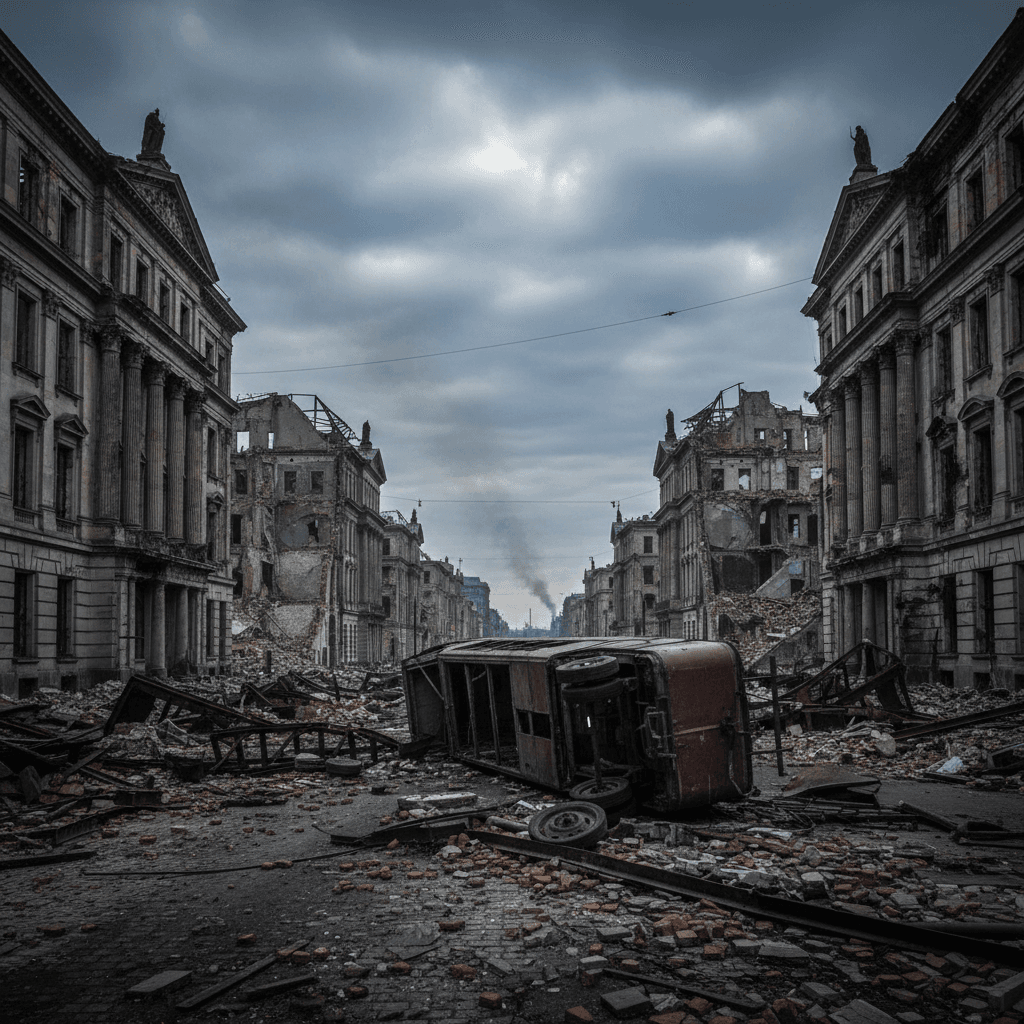
- Turning Tide: Soviet resistance (Battle of Stalingrad), Allied landings in North Africa and Italy, and the D-Day landings (June 1944) opened new fronts. Allied bombing campaigns devastated German cities.
The Downfall and End of the Third Reich
- Allied Advance: Allied armies closed in on Germany from east and west.
- Hitler’s Deterioration: Hitler’s health and grip on reality weakened; he remained in his Berlin bunker, issuing unrealistic orders.
- July 20 Plot (1944): An assassination attempt on Hitler, leading to brutal purges.
- Collapse of the Reich: By early 1945, Germany was collapsing.
- Battle of Berlin: A brutal urban conflict in April 1945.
- Hitler’s Suicide: On April 30, 1945, Hitler committed suicide in his bunker, along with Eva Braun. Their bodies were cremated.
- German Surrender: Germany surrendered unconditionally to the Allied powers on May 8, 1945, ending World War II in Europe. The Third Reich lasted 12 years.
Hitler’s Enduring Legacy and Lessons Learned
- Legacy of Destruction: Unparalleled destruction, genocide, and a rupture in human history. Responsible for World War II (70-85 million deaths) and the Holocaust. His name is a byword for evil.
- Lessons:
- Warning Against Totalitarianism: How democratic institutions can be subverted by demagogues exploiting hardship.
- Dangers of Ideology: Destructive power of extremist beliefs (racial theories, expansionism).
- Importance of Vigilance: Necessity of confronting threats to peace and human rights decisively.
- Holocaust Remembrance: Demands perpetual remembrance to prevent recurrence, highlighting dangers of anti-Semitism, racism, and indifference.
- Human Nature and Evil: Confronting questions about human capacity for good and evil.
- Post-War Developments: Led to Nuremberg Trials (precedents for international law), division of Germany, formation of the United Nations, and a redrawn global order. The scars of his reign continue to shape international relations and memory.
The study of Hitler is not for glorification but for dissecting the mechanisms of his power and the consequences of his actions to learn and prevent recurrence.
Editor’s Reflection
Hitler’s final days in the bunker are a pathetic coda to a life of grand delusion. He died not as a conqueror, but as a frightened man hiding underground while his “Thousand Year Reich” burned above him. The true tragedy is not his death, but the millions who died because the world waited too long to stop him. His legacy is a crater in history—a void where humanity should have been.
The Enigma of Power: Unraveling the Conspiracy Theories Surrounding Past Dictators