
The Clockwork of Empire: The Mystery of the Imperial Fabergé Eggs
🏛 Curator’s Note
Journey with us into a world of impossible opulence and exquisite engineering. The Imperial Fabergé Eggs are not merely jewels; they are time capsules from a doomed empire, each one a universe of clockwork wonders and tragic secrets, reflecting the final, glittering moments of the Romanov dynasty.
I. The Engineering of Wonder
Beyond their diamond-encrusted shells, the true genius of the Fabergé eggs lies in their soul: intricate, moving automata. These were not static ornaments but marvels of micro-engineering. Consider the 1900 Trans-Siberian Railway Egg. Its surprise was a miniature, platinum-and-gold replica of the steam train, complete with diamond headlights and ruby taillights, which could be wound up and set in motion. Similarly, the 1908 Peacock Egg concealed a tiny, enameled peacock automaton that could strut across a tabletop and fan its tail. Fabergé’s firm operated less like a jeweler and more like a high-precision, imperial-grade engineering contractor, where artistry and mechanics were one and the same.
II. A Dynasty in Decline
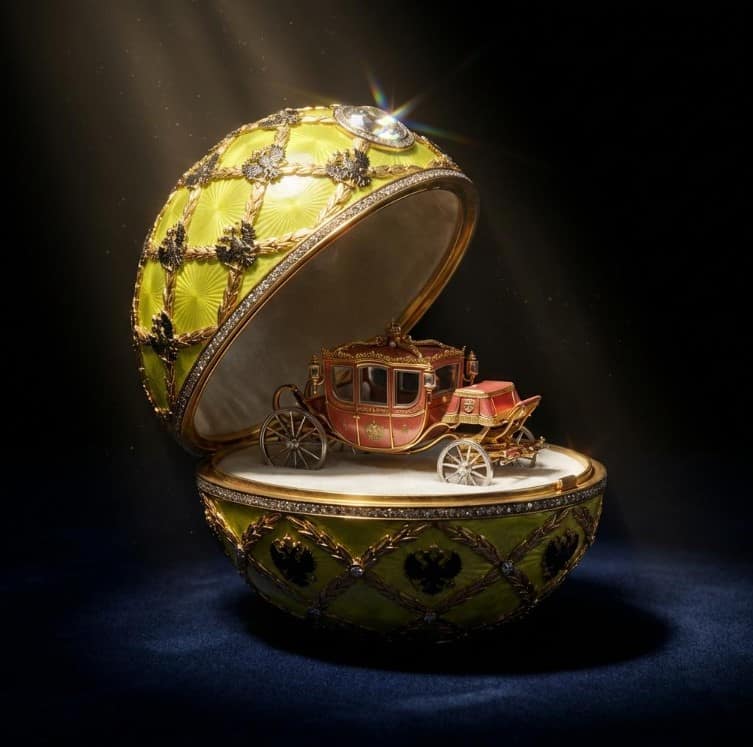
Each egg is a chapter in the Romanov family’s story, charting their journey from absolute power to tragic annihilation. The first, the 1885 Hen Egg, was a simple, intimate gift from a loving husband, Tsar Alexander III, to his wife. By 1897, the Coronation Egg—containing a perfect miniature of the imperial coach—reflected the staggering grandeur of Nicholas II’s ascent. But later eggs tell a different story. The 1906 Moscow Kremlin Egg, created after devastating political losses, looked inward, celebrating religious heritage. The final commissioned pieces, like the austere 1916 Steel Military Egg, stand in stark contrast to earlier opulence, its polished steel surface a grim mirror to the realities of World War I. The dynasty’s story ends with the unfinished 1917 Constellation Egg, its creation halted by the Tsar’s abdication—a clockwork wonder frozen in time, just as the empire itself was.
III. The Alchemy of Supreme Luxury
The cost of a single Imperial Egg was astronomical, often equivalent to millions of dollars today. But Fabergé’s mastery was not just in expense, but in material alchemy. Under the direction of workmasters like Michael Perchin and Henrik Wigström, his workshops pioneered unique gold alloys—green, red, white, and quaternary gold—to achieve painterly effects. Their signature technique, guilloché enamel, involved engraving intricate geometric patterns onto the egg’s gold surface before layering it with translucent enamel. Fired at extreme temperatures, this process was perilous; a single crack meant starting over. The result was a surface with unparalleled depth and luminescence, a testament to a level of craftsmanship that has rarely been equaled since.
IV. The Great Imperial Egg Hunt
Following the revolution, the Bolsheviks viewed the eggs as decadent symbols of the old regime. To raise foreign currency, they sold off the Romanov treasures, scattering the collection across the globe. Of the 50 Imperial Eggs created, seven remain missing. Their stories are the stuff of legend. The most famous discovery was the 1887 Third Imperial Easter Egg, bought by an American scrap metal dealer for $14,000, who planned to melt it down. Only after seeing a news article did he realize its true identity; it was later sold for an estimated $33 million. This “scrap metal miracle” fuels the ongoing hunt for other lost treasures like the Empire Nephrite and Cherub with Chariot eggs, potentially hidden in plain sight, waiting to be rediscovered.
V. Blood on the Diamonds
The Imperial Eggs exist in a state of profound paradox. They are breathtakingly beautiful, yet they were crafted during a period of intense social unrest and poverty. The 1913 Winter Egg, made of rock crystal and platinum to resemble frost on a windowpane, cost more than the annual budget of many Russian towns. This disconnect is central to their story. The opulence was a gilded cage, an imperial bubble that insulated the Romanovs from the simmering revolution outside their palace walls. The eggs were, in essence, the final, crystallized breaths of a dying empire, each jewel a reflection of a world that was about to be violently swept away.
VI. Legacy in Miniature
Today, the surviving eggs are scattered among museums and private collections worldwide, from the Kremlin Armoury in Moscow to the Virginia Museum of Fine Arts. They are more than just historical artifacts; they are potent symbols of a lost world. Each egg is a masterclass in mechanical engineering, a poignant historical document, and a treasure of supreme luxury. They continue to captivate us because they embody the heights of human ingenuity and the tragic fragility of power, proving that even an empire can be held within the delicate shell of an egg.
Knowledge Check
Curator’s Final Reflection: The Clockwork of Fate
As we close the lid on the history of the Imperial Fabergé Eggs, we are left with a profound and unsettling paradox. These objects represent the absolute pinnacle of human craftsmanship—a triumph of micro-engineering where every gear, spring, and hinge functioned with mathematical perfection. Yet, they were commissioned by a regime that was fundamentally broken, unable to manage the complex machinery of its own society.
There is a tragic irony in the fact that Nicholas II could command the creation of a miniature gold train that ran on time within a diamond egg, while the actual trains of Russia were grinding to a halt, carrying a starving populace toward revolution. The eggs served as a dazzling blindfold, a “gilded reality” that allowed the Romanovs to retreat into a world of clockwork predictability while the chaos of the real world gathered outside their palace gates.
Ultimately, the Fabergé Eggs are more than just treasures of the past; they are a timeless warning.
They remind us that technical perfection and aesthetic beauty are meaningless without a foundation of reality. Today, as we marvel at their survival, we do not just see the sparkle of diamonds. We see the frozen, final heartbeat of an empire that perfected the art of decoration while forgetting the art of survival. They remain beautiful, silent witnesses to the truth that even the most exquisite shell cannot protect a fragile core from the crushing weight of history.