
Historical Enigma
The Face of Eternity: Deconstructing the Mask of Tutankhamun
A deep dive into the metallurgy, symbolism, and Amarna-era mysteries of King Tut’s death mask. Separating the curse from the craftsmanship.
🏛 Curator’s Note
It is the most famous face in history, discovered on October 28, 1925, yet it remains a profound enigma. Beyond its iconic status, the Mask of Tutankhamun is a masterpiece forged in the fires of a religious revolution, perhaps stolen from a queen, and designed to act as a high-tech machine for immortality. We will look past the gold and delve into the science, art, and theology that make this object truly eternal.
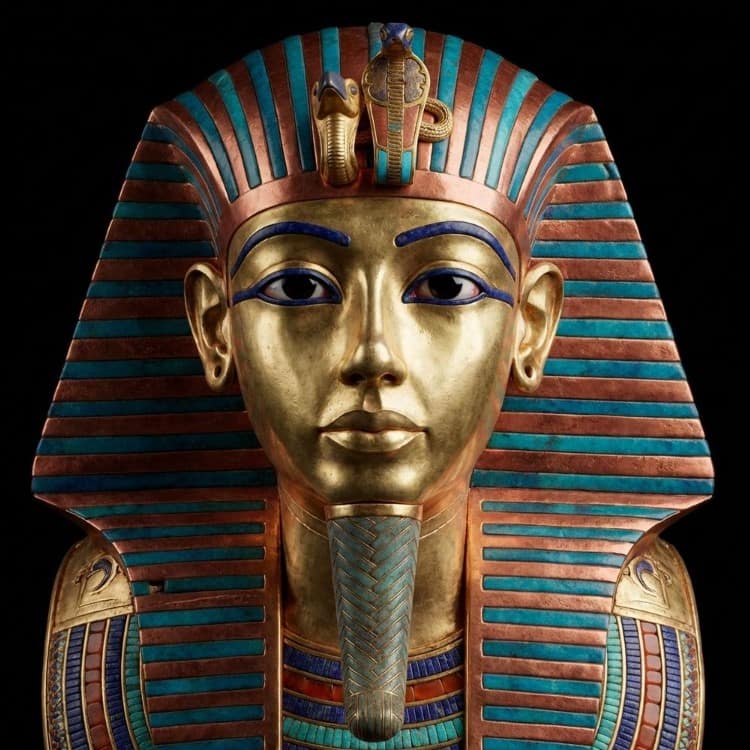
I. The Resurrection Vehicle: Anomalies in Gold
The mask is not mere decoration; it is a functional piece of theological machinery. For the ancient Egyptians, it was a “resurrection vehicle,” an imperishable substitute head for the deceased King’s Ba (soul) to recognize and re-inhabit. Standing 54 cm tall and weighing over 10 kg, its core was crafted through hammering (repoussé) sheets of high-purity gold, with fine details added by chasing. A final burnish, achieved by rubbing with hard stones, gave it a divine sheen. Yet, a critical anomaly exists: the mask is made from two distinct sheets of gold, riveted together. The face is a lighter, electrum-rich alloy (approx. 18.4 karat), while the headdress is a darker, redder gold (approx. 22.5 karat). This material discrepancy fuels the theory that the mask was a composite, with the headdress possibly made for a predecessor like Smenkhkare or even Nefertiti, hastily retrofitted with a new face for Tutankhamun’s unexpected death.
II. The Chemistry of Eternity: Material Symbolism
The materials were chosen for their magical potency, not their monetary value. Gold (Nebw) was considered the “flesh of the gods,” its incorruptibility a chemical guarantee of transforming the King into a solar deity. Lapis Lazuli (Khesbed), painstakingly acquired from the mines of Badakhshan, Afghanistan, symbolized the night sky and primordial waters—the “hair of the gods”—enabling safe passage through the underworld (Duat). The eyes, however, create an unnerving lifelike effect. Pupils of obsidian are set in whites of quartz, with the corners pigmented red to simulate blood vessels. This creates an “Uncanny Valley” effect of sentient presence. Intriguingly, the iconic blue stripes are not Lapis Lazuli but blue glass paste (faience), a deliberate choice to control the symbolic hue associated with the solar cycle and rebirth.
III. Art History: The Shadow of Amarna
Tutankhamun’s life was defined by the Amarna period, a religious revolution initiated by his father, Akhenaten, who embraced monotheism and a fluid, realistic art style. The mask embodies this transitional era. While it restores tradition with the Nemes headcloth and the “Two Ladies” (Wadjet and Nekhbet) protecting the brow, it retains key Amarna stylistic traits. The full, sensual mouth and slightly upturned lips are hallmarks of Amarna realism. Most telling are the pierced earlobes. While common for children and royal women, this was highly unusual for an adult male Pharaoh. The holes were found covered by gold foil discs, strengthening the theory that the mask was originally intended for a child king or, more provocatively, a female predecessor like Nefertiti.
IV. The Palimpsest: Reading the Back
Engraved on the mask’s back shoulders is a protective spell from Chapter 151b of the Book of the Dead. But a closer look reveals a deeper secret. Egyptologist Nicholas Reeves has identified traces of erased hieroglyphs within the cartouches containing Tutankhamun’s name. He argues that the original name was Ankhkheperure, the coronation name of Nefertiti. This “palimpsest” suggests the mask was not just stylistically similar to items for a female pharaoh, but was explicitly made for her. The implication is staggering: Tutankhamun may have been buried in a tomb not his own, with repurposed funerary goods, wearing his stepmother’s mask.
V. The Myth of the Curse and the Fragility of Reality
The “Curse of the Pharaohs” was a media sensation following Lord Carnarvon’s death in 1923, fueled by fabricated tales of ominous inscriptions. The real “curse” was likely biological: dormant spores of toxic mold (like Aspergillus flavus) and bacteria, sealed for millennia, which became airborne upon the tomb’s opening and could cause fatal infections. The mask’s journey has not been without modern peril. In 2014, its braided beard was accidentally knocked off during cleaning at the Egyptian Museum and infamously reattached with industrial epoxy glue. This was later professionally corrected using beeswax, the ancient adhesive. It’s a stark reminder that this symbol of eternity is a fragile object, once covered in 3,000-year-old solidified resin that required heated knives for its careful removal by Howard Carter’s team.
Knowledge Check
Curator’s Final Reflection: The Accidental Immortal
When we look into the obsidian eyes of this mask, we are confronted with a profound historical irony. Tutankhamun was a minor king who died young, likely erased from official records by his successors who wished to bury the Amarna heresy. Yet, it was precisely this obscurity that saved him. While the tombs of the great pharaohs like Ramesses II were looted in antiquity, Tutankhamun slept undisturbed under the debris of history, protected by his own insignificance.
The mask itself serves as a perfect metaphor for his reign: a dazzling, golden patchwork. The evidence suggesting it was repurposed from a female predecessor—possibly Nefertiti—reminds us that history is often not a clean narrative of power, but a messy layering of reuse, adaptation, and political necessity. The face of the world’s most famous man may, in fact, belong to a woman whose name was forbidden to be spoken.
In the ancient Egyptian belief, to speak the name of the dead is to make them live again.
By that standard, the boy king achieved a resurrection far greater than any magic spell could have promised. He is no longer just a ruler of the Nile; he is the face of antiquity itself. The mask, with all its hidden scars and stolen gold, has fulfilled its ultimate purpose: it has defeated time, ensuring that Tutankhamun’s name will be spoken for as long as humanity remembers how to wonder.