
The Mysteries of Cosmology:
‘Impossible’ Galaxies Revealed
Is James Webb shaking the foundations of the Big Bang Theory, or revealing a universe far more creative than we dared to imagine?
🔭 Curioscope’s Lens
The Big Bang theory, a cornerstone of scientific consensus for decades, has been challenged by discoveries from the James Webb Space Telescope (JWST). JWST’s advanced resolution and infrared capabilities have revealed massive, complex galaxies existing just a few hundred million years after the Big Bang. This starkly contrasts with predicted galaxy formation scenarios, leading some scientists to label it a “cosmic crisis.” The introduction questions whether JWST is shaking the foundations of the Big Bang theory or opening a new chapter in our understanding of the universe.
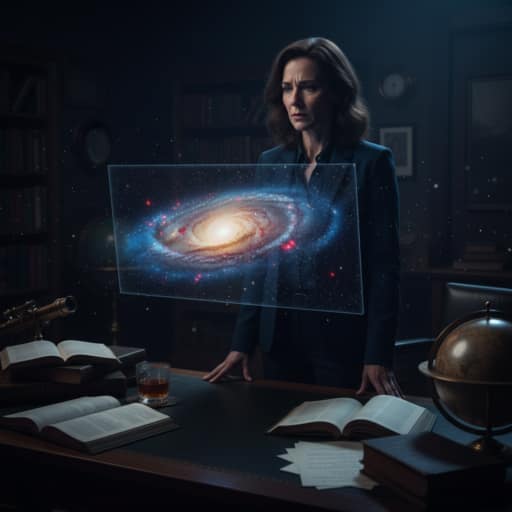
The Abyss of Cosmology: The Mystery of ‘Impossible’ Galaxies
The James Webb Space Telescope (JWST) is making unprecedented discoveries that are redefining humanity’s understanding of the universe. The most shocking among these is the discovery of galaxies that appear to have formed just a few hundred million years after the Big Bang, yet are too massive, bright, and evolved to be explained by current cosmological models. These “impossible galaxies” raise serious questions about our standard model of cosmology, the Lambda-Cold Dark Matter (ΛCDM) model, and have sparked debate about a “cosmic crisis.”
JWST’s observational capabilities have pushed our view back to the universe’s earliest moments. Galaxies like MoM-Z14, discovered as early as approximately 280 million years after the Big Bang, exhibit unexpected brightness, density, and chemical evolution. The ΛCDM model predicts that in the early universe (500-700 million years after the Big Bang), galaxies should be small, irregular, and grow gradually. However, JWST has detected “red monsters” and “blue monsters” with masses comparable to our own Milky Way. These findings suggest that galaxy formation was much faster and more efficient than previously thought.
Clash with the ΛCDM Model
The ΛCDM model posits that dark matter halos form first through gravity, and ordinary matter then collapses within these halos to form stars and galaxies. According to this, the early universe should contain relatively small “proto-galaxies.”
JWST’s evidence directly contradicts this. It has found numerous galaxies with stellar masses exceeding 10 billion solar masses within 500-700 million years after the Big Bang. This rapid formation implies that either the efficiency of ordinary matter converting into stars was much higher than assumed, or unknown physical mechanisms were at play.
Seeking Solutions: Is the Big Bang Broken?
Despite sensational headlines, most scientists believe that refinement rather than a complete overhaul is needed. Several proposed explanations attempt to reconcile JWST’s findings:
- 01. The “Little Red Dots”: Initial analyses might have overestimated mass. Some “massive galaxies” might actually be smaller galaxies hosting rapidly growing supermassive black holes (quasars) that outshine their hosts.
- 02. Ultra-Efficient Star Formation: The early universe might have been far more efficient at converting gas into stars, experiencing short, intense “bursty” periods of creation.
- 03. Alternative Gravity (MOND): Some theories suggest gravity might behave differently on cosmic scales, accelerating early structure formation without dark matter.
TEST YOUR KNOWLEDGE
Cosmic Origins & JWST
Editor’s Reflection
“The universe is not only queerer than we suppose, but queerer than we can suppose.” — J.B.S. Haldane
The spectacle revealed by JWST as it lifts the veil on the universe’s earliest moments is not merely a scientific update; it is a philosophical earthquake. For decades, we rested comfortably on the Lambda-CDM model, believing we had mapped the nursery of the cosmos. We expected to find a messy, chaotic infant universe. Instead, JWST looked back 13 billion years and found fully formed “adults”—massive, structured galaxies—staring back at us. This is akin to walking into a nursery and finding a teenager reading Shakespeare.
This “crisis” is arguably the best thing to happen to astrophysics in a century. It reminds us that nature refuses to be tamed by our equations. The existence of these “impossible” galaxies suggests that the universe was far more creative, violent, and rapid in its genesis than our conservative models allowed. It forces us to confront the “Little Red Dots”—monstrous black holes born in the cosmic dawn—which defy the chicken-and-egg logic of galaxy formation. Did the black hole come first, seeding the galaxy? Or did the galaxy feed the beast?
There is a profound humility in this data. We are a species that has existed for a blink of an eye, trying to reverse-engineer an eternal machine. The shaking of the Big Bang theory is not a failure of science, but its triumph. It proves we are looking closely enough to see the cracks in our understanding.
Curioscope invites you to look at these “impossible” images not with fear that we were wrong, but with the thrill that the universe is far richer than we thought. We are standing on the edge of a new Enlightenment, realizing that the map we drew was just a sketch. The real territory is waiting to be explored.
The Ko’olau Conundrum: Unearthing the Billionaire Bunkers of the Apocalypse