
Cicada
3301
“We are looking for highly intelligent individuals. To find them, we have devised a test.”
Curioscope’s Lens
The internet is often called a “web,” but rarely do we think about the spiders that weave it. In 2012, a mysterious image appeared on the chaotic forums of 4chan. It contained a simple message: “There is a message hidden in this image.” This was the first thread of Cicada 3301, a labyrinthine puzzle that would lead thousands of hackers, linguists, and cryptographers down the deepest rabbit hole in digital history. Was it a recruitment drive for the NSA? A cult? Or perhaps a global collective fighting for digital privacy? This article decodes the code, exploring the intersection of cryptography, philosophy, and the human need for mystery.
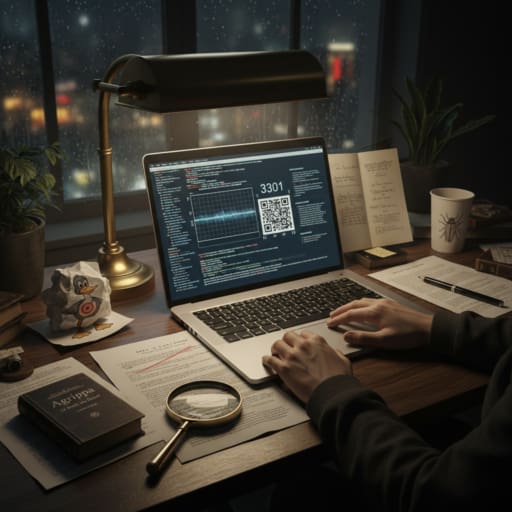
Phase I: The Image That Started It All
It began on January 4, 2012. An anonymous user posted an image of white text on a black background. To the untrained eye, it was just another piece of internet noise. But to those who knew where to look, it was a door.
Users opened the image file in a text editor (like Notepad) instead of an image viewer. Buried in the code was a string of text: “TIBERIVS CLAVDIVS CAESAR says ‘lxxt>33m2mqkyv2gsq3q=w]O2ntk'”. This was a Caesar Cipher, a simple encryption technique used by Julius Caesar where letters are shifted by a certain number. The reference to Claudius (the 4th emperor) was a hint to shift the letters by 4.
Decoding this led to a URL. But that was just the lobby. The real game was about to begin. The URL led to an image of a duck, which contained a hidden message using Steganography (hiding data within the pixels of an image). The message was a warning: “Woooow Shes so cute… Stop being distracted. We want the best, not the followers.”
Technical Deep Dive: Steganography
Steganography differs from cryptography. Cryptography scrambles a message so it cannot be read; Steganography hides the existence of the message entirely. Cicada used a tool called OutGuess to embed text files inside JPEGs without altering the visual appearance of the image. To find the clues, solvers had to analyze the least significant bits of the image data.
Phase II: The Global Scavenger Hunt
As the puzzles grew more complex, they moved from the digital world to the physical one. Solvers found GPS coordinates hidden in the metadata of images. These coordinates pointed to locations all over the globe: Warsaw, Paris, Seattle, Seoul, Arizona, California, Hawaii, Japan, Russia, Poland.
Brave souls who traveled to these locations found physical posters taped to telephone poles. Each poster bore the Cicada symbol and a QR code. Scanning the code led to the next step. This proved that Cicada 3301 was not just a bored teenager in a basement. It was a highly organized, funded, global entity with agents on multiple continents.
The puzzles required knowledge of Mayan numerology, Victorian occultism (specifically the works of Aleister Crowley), cyberpunk literature (William Gibson’s Agrippa), and advanced number theory (Prime Numbers). It was a test not just of coding skill, but of general erudition.
Phase III: The Liber Primus & The Silence
In 2014, the puzzles culminated in the release of the Liber Primus (“First Book”). It is a 58-page book written in Runic characters, encrypted with multiple layers of ciphers. To this day, only a fraction of its pages have been decoded.
# EXCERPT FROM LIBER PRIMUS (Decoded)
"A WARNING
Believing that one is right is the enemy of finding what is true.
Do not seek to follow in the footsteps of the men of old; seek what they sought."
The text is a philosophical manifesto, blending Gnosticism, Zen Buddhism, and Nietzschean philosophy. It speaks of a “simulation,” the need to exit the loop, and the preservation of privacy.
Since 2014, Cicada has gone silent. No new puzzles. No official statements. Just the waiting. The few individuals who claim to have “won” the earlier rounds say they were invited into a private dark web forum to work on privacy-enhancing software (like CAKES), but the group fractured due to internal disagreements.
Part IV: Who Are They?
The theories are endless.
- >_Intelligence Agencies (NSA/CIA/MI6) Using puzzles to recruit talent is an old spy trick. Bletchley Park used crossword puzzles to find codebreakers in WWII. However, Cicada’s anti-establishment philosophy clashes with government work.
- >_Cypherpunks / Crypto-Anarchists The most likely theory. A group of privacy activists (like WikiLeaks or Anonymous, but more disciplined) building tools to protect anonymity in the digital age.
- >_A Banking Cartel / Corporate Entity Some speculate a cryptocurrency group or a fintech company looking for quants and security experts.
Access Verification: True or False
Prove your understanding of the protocol.
Editor’s Reflection
Cicada 3301 is compelling because it is the antithesis of the modern internet. Today, everything is designed to be easy, accessible, and instant. We scroll, we click, we consume. Cicada demanded the opposite. It demanded patience, deep study, and the kind of obsessive focus that most of us have lost. It was a gatekeeper in an era of open gates.
There is a romantic notion in the idea of a secret society of geniuses working to save the world (or destroy it) from the shadows. It appeals to our vanity—the hope that we might be special enough to be chosen. But beyond the ego, Cicada 3301 represents a fundamental anxiety about our digital lives. We know we are being watched. We know our data is mined. Cicada offered a fantasy of escape: a way to use the master’s tools to dismantle the master’s house.
The fact that the Liber Primus remains unsolved is perhaps the most perfect ending. In a world where Google has an answer for everything, it is comforting to know that some questions remain out of reach. It reminds us that there are still frontiers, still mysteries, and still things that cannot be indexed by a search engine.
Curioscope invites you to consider: Are you just a user, or are you a player? The puzzle might be dormant, but the game never really ends.
Roko’s Basilisk: Unmasking the AI Thought Experiment That Could Haunt Your Future