
MEDIA | ANOMALIES
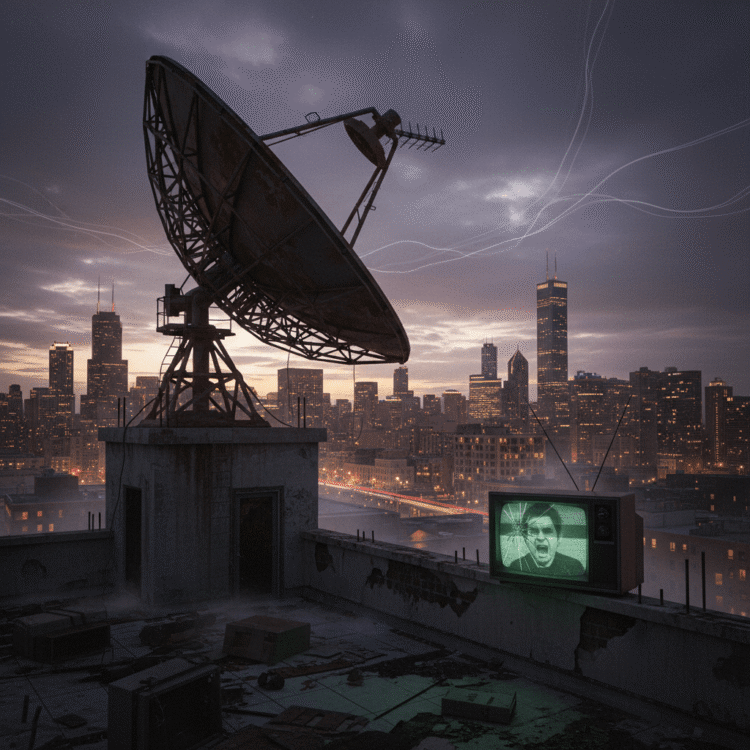
Echoes in the Airwaves: Unraveling the Max Headroom TV Interruption, America’s Bizarre Unsolved Broadcast Mystery
Curioscope’s Lens
In an age where every digital footprint is tracked and recorded, the Max Headroom incident stands as a relic from a lost timeline. It wasn’t just a prank; it was a forcible seizure of reality. For 90 seconds, the “Gods of Broadcasting” lost control. At Curioscope, we are obsessed with this moment because it represents the ultimate cyberpunk fantasy: the anonymous hacker breaking the corporate signal. It reminds us that no system is impenetrable, and sometimes, the static speaks louder than the broadcast.
Introduction
The Max Headroom broadcast intrusion of November 1987 is presented as an enduring enigma in broadcasting history, a bizarre and inexplicable event that breached the sanctity of two Chicago television stations. For a few minutes, a rogue signal presented viewers with a distorted parody of the AI character Max Headroom, accompanied by garbled audio and unsettling visuals. This incident, a technological prank or protest of unknown origin, remains unsolved and is characterized as a brazen act of defiance against media, a fleeting moment of anarchy with an indelible mark on American cultural consciousness.
Historical Context (1987)
The year 1987 is described as a time of technological transition, with the internet nascent, personal computers becoming more common, and television being the dominant mass communication medium. Over-the-air broadcast signals were considered relatively secure, making the idea of hijacking a major network’s signal seem like science fiction. However, on November 22nd, 1987, this vision became a reality for thousands in the Chicago metropolitan area, demonstrating astonishing technical knowledge and audacity by exploiting unknown vulnerabilities.
The First Intrusion (WGN-TV Channel 9)
- Date and Time: November 22nd, 1987, during the 9 PM broadcast of the Nine O’Clock News on WGN-TV Channel 9.
- Event: The screen went black during sportscaster Dan Roan’s segment on the Chicago Bears.
- Content: A distorted image of a figure in a Max Headroom mask appeared against a rotating corrugated metal background. The audio was a high-pitched, garbled squeal with muffled laughter and an indistinct voice.
- Duration: Approximately 25 seconds.
- Resolution: WGN engineers switched the transmitter’s frequency, restoring control. The station crew initially believed it was an internal prank or technical fault. WGN apologized and promised an investigation.
The Second Intrusion (WTTW Channel 11)
- Date and Time: Less than two hours later, approximately 11:15 PM, during a broadcast of Doctor Who (“The Horror of Fang Rock”) on WTTW Channel 11 (PBS affiliate).
- Duration: Roughly 90 seconds.
- Content: The distorted Max Headroom figure reappeared with more discernible (though distorted) audio, including phrases like “Yeah, I think I’m a goddamn nerd!” and “My giant penis.” In a particularly disturbing segment, the figure’s bare buttocks were briefly exposed and spanked with a flyswatter by an unseen accomplice. The audio included the phrase “Catch the wave” (a Coca-Cola slogan) and a final scream.
- Impact: The audacity and vulgarity escalated the event to an infamous status, a deeply unsettling act of public defiance.
Technical Feasibility and Speculation
- Method: The intrusion relied on “signal hijacking” or “ghosting,” overpowering WGN and WTTW’s legitimate signals with a stronger, unauthorized signal on the same frequency.
- Required Equipment: A powerful microwave transmitter, an antenna precisely aimed at the target station’s microwave receiving dish, and the technical expertise to modulate the rogue signal.
- Perpetrator Setup: Experts speculate a mobile transmission unit (van with microwave dish and broadcast equipment) was positioned with a clear line of sight to the target antennas.
- Coordination: The distinct nature of the two intrusions and the short timeframe suggest a coordinated effort, possibly involving a support team, rather than a single individual.
- Access to Equipment: The cost and specialization of the equipment point to individuals with access to professional-grade broadcasting gear, such as disgruntled engineers, former station employees, or highly skilled electronics hobbyists.
Public Reaction and Investigation
- Reaction: A mix of bewilderment, amusement, and genuine fear. The sinister undertones of the second intrusion and lack of explanation fostered unease.
- Investigation: The FCC and FBI launched a full-scale investigation, treating it as a serious breach of federal law with severe penalties.
- Outcome: Despite extensive efforts and appeals for information, the investigation yielded no arrests, and the perpetrators’ identities remain unknown. This lack of resolution deepened the mystery and transformed the event into digital folklore.
Theories on Motives and Identities
- Inside Job: Perpetrated by someone with intimate knowledge of station infrastructure or access to professional broadcast equipment (disgruntled employee, former technician).
- Skilled Hackers: Demonstrating prowess and challenging traditional media authority, possibly as a form of “culture jamming” (disrupting and parodying mainstream media). The choice of Max Headroom, a character commenting on media and AI, adds a meta-commentary layer.
- Political Motive: A protest against corporate control of media or a broader anti-establishment message, aligning with a counter-cultural ethos. However, the content lacked a clear political manifesto, leaning more towards absurdity and defiance.
- Sophisticated Prank/Thrill: Showcasing technical skill for its own sake, with the vulgarity potentially serving as juvenile exhibitionism or the shock itself being the message.
Technical Challenges and Execution
- Complexity: Overpowering a broadcast signal required powerful equipment, precise timing, and a deep understanding of radio frequency propagation.
- Location: Perpetrators likely operated from a high vantage point (another tall building or specially equipped vehicle) with a direct line of sight to target microwave dishes.
- Signal Injection: They had to intercept the legitimate signal, inject their own video/audio, and retransmit with sufficient power to override.
- Strategy: Monitoring legitimate broadcasts, waiting for opportune moments, and executing quick “hit-and-run” transmissions to avoid detection.
Cultural Impact and Legacy
- Discussions: The incident is a touchstone for discussions on media manipulation, broadcast system vulnerability, and anonymous defiance.
- Viral Phenomenon: In the internet age, it has gained new life on platforms like YouTube, inspiring discussions, analyses, and creepypastas.
- Precursor to Digital Disruptions: It predates modern “glitch art” and internet pranks, serving as a chilling analog precursor to digital disruptions.
- Icon of the Uncanny: The distorted Max Headroom image is an icon of the uncanny, symbolizing technology run amok and the possibilities of an anonymous digital underworld.
- Enduring Mystique: The lack of capture adds to its mystique, allowing it to exist as an unresolved mystery.
Comparison to Other Broadcast Intrusions
- Captain Midnight (1986): Interrupted HBO to protest programming costs, left a clear message, and was eventually caught.
- Max Headroom Incident: More abstract, with a message obscured by distortion and surrealism. It was a spectacle of the bizarre, a performance art piece transmitted without consent.
Psychological Impact
- Shattered Illusion: Broke the illusion of television as a safe, predictable medium, exposing its fragility and susceptibility to manipulation.
- New Kind of Fear: Introduced fear not of what was on the news, but of the medium delivering it.
The Lingering Mystery
- Unanswered Questions: Motives (profit, protest, thrill), fate of equipment, and whether perpetrators ever claimed responsibility.
- Anonymity: The remarkable lack of credible claims of responsibility decades later suggests a group determined to remain anonymous or individuals who regretted their actions.
- Evasion of Capture: Successfully evading federal authorities highlights their operational security and ability to disappear.
- Reminder of Anonymity: Serves as a reminder that anonymity can still be achieved through mastery of technology and daring execution.
Test Your Knowledge!
1. The Max Headroom broadcast intrusion occurred on only one television station in Chicago.
2. The perpetrators of the Max Headroom incident were quickly identified and arrested by the FBI.
3. During one of the intrusions, the Max Headroom impersonator’s bare buttocks were briefly shown and spanked.
Conclusion
The Max Headroom broadcast intrusion remains one of America’s most bizarre and compelling unsolved mysteries in broadcast history. It was a fleeting moment of chaos, a technical marvel of defiance showcasing media vulnerability and audacious mischief. The distorted image, unsettling audio, and sheer audacity have cemented its place in cultural memory. Decades later, questions persist: Who were they? Why did they do it? How did they disappear? The incident is a testament to the enduring power of the unexplained, a phantom signal echoing through time, reminding us of the strange, unpredictable possibilities lurking beyond our screens.
Editor’s Reflection
Part of me wants to know who was behind the mask. Was it a disgruntled engineer? A bored genius? But a bigger part of me hopes we never find out. If we put a name and face to the intruder, the magic evaporates. They become just people. Remaining anonymous makes them a legend—a faceless trickster god of the analog age. In a world where privacy is dead, maintaining a secret for 40 years might be the most impressive feat of all.