
Editor’s Desk
The Dancing Plague of 1518: Unraveling a Bizarre Historical Mystery
Curioscope’s Lens
Imagine a dance floor where the music never stops, but there is no joy, only desperation. The Dancing Plague of 1518 is the ultimate historical horror story because it turns a celebration of life—dancing—into a macabre march towards death. At Curioscope, we see this event as a terrifying reminder of how fragile the human mind is under extreme stress. When reality becomes too unbearable (famine, disease, poverty), perhaps the mind simply breaks into a fever dream that the body feels compelled to act out.
The provided text details the historical event known as the Dancing Plague of 1518, which occurred in Strasbourg, then part of the Holy Roman Empire. This bizarre epidemic saw hundreds of people dancing uncontrollably for weeks, leading to exhaustion, heart attacks, strokes, and death.
Overview of the Dancing Plague of 1518
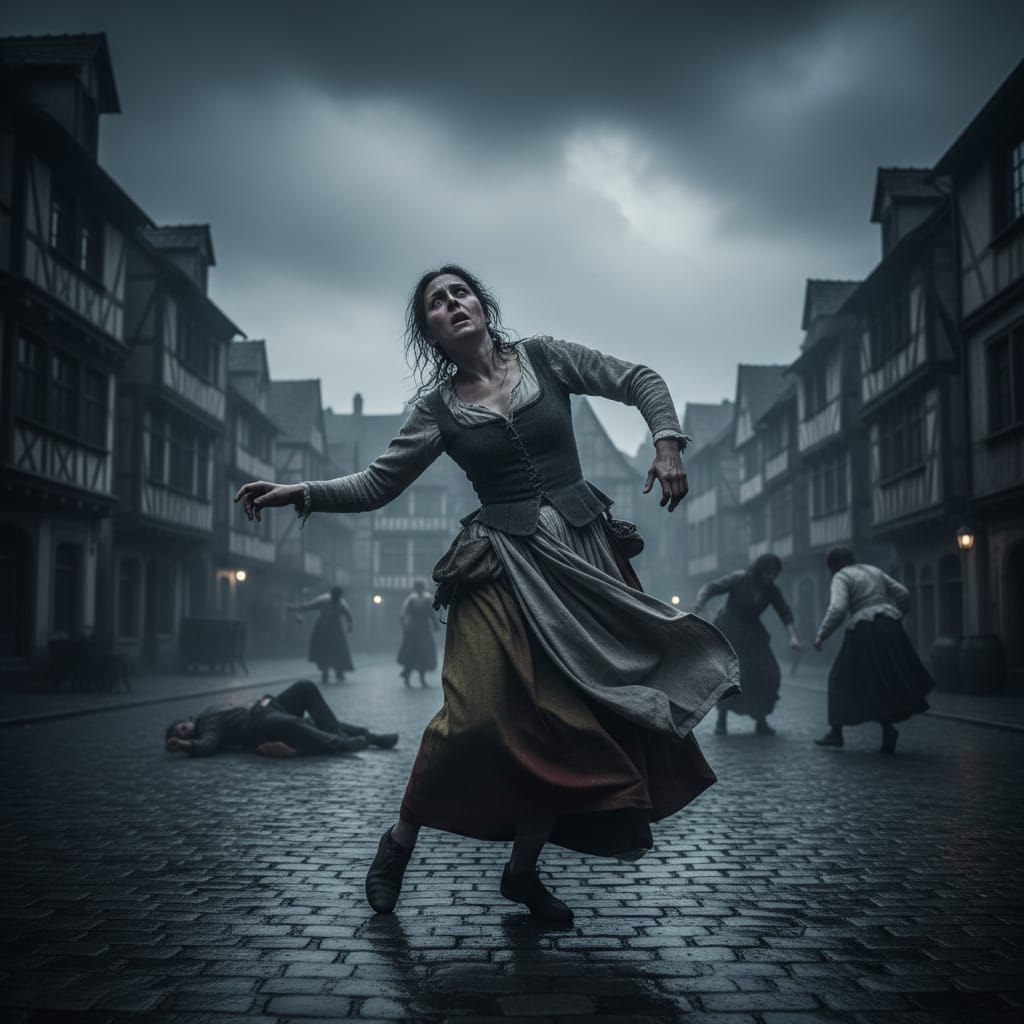
The plague began in the summer of 1518 during a period of hardship for Strasbourg, marked by famine, disease, and political unrest. It started with a woman named Frau Troffea, who stepped into a street and began to dance frantically and without purpose. She continued for hours without rest, food, or water. Within a week, about thirty more people joined her. The phenomenon spread rapidly, and within a month, 100 to 400 individuals, including men, women, and children, were compelled to dance. Their movements were described as desperate, agonizing, and driven by an invisible force, with faces contorted in exhaustion.
City’s Response and Attempts at Cure
Initially, local physicians and magistrates attributed the condition to “hot blood” and prescribed more dancing. They believed the afflicted needed to dance vigorously to expel this imbalance. This led to the construction of a public stage, hiring musicians, and opening guild halls for the dancers. This approach proved disastrous, as the continuous exertion led to deaths from exhaustion, heart attacks, and strokes, with an estimated 15 people dying daily at its peak.
Recognizing the failure of their initial strategy, the authorities shifted to spiritual interventions. They forbade public dancing and transported the afflicted to a shrine dedicated to Saint Vitus in Saverne. Priests performed rituals, including placing dancers in red shoes and leading them around a statue of the saint. It is believed that the removal from public view, change of environment, and the dancers’ exhaustion contributed to the plague’s eventual subsiding by early September 1518.
Theories and Explanations
The Dancing Plague has been subject to various explanations throughout history:
- Historical Explanations: Contemporary accounts often attributed the event to divine wrath or demonic possession, reflecting the religious beliefs of the era.
- Ergotism Hypothesis: This theory suggests that the plague was caused by ergotism, a disease resulting from consuming rye contaminated with the ergot fungus. The fungus produces psychoactive alkaloids that can cause convulsions and hallucinations. However, this theory is less favored as ergotism typically presents with a wider range of symptoms, including gangrene, and does not usually induce sustained, voluntary-like dancing for days.
- Mass Psychogenic Illness (MPI) / Mass Hysteria: This is the leading modern theory. MPI involves the rapid spread of illness symptoms among a group with no clear physical cause, stemming from psychological factors. The conditions in Strasbourg were conducive to MPI due to:
- Extreme Stress: Widespread famine, poverty, disease (syphilis, smallpox), and religious anxieties created immense psychological pressure.
- Cultural Precedent: Earlier dancing manias were documented in medieval Europe, providing a potential “template” for behavior.
- Social Contagion: The public display of dancing likely triggered similar compulsions in others, amplified by the authorities’ initial encouragement.
- Trance and Dissociation: Prolonged dancing could induce trance-like states, perpetuating the compulsive movements.
Role of Saint Vitus and Other Dancing Manias
Saint Vitus was invoked against nervous diseases and dancing manias. His shrine in Saverne was a pilgrimage site for those suffering from such afflictions. The 1518 event was not unique; other dancing manias were reported in Europe, particularly in the Rhineland, from the 14th to 17th centuries (e.g., Krefeld in 1374, Aachen in 1374, Erfurt in 1237). The Tarantism phenomenon in Italy, involving spider-bite cures through frenzied dancing, is another parallel. The Strasbourg plague was notable for its scale, intensity, and mortality.
Socio-Cultural Context and Impact
The 16th century was a period of religious ferment (pre-Reformation), economic hardship, and limited medical understanding of mental and neurological conditions. The Dancing Plague highlights the interconnectedness of mind, body, and environment, demonstrating how extreme psychological stress, cultural beliefs, and social contagion can manifest in severe physical symptoms. It serves as a case study of collective anxiety and the power of belief, challenging modern notions of illness and the boundaries between mental and physical ailments. The event’s memory endures as a testament to the unexpected and extreme forms human behavior can take under duress.
Editor’s Reflection
Are we so different today? We may not dance in the streets until we collapse, but we have our own forms of collective mania—burnout, social media frenzies, panic buying. The Dancing Plague is a mirror held up to human fragility. It shows that when the weight of the world becomes too heavy, the collective psyche can snap in ways that defy logic. The dancers of 1518 weren’t just mad; they were screaming with their bodies in a world that had stopped listening.
Test Your Knowledge: The Dancing Plague Quiz
The Dancing Plague of 1518 began with a woman named Frau Troffea.
Local authorities initially believed the cure for the dancing was less dancing.
The leading modern theory for the Dancing Plague is Ergotism.
The Antikythera Mechanism: Humanity’s Forgotten Technological Legacy