
The Architect of Modern China: Unpacking the Enduring Legacy of Mao Zedong
Curioscope’s Lens
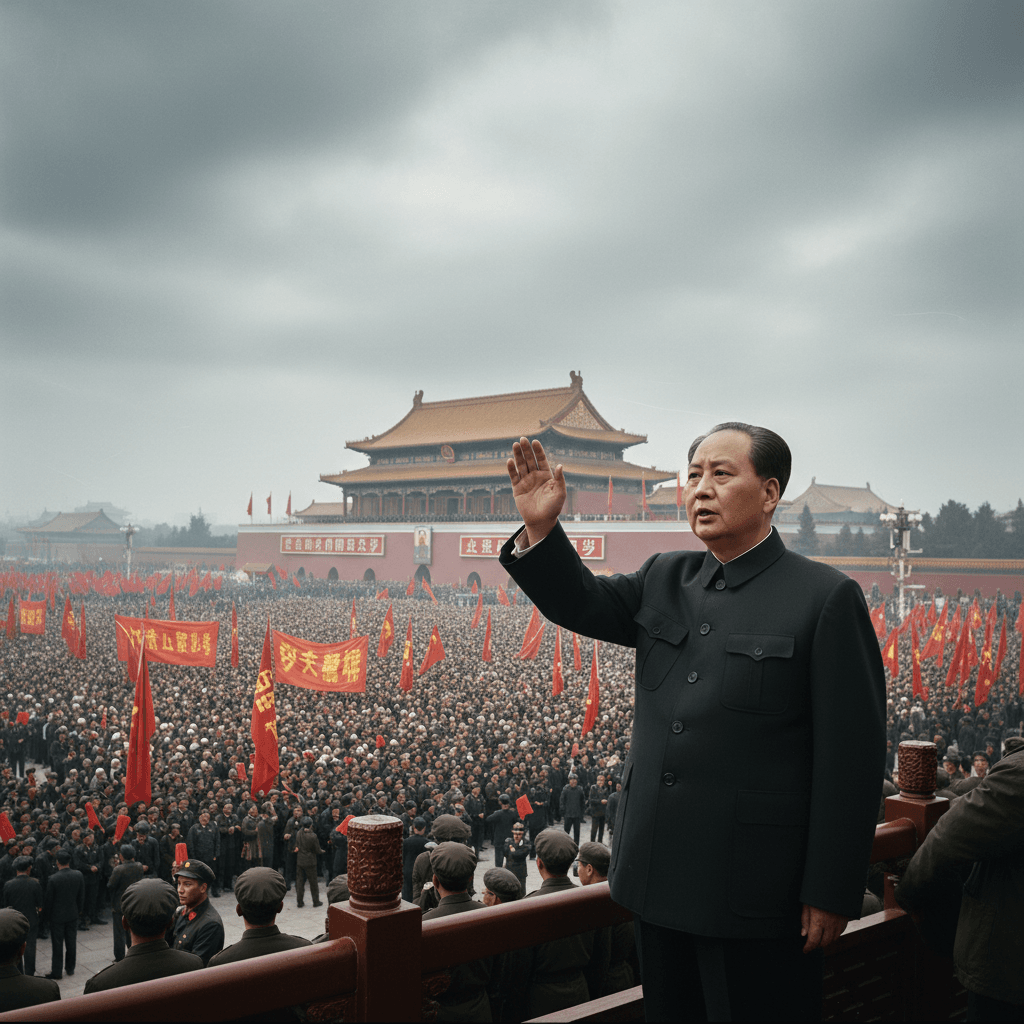
Mao Zedong is a figure who defies simple categorization. He was a poet who wrote of snow and plum blossoms, yet a general who commanded millions to their deaths. At Curioscope, we are fascinated by the “Mao Paradox”: how a man who liberated a nation from foreign imperialism could then enslave it to his own ideological whims. His story is a stark reminder that the road to hell is often paved with revolutionary intentions.
Mao Zedong is a pivotal and controversial 20th-century figure, evoking diverse interpretations from revolutionary hero to tyrannical dictator. As the founder of the People’s Republic of China (PRC), his impact on Chinese society, politics, and culture is profound and shapes modern China and its global standing. Understanding Mao is crucial for grasping modern China’s trajectory. This exploration covers his early life, revolutionary path, policies, consequences, and complex legacy.
From Rural Beginnings to Revolutionary Ideologue: The Formative Years
Mao Zedong was born on December 26, 1893, in Shaoshan, Hunan province, to a prosperous peasant family. His rural upbringing influenced his revolutionary thought, emphasizing the peasantry as the vanguard of revolution in China. His early education exposed him to classical Chinese texts and Western ideas, fostering nationalism and a desire for change in a China weakened by foreign humiliation and internal strife.
China in the early 20th century was tumultuous. The Qing Dynasty fell to the Xinhai Revolution of 1911, leading to a Republic plagued by warlordism. Mao briefly served in the revolutionary army before focusing on intellectual and political pursuits. Working as an assistant librarian at Peking University, he encountered intellectuals like Li Dazhao and Chen Duxiu, who introduced Marxist ideas. These encounters solidified his commitment to communism as China’s solution. He co-founded the Communist Party of China (CPC) in 1921.
The Long March and the Rise to Prominence: Forging a Revolutionary Path
The initial alliance between the CPC and the Kuomintang (KMT), led by Chiang Kai-shek, dissolved in 1927 when Chiang purged communists. This forced the CPC underground and led Mao to develop his strategy of “rural encirclement of the cities,” organizing the peasantry and establishing rural base areas.
Mao’s leadership solidified during the Long March (1934-1935). Facing KMT encirclement, the Red Army undertook an arduous year-long trek. Though devastatingly costly (few of the original 86,000 survived), the Long March was a propaganda triumph and cemented Mao’s position as the undisputed leader of the CPC. Upon reaching Yan’an, his authority was paramount.
The CPC’s strength grew during the Japanese invasion of China in the late 1930s. While the KMT fought Japan, the communists expanded their influence and popular support, implementing land reform. After Japan’s defeat in 1945, the CPC and KMT civil war resumed. Mao’s People’s Liberation Army (PLA), using guerrilla tactics and capitalizing on peasant discontent with KMT corruption, gained ground. On October 1, 1949, Mao declared the founding of the PRC in Beijing, stating, “The Chinese people have stood up.”
The Early Years of the PRC: Consolidation and Vision
With the PRC’s establishment, Mao focused on consolidating power, rebuilding the nation, and transforming China into a socialist state. Initial achievements included nationwide land reform, redistributing land from landlords to peasants, which solidified rural support but involved violence and executions. Industrialization began with Soviet assistance, and basic social services like healthcare and education expanded.
However, Mao’s authoritarian tendencies emerged. The “Campaign to Suppress Counterrevolutionaries” (1950-1953) targeted perceived enemies, leading to arrests and executions. The “Hundred Flowers Campaign” (1956-1957), initially encouraging criticism, turned into the “Anti-Rightist Campaign,” purging thousands of intellectuals and dissidents, silencing dissent and fostering fear.
The Great Leap Forward: A Visionary Dream Turns into Catastrophe
Mao aimed to rapidly transform China into an industrial and agricultural powerhouse with the “Great Leap Forward” (1958). This campaign sought to accelerate collectivization and industrialization through mass mobilization, bypassing conventional economic development. Agricultural communes were established, and backyard steel furnaces were promoted.
The Great Leap Forward was a catastrophic failure. Farmers neglected fields due to commune demands and steel production. Exaggerated harvest reports led to excessive grain extraction, leaving peasants with little. Disastrous agricultural techniques and unusable pig iron from backyard furnaces compounded the issues. Natural disasters exacerbated the man-made errors.
This resulted in one of history’s deadliest famines, with an estimated 15 to 45 million deaths from starvation between 1959 and 1962. The state suppressed information about the famine. While some leaders questioned Mao’s policies, Mao remained largely unrepentant, attributing blame to saboteurs and natural forces. The Great Leap Forward damaged Mao’s standing within the party, leading to a temporary retreat from governance, but his authority remained unchallenged.
Quiz Time: Test Your Knowledge of Mao’s Early Years and Policies
Mao Zedong: True or False Quiz
The Cultural Revolution: A Decade of Upheaval and Devastation
By the mid-1960s, Mao believed the revolution was being undermined by “revisionists” and “capitalist roaders” within the party, such as Liu Shaoqi and Deng Xiaoping, who advocated pragmatic, market-oriented policies. To reassert his authority, Mao launched the “Great Proletarian Cultural Revolution” in 1966.
This movement aimed to purge traditional Chinese culture, capitalist tendencies, and perceived opponents from the party and society. Mao encouraged youth, organized as Red Guards, to challenge authority. This unleashed a decade of chaos, violence, and destruction.
Millions were persecuted, tortured, or killed. Intellectuals, artists, teachers, party officials, and those with perceived foreign connections were targeted. Cultural relics, historical sites, and books were destroyed. Factional fighting between Red Guard groups led to armed conflict. The economy stagnated, and education systems collapsed.
Mao’s wife, Jiang Qing, and her allies (the “Gang of Four”) played a prominent role. While Mao eventually deployed the PLA to restore order in the late 1960s, the Cultural Revolution continued until his death in 1976. Its impact was devastating, leaving deep psychological scars, disrupting education, and setting back China’s development.
Mao Zedong Thought and the Cult of Personality
Mao’s influence was cemented by “Mao Zedong Thought” (Maoism), which adapted Marxism-Leninism to China’s conditions, emphasizing the peasantry, continuous revolution, guerrilla warfare, and self-reliance. It became the CPC’s guiding ideology, propagated through propaganda, education, and the “Little Red Book” (Quotations from Chairman Mao Zedong).
Mao cultivated a pervasive cult of personality, portraying himself as an infallible leader and the greatest revolutionary. His image was ubiquitous, his words sacrosanct. This cult mobilized the masses and maintained his authority. For many, Mao was a savior who liberated them and restored China’s dignity.
International Relations and the Sino-Soviet Split
Mao significantly shaped China’s foreign relations. Initially, the PRC aligned with the Soviet Union. However, ideological and geopolitical differences led to the “Sino-Soviet split” in the late 1950s/early 1960s. Mao viewed Khrushchev’s de-Stalinization as a betrayal, while the Soviets saw Mao’s policies as reckless. This split created a third major player in the Cold War.
In a dramatic shift, Mao pursued an opening to the United States, culminating in President Richard Nixon’s visit in 1972. This move, aimed at counterbalancing Soviet influence, altered global geopolitics and paved the way for China’s economic reforms and rise.
The End of an Era: Death and Immediate Aftermath
Mao Zedong’s health declined in his later years. He died on September 9, 1976, at 82, marking the end of an era of revolutionary fervor and personal rule. The immediate aftermath saw a power struggle, leading to the arrest of the “Gang of Four” and the rise of Deng Xiaoping, who initiated China’s economic reforms.
The Enduring and Divisive Legacy of Mao Zedong
Mao Zedong’s legacy is complex and debated.
Revered as:
- The Unifier: Led the CPC to victory, ending foreign domination and establishing a unified Chinese state.
- The Liberator: Oversaw social reforms (land redistribution, improved literacy, healthcare) benefiting millions.
- The Architect of National Pride: Instilled national dignity and self-reliance, making China a global player.
- The Visionary Leader: His “Mao Zedong Thought” inspired revolutionary movements.
Condemned for:
- Mass Casualties: Policies like the Great Leap Forward and Cultural Revolution caused tens of millions of deaths.
- Economic Devastation: Utopian experiments led to poverty and stifled development.
- Political Repression: Established a totalitarian system that crushed dissent and freedoms.
- Destruction of Culture: The Cultural Revolution destroyed cultural heritage and intellectual class.
In contemporary China, Mao is officially assessed as “70% right and 30% wrong.” He is still called the “Great Leader,” and his portrait remains on Tiananmen Gate. This narrative allows the CPC to maintain revolutionary legitimacy while pursuing economic reforms. Globally, assessments remain divided.
Conclusion: A Figure of Paradox and Enduring Relevance
Mao Zedong was a figure of paradox: poet and strategist, visionary and tyrant, liberator and destroyer. His work reshaped China at an unimaginable human cost. His legacy prompts questions about revolution, power, ideology, and individual sacrifice.
Editor’s Reflection
Mao remains a ghost that China cannot exorcise. To denounce him completely would be to delegitimize the very foundation of the modern state. To embrace him fully would be to condone unspeakable tragedy. He sits in the middle, a “70% good” myth that holds the country together. But as we look at his portrait overlooking Tiananmen Square, we must ask: Can a nation truly move forward if it cannot fully reckon with its past?
As China ascends globally, Mao’s ghost looms. His contributions to the PRC’s founding are undeniable. However, the lessons from the Great Leap Forward and Cultural Revolution serve as warnings against utopian zealotry and the dangers of a cult of personality. Understanding Mao requires grappling with the complexities of a figure who indelibly altered China’s course and left a profound mark on human history.
The Enigma of Power: Unraveling the Conspiracy Theories Surrounding Past Dictators