
The Raft of the Medusa:
Cannibalism, Madness, & Betrayal
147 people were abandoned on a raft to die. Only 15 survived. This is the gruesome true story behind the world’s most terrifying painting.
Curioscope’s Lens
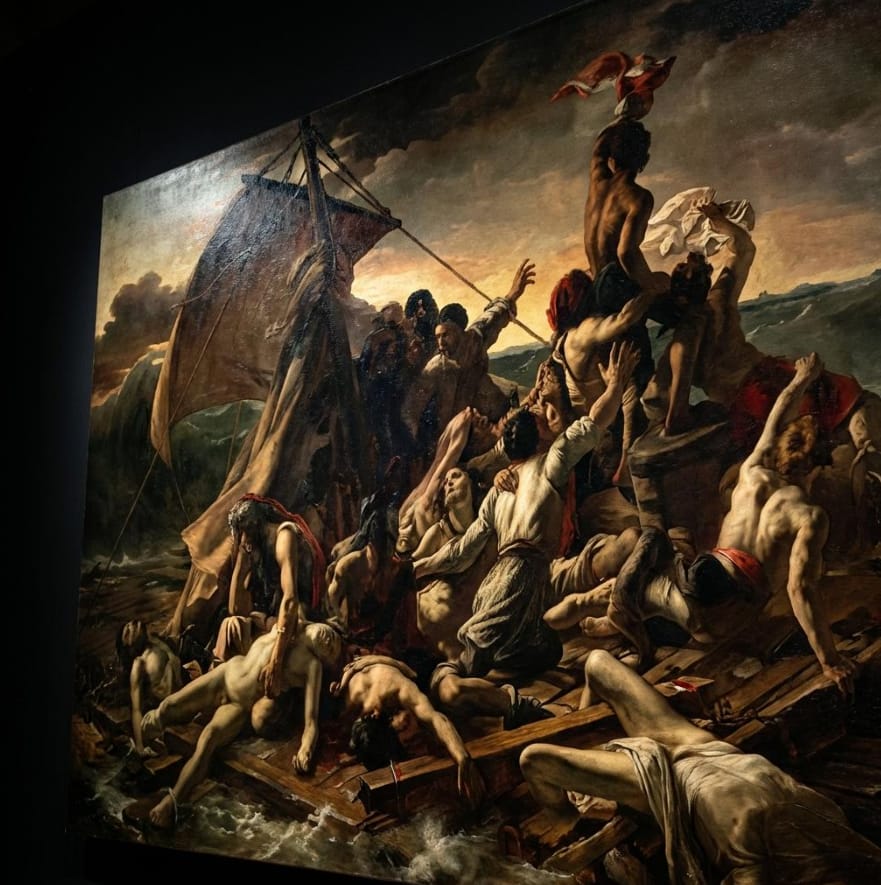
In the Louvre Museum, visitors often recoil from a massive canvas depicting a tangled mass of writhing, dying bodies on a makeshift raft. It is Théodore Géricault’s The Raft of the Medusa. But this is not just a painting; it is a crime scene report. In 1816, a French naval captain, appointed solely due to royal nepotism, ran his ship aground and then committed an act of cowardice so profound it shook the nation. He cut the ropes towing a raft carrying 147 of his own crew and passengers, leaving them to drift in the open Atlantic. What happened over the next 13 days is a descent into the absolute nadir of human behavior—mutiny, murder, and the ultimate taboo: cannibalism. This article peels back the oil paint to reveal the rotting flesh of a societal collapse.
I. The Anatomy of a Betrayal
The tragedy began not with a storm, but with a signature. Following the restoration of the French monarchy, Viscount Hugues Duroy de Chaumareys was appointed captain of the frigate Méduse. He had not sailed in 20 years. His qualification? He was a loyal royalist. His mission was to transport soldiers and settlers to Senegal.
On July 2, 1816, due to his incompetence and refusal to listen to his officers, the ship ran aground on the Arguin Bank off the coast of modern-day Mauritania. The ship was not sinking, but it was stuck. When attempts to free it failed, chaos ensued.
There were not enough lifeboats. The captain and senior officers took the boats. For the 147 soldiers, sailors, and civilians left behind, a raft was hastily constructed from the ship’s masts and beams. It was 20 meters long and 7 meters wide—woefully unstable. The plan was for the lifeboats to tow the raft to shore. But the raft was heavy, and it acted as a sea anchor. Within minutes, Captain Chaumareys made the decision that would damn him to history: he ordered the tow ropes cut. The lifeboats sailed away, abandoning 147 souls to the mercy of the Atlantic.
II. Thirteen Days of Hell: Mutiny and Cannibalism
The first night was terrifying, but order held. By the second night, the passengers realized they were doomed. They broke open the casks of wine (the only liquid they had besides water, which was lost early on) and got drunk. Paranoia set in. A mutiny erupted. Officers killed soldiers; soldiers killed officers. By morning, dozens were dead, their bodies littering the raft or washed overboard.
— Henri Savigny, Survivor
By the fourth day, starvation drove them to the unthinkable. They began to eat the bodies of the dead. Some refused at first, but hunger broke everyone eventually. They dried strips of human flesh in the sun to make it palatable.
But the horror didn’t end there. By the eighth day, the 15 strongest survivors decided that the wounded and weak were consuming too many resources. In a cold, calculated decision, they threw the sick and injured overboard, including the lone woman on the raft. They murdered their companions to save themselves. When the brig Argus finally spotted them on July 17, only 15 men remained alive. Five of them would die within days of rescue, their bodies too ravaged to recover.
III. The Artist’s Obsession: Géricault in the Morgue
When the story broke in France, it caused a political scandal that nearly toppled the government. But for a young artist named Théodore Géricault, it was a dark muse. He became obsessed with the incident. He didn’t want to paint a heroic rescue; he wanted to paint the raw, rotting reality of despair.
Géricault’s research was macabre. He interviewed the survivors, Henri Savigny and Alexandre Corréard. He built a scale model of the raft in his studio. But that wasn’t enough. He needed to know what death looked like.
He visited the morgue at the Hôpital Beaujon. He borrowed severed limbs and heads, bringing them back to his studio to study the colors of decomposition—the greens, the purples, the grays of necrotic flesh. For months, he lived with the smell of death, painting surrounded by rotting human remains. He shaved his head and locked himself away, descending into his own form of madness to capture the truth.
IV. Decoding the Masterpiece: The Pyramid of Hope and Despair
The painting is a masterclass in composition. Géricault organized the chaotic mass of bodies into two pyramids.
- 01.The Pyramid of Despair On the left, the mast and the sail pull the eye back, pushing the raft away from rescue. Beneath it sits an old man grieving over the corpse of his son—a figure of absolute resignation.
- 02.The Pyramid of Hope On the right, a diagonal line of bodies rises from the dead, to the struggling, up to the figure at the apex—Jean Charles, a Black crewman. He waves a rag at a tiny speck on the horizon (the rescue ship).
By placing a Black man at the pinnacle of the composition, Géricault made a powerful abolitionist statement in an era when France was still debating the slave trade. Jean Charles represents the resilience of humanity, the last shred of hope in a sea of darkness.
Tragically, the painting itself is dying. Géricault experimented with bitumen, a tar-like substance, to achieve deep, rich blacks. But bitumen never fully dries; it degrades and darkens over time. The painting is slowly turning black, swallowing the figures into the shadows, much like the sea swallowed the victims.
V. The Legacy: Art as a Political Weapon
When The Raft of the Medusa was unveiled at the 1819 Salon, it shocked the public. It wasn’t a glorification of the state; it was a gritty, gruesome exposure of government incompetence. It was the “Inconvenient Truth” of its day. Critics were divided—some horrified by the pile of corpses, others moved by its political power.
Géricault died young, at 32, exhausted by his own intensity. But his work changed art forever. It marked the shift from Neoclassicism (calm, idealized, noble) to Romanticism (emotional, chaotic, raw). He proved that art could be ugly, terrifying, and political—and still be beautiful.
Survival Test: True or False
Test your knowledge of the darkest voyage in history.
Editor’s Reflection
Standing before Géricault’s masterpiece, I don’t just see paint on canvas. I see a mirror. The story of the Medusa is not merely a historical accident; it is a timeless allegory for the failure of leadership and the fragility of civilization.
We like to think of ourselves as civilized, rational beings. We have laws, we have morals. But the raft shows us how quickly those structures dissolve when survival is on the line. Thirteen days. That is all it took for officers to murder their men, for friends to eat friends, for the strong to cull the weak. It is a terrifying reminder that the line between human and beast is thinner than we dare to admit.
Yet, there is Jean Charles at the top of the pyramid, waving his rag. Even in the midst of hell, the human impulse is to hope, to signal, to survive. Géricault didn’t just paint the despair; he painted the indomitable will to live.
Curioscope invites you to ask: If you were on that raft, starving and surrounded by madness, who would you be? The one who cuts the rope, the one who gives up, or the one who waves the flag?