
The Miracle in the Mud:
Unearthing the Baekje Gilt-Bronze Incense Burner
Curator’s Note
Some artifacts are dug up; others seem to wait until the world is ready to understand them. The Baekje Gilt-Bronze Incense Burner is one such marvel—a vessel of profound grief, a beacon of technological genius, and a message in a bottle from a vanquished kingdom, patiently waiting 1,333 years to share its story.
1. The Parking Lot Paradox
On December 12, 1993, history surfaced in the unlikeliest of places. During a routine survey for a parking lot expansion near the Neungsan-ri royal tomb complex in Buyeo, South Korea, workers stumbled upon a muddy pit. Inside, perfectly preserved, lay a masterpiece. The artifact’s gleam was untarnished, its intricate details uncorroded, thanks to the anaerobic mud that had acted as a vacuum seal for centuries. The prevailing theory is as poignant as it is cinematic: during the Silla-Tang invasion of Baekje in 660 AD, a loyal monk or guard, desperate to save this cultural treasure, hid it in a water trough, intending to return. They never did. The burner waited, silent and safe, for 1,333 years.
2. A Universe in Bronze: The Iconography
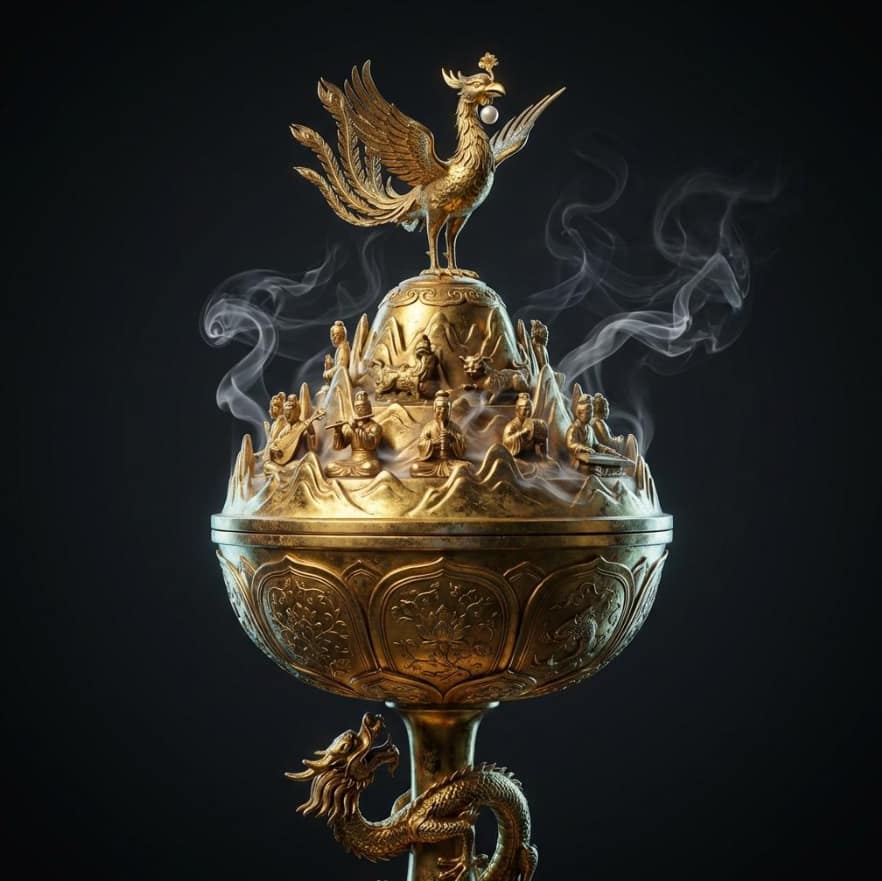
Standing 61.8 cm tall and weighing 11.8 kg, the burner is a cosmos rendered in metal, a breathtaking synthesis of philosophy and faith. It is comprised of four main sections, each representing a different plane of existence.
- The Base: A formidable dragon, coils tense, seems to launch the entire structure skyward. It represents the underworld, Yin energy, and the foundational power of water.
- The Body: A blossoming lotus flower, symbol of purity rising from the mud, forms the burner’s core. Its 26 petals are engraved with 24 animals and 2 humans, a vibrant depiction of the earthly realm.
- The Lid: A miniature mountain range representing the Taoist paradise of the immortals. This intricate landscape features 74 peaks, 16 immortals, 39 animals, and, remarkably, Five Musicians playing instruments of the Baekje court—a priceless insight into a lost musical tradition.
- The Finial: Crowning the entire piece is a majestic phoenix (Bonghwang), a symbol of the heavens and Yang energy. It holds a magical pearl (Yeouiju) in its beak. When incense is lit, smoke cleverly exits through hidden holes in the phoenix’s chest, shrouding the mountains in a mystical, fragrant mist.
3. The Ghost of a Beheaded King
Why create such an elaborate masterpiece? The answer likely lies in a story of royal grief and filial piety. The burner is believed to have been commissioned by King Wideok of Baekje (554–598 AD). In 554 AD, his father, King Seong, was killed in battle against the rival Silla kingdom. In an act of ultimate desecration, King Seong was beheaded, and his head was buried under the stairs of a Silla government building. Haunted by this trauma, King Wideok likely commissioned the burner as a profound act of atonement and a *Jin-hon*—a vessel to soothe his father’s tormented soul. The incense burner was not just an object; it was a prayer, an eternal paradise created in bronze, its smoke carrying pleas for peace to the heavens.
4. An Ancient Impossible Object
The burner’s construction is so advanced for its time that it has been called an “Out-of-Place Artifact” (OOPART). Baekje artisans employed two highly sophisticated techniques. First, the **lost-wax casting** method was used to create the incredibly detailed and hollow structure with uniform 5mm thin walls—a feat requiring immense control. Second, they used **mercury amalgam gilding**, dissolving gold in mercury to create a paste. This paste was applied to the bronze, and then the object was heated, vaporizing the toxic mercury and leaving a flawlessly bonded layer of pure gold. It was a dangerous, painstaking process that yielded divine results.
5. Elephants in Korea? The Global Connection
Among the 39 animals depicted on the lid are curious figures: elephants with riders and crocodiles. These non-native species are powerful evidence of Baekje’s extensive maritime trade routes, which likely reached China, Japan, Southeast Asia, and perhaps even India. Baekje was the “Phoenicia of East Asia,” a cosmopolitan hub of culture and commerce. This global perspective is mirrored in the burner’s syncretic philosophy, seamlessly blending Buddhist (the lotus), Taoist (the immortal mountains), and Confucian (the filial piety of its creation) ideals, all balanced within the Yin-Yang framework of the dragon and phoenix.
6. A Legacy Forged in Fire
The Baekje Gilt-Bronze Incense Burner is more than a beautiful object. It is a historical document, a spiritual diagram, and a testament to a kingdom at its cultural zenith, even as it faced its twilight. It encapsulates the grief of a son, the faith of a people, and the interconnectedness of the ancient world. Discovered by chance, it serves as a powerful reminder that the deepest truths and most beautiful stories are often buried just beneath the surface, waiting for the right moment to emerge and change our understanding of the past forever.
Knowledge Check
Curator’s Final Reflection: The Mercy of the Mud
As we stand before the Baekje Gilt-Bronze Incense Burner, we are confronted with a haunting irony. This object, radiating the golden light of paradise, survived only because it was cast into the darkness of a muddy pit. Had it remained on the altar during the fall of the kingdom, it would almost certainly have been looted, melted down, and turned into weapons or coins by the conquering armies. The mud, in its silence, was not a grave, but a sanctuary.
There is something profoundly moving about the motivation behind its creation. It reminds us that great art often stems not from triumph, but from trauma. King Wideok did not commission this masterpiece to boast of his wealth; he forged it from the raw ore of his grief, trying to create a fragrant utopia for a father he failed to protect. It is a physical manifestation of a son’s apology, frozen in eternal bronze.
Baekje vanished from the maps. Its palaces were burned, and its people scattered. But this burner remains.
It serves as a humbling lesson to our modern, disposable culture. We build for the next fiscal quarter; the artisans of Baekje built for eternity. When the smoke rises from the phoenix’s chest, it does more than perfume the air; it bridges the gap of thirteen centuries, whispering a resilient truth: that while kingdoms may crumble and flesh may turn to dust, the beauty born of the human spirit has the power to outlast history itself.
The Face of Eternity: Deconstructing the Mask of Tutankhamun