
The Eternal Legion: Unmasking the 8,000 Ghosts of Qin
🏛 Curator’s Note
In 1974, the world imagined a single artist sculpting 8,000 unique soldiers for a megalomaniac emperor. But the Terracotta Army is not a story of romantic artistry; it’s a testament to something far more profound—the birth of industrial-scale production, a system so advanced it rivals modern manufacturing. We’re peeling back the myth to reveal the machinery of an empire.
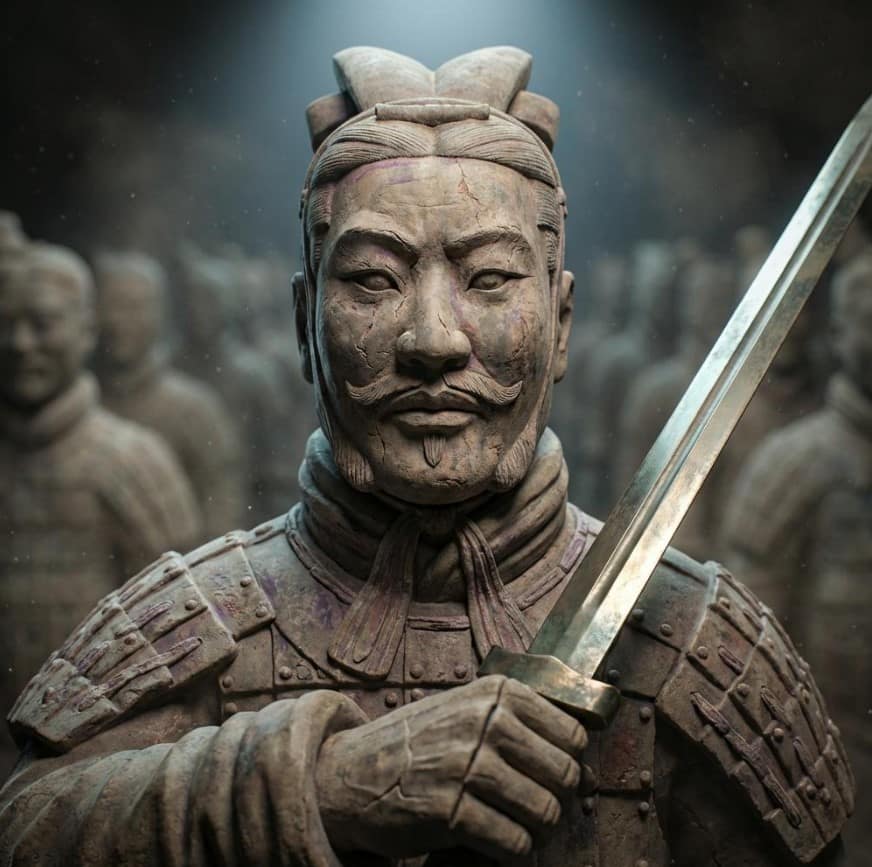
The silent ranks of the Terracotta Army stand as one of history’s most breathtaking discoveries. Unearthed by farmers chasing a well, this subterranean legion was crafted to guard China’s first emperor, Qin Shi Huang, in the afterlife. For decades, we’ve marveled at their scale and the unnerving individuality of each warrior’s face. But beneath this haunting artistry lies a story of cold, calculated efficiency—a tale of mass production, metallurgical genius, and a bureaucratic system that predates the modern assembly line by two millennia. Let’s excavate the truth.
I. The Illusion of Individuality: 8,000 Ghosts
The most arresting feature of the army is the lack of repetition; no two soldiers appear to be the same. This led to the romantic notion of artisans sculpting thousands of unique portraits. The reality is a masterclass in modular design. Archaeologists have identified only 8 to 10 primary face molds. From these templates, artisans would apply wet clay to add distinct features—moustaches, ears of varying shapes, wrinkles, and expressions. This process created a powerful illusion of a diverse, individual army, perhaps reflecting the multi-ethnic empire Qin Shi Huang had forged.
II. The Toyota of the Ancient World: An Imperial Assembly Line
The bodies were constructed with even greater efficiency. Legs were mass-produced solid columns of clay, torsos were coiled or made from two molded halves, and arms and hands were created in vast quantities to be attached later. This component-based system allowed for different poses—archers, officers, infantry—to be assembled from a standardized set of parts. It was the Ford Model T assembly line, 2,000 years early. Every piece was stamped with the name of the workshop and its foreman, a brutal quality control system known as “Gongwu.” Any defect could be traced back to its source, and the punishment for failure was often execution.
III. The Chromium Mirage and The True Science of Preservation
For years, the pristine condition of the bronze weapons, especially their razor-sharp edges, was attributed to an advanced chromium plating technology, a technique not “invented” until the 20th century. This theory made global headlines. However, deeper analysis debunked this “miracle.” The chromium was a contaminant from the lacquer used on wooden handles and sheaths, not an intentional coating. The weapons’ true preservation is due to the soil’s unique pH, low oxygen levels, and the bronze’s high tin content—a deliberate metallurgical choice that made the alloy exceptionally resistant to corrosion. The real marvel was the standardized crossbow trigger, an intricate mechanism of interlocking parts so precisely engineered they were interchangeable across the entire army.
IV. The Lost Colors and the Mercury Rivers
When unearthed, the warriors were not the monochrome figures we see today. They were painted in a dazzling palette of vibrant lacquers: royal purples, brilliant reds, and deep greens. One pigment, known as “Han Purple,” was a synthetic compound so complex it wasn’t recreated until the 1990s. Tragically, the ancient lacquer, bonded with egg, would curl and flake off within minutes of being exposed to the dry Xi’an air. Modern conservation techniques now race against time to preserve the color on newly excavated figures. This splendor hints at the unimaginable riches within the emperor’s still-sealed tomb, which historical texts claim contains a map of his empire with rivers and oceans simulated by flowing mercury—a claim eerily substantiated by modern soil analysis showing extreme mercury concentrations in the surrounding earth.
V. The Fire and the Shards
The army did not rest undisturbed. Archaeological evidence—charred ceiling timbers, scorched earth, and scattered, broken bodies—points to a great fire that ravaged the pits. Historical accounts suggest that Xiang Yu, a rebel leader who overthrew the Qin dynasty, looted the mausoleum and set it ablaze. The fire caused the heavy earth roof to collapse, crushing the warriors below. What we see today is not how they were found; most statues are painstaking reconstructions, pieced together from hundreds of fragments like a colossal 3D jigsaw puzzle. Each restored soldier is a triumph of modern archaeology, resurrected from the ashes of ancient rebellion.
VI. Legacy of the Silent Craftsmen
Over 700,000 laborers, many of them convicts or conscripts, toiled for decades to build this subterranean world. Their names, stamped onto their work, were not for glory but for accountability. Yet, in this system of brutal control, they achieved a breathtaking fusion of art and industry. The Terracotta Army is more than just an emperor’s vanity project; it is the enduring legacy of the anonymous craftsmen who, under immense pressure, engineered one of the greatest wonders of the ancient world. Their silent figures stand as a testament not only to an emperor’s power but to the ingenuity and resilience of those who built his eternal empire.
Knowledge Check
Curator’s Final Reflection: The Industrial Machinery of Immortality
When we gaze into the pits of Xi’an, we are not looking at a sculpture garden; we are looking at a frozen factory floor. The true awe of the Terracotta Army lies not just in its artistic merit, but in the chilling realization that the concepts of modular design, standardized parts, and rigorous quality control—the very bedrock of modern industry—were perfected over two millennia ago to serve the paranoia of a single man.
Qin Shi Huang didn’t just want an army in the afterlife; he wanted to project the bureaucratic terror of his living empire into eternity. The “Gongwu” system, where every error could be traced back to a craftsman under threat of death, ensured perfection through fear. It was an assembly line powered not by electricity, but by absolute authoritarian control.
Ultimately, the 8,000 silent figures stand as a magnificent, terrifying paradox. They are a monumental testament to human ingenuity and organizational capability, yet they are also a somber memorial to the hundreds of thousands of anonymous laborers crushed beneath the weight of imperial ambition. They remind us that the most breathtaking wonders of history are often built on a foundation of unimaginable human cost.
Gunung Padang: World’s Oldest Pyramid or Earth’s Grand Deception?