
‘Oumuamua:
The Interstellar Enigma
It came from the dark, accelerated past the Sun, and vanished. Was it a rock, or a wrecked ship?
☄️ Curioscope’s Lens
In October 2017, humanity received its first confirmed visitor from another star system. It wasn’t a radio signal or a flying saucer landing on the White House lawn. It was a dark, reddish, cigar-shaped object tumbling through the silence of space. We named it ‘Oumuamua—Hawaiian for “a messenger from afar arriving first.” But the message it brought was a riddle. It didn’t behave like a comet, nor did it look like an asteroid. And just as we turned our telescopes towards it, it accelerated away, as if it had an engine. This is the story of the most controversial rock in history.
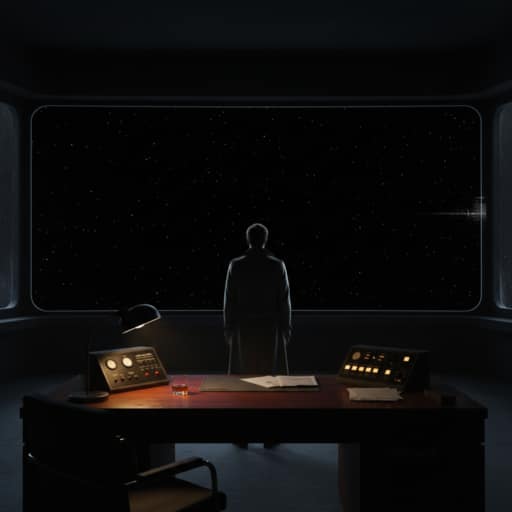
The Visitor That Broke the Rules
On October 19, 2017, the Pan-STARRS telescope in Hawaii spotted a faint point of light moving way too fast to be from our solar system. Most asteroids orbit the Sun in a predictable circle or ellipse. ‘Oumuamua was moving at 196,000 miles per hour on a hyperbolic trajectory—a one-way ticket straight out of the solar system. It had plunged in from deep space, swung around the Sun, and was already leaving.
But its speed wasn’t the weirdest part. Its shape was bizarre. As it tumbled end-over-end every 7.3 hours, its brightness varied wildly, by a factor of ten. This suggested an extreme shape: either a long, thin cigar (10 times longer than it is wide) or a flat pancake. In our solar system, space rocks are usually potato-shaped. We had never seen anything this stretched out before.
The Non-Gravitational Acceleration
The true shock came when astronomers tracked its exit path. ‘Oumuamua was speeding up. Gravity from the Sun should have slowed it down as it moved away, but something was pushing it. Comets do this by venting gas (outgassing), acting like a natural rocket. But ‘Oumuamua had no tail, no coma, and no gas cloud. It was accelerating invisibly.
Hypothesis 1: The Alien Light Sail?
This anomaly led Harvard astronomer Avi Loeb to propose a radical theory: What if ‘Oumuamua is artificial? Loeb argued that the only way to explain the acceleration without gas was Solar Radiation Pressure—photons from the Sun pushing on the object. But for that to work, the object would have to be incredibly thin, like a sheet of paper, and highly reflective.
In other words, a Light Sail. Could it be a piece of defunct alien technology, a probe sent to survey Earth, or simply space junk from a galactic civilization drifting through the void? While mainstream science pushed back hard, Loeb’s question remains: “Why are we so afraid to consider that we might not be the only kids on the block?”
Hypothesis 2: The Hydrogen Iceberg
In 2020 and 2023, scientists struck back with a compelling natural explanation. What if ‘Oumuamua was a chunk of solid hydrogen?
In the freezing depths of a “Molecular Cloud”—a stellar nursery—temperatures are so low that hydrogen gas can freeze into a solid rock. If ‘Oumuamua were a hydrogen iceberg, the Sun’s heat would boil the hydrogen off the surface, creating a jet to push it. Crucially, hydrogen gas is invisible to our telescopes. No dust, no visible tail. Just a silent, invisible thrust.
This theory elegantly explains the acceleration and the shape (it would have eroded into a flat sliver, like a bar of soap, as it traveled). However, skeptics argue that a hydrogen iceberg would likely evaporate completely before surviving the journey between stars.
A Legacy of Questions
Whether it was a shard of a Pluto-like planet, a hydrogen iceberg, or a piece of alien trash, ‘Oumuamua taught us one thing: Interstellar space is not empty. It is full of wanderers. And now that we know what to look for, we are building better traps (like the Vera Rubin Observatory) to catch the next one. ‘Oumuamua was the first, but it won’t be the last.
Alien or Asteroid? Test Your Knowledge
How well do you know our first interstellar guest?
Editor’s Reflection
I often wonder why ‘Oumuamua captivated us so deeply. Was it the science? Or was it the silence? There is a profound loneliness in the human condition. We shout into the void with our radio telescopes, sending greetings to no one in particular, hoping for an echo. When ‘Oumuamua appeared—weird, fast, and unexplainable—we projected our deepest hope onto it: “Are you the one? Are you the answer?”
The scientific debate between “rock” and “rocket” is fierce, but underneath the data lies a philosophical battle. If it was just a rock, the universe remains a graveyard of dead matter. But if it was artificial, even if it was just a piece of broken debris, then the universe is teeming with history, intention, and life.
Personally, I find the “Hydrogen Iceberg” theory just as poetic as the alien ship. Think about it: a piece of pure, frozen elemental gas, born in the dark nursery of a distant star, traveling alone for millions of years, only to melt away and vanish just as it brushed past our home. It’s a ghost story written in physics.
Curioscope invites you to consider this: ‘Oumuamua is gone. It is now past the orbit of Neptune, heading back into the black. We will never catch it. But it left us with a gift—it forced us to look up, to open our minds, and to realize that the universe is far stranger than we ever dared to dream. The door is now open. We are waiting for the next knock.